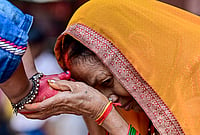
An award-winning artist, Labani Jangi is the CPIMLL candidate contesting from Krishnanagar Dakshin
Dipsita Dhar, a prominent youth leader, is a candidate for the Left Front, representing CPI(M) from the Dum Dum Uttar constituency
The two young women, undeterred by the fact that are facing Mamata Banerjee, quietly focused on their campaigns in the run up to the elections
Labani Jangi hails from Dhubulia, her Bengali rustic, and clear, the kind that carries the grain of the soil it rises from. There is something recognisably old in her politics, a confidence that recalls an earlier Left in Bengal, yet she resists becoming a cliché of it. A Master’s and a PhD in Political Science sit alongside her life as an artist, not as credentials to be displayed but as simultaneous ways of comprehending the world.
Across from her stands Dipsita Dhar, forged in a different corridor of the same ideological house, rising through the ranks of the Communist Party of India (Marxist) after her years at Jawaharlal Nehru University, seasoned by multiple electoral contests and now stepping into Dumdum North against opponents far larger in machinery and memory.

Between them runs a quieter, deeper thread. Both come from landscapes where history did not merely pass through but redrew the ground itself, regions marked by Partition, by chhinnomool (uprooted) lives. People surgically removed from homelands and forced into new geographies of survival. That two women in their mid-twenties to early thirties now stand at the forefront of the Left in West Bengal is, in itself, an interruption of its own past, even as they find themselves measured against the enduring force of Mamata Banerjee.


When they speak, the differences sharpen, not into opposition but into layers of hope. Labani says, almost quietly, “manusher modhye magic achey” (there is magic in people), as if politics begins in an act of faith, in the stubborn belief that something latent in people can still be summoned. It is not naïve, not quite hopeful either, but grounded in the slow, intimate work of being among people long enough to notice what shifts.
Dipsita, by contrast, is more declarative, her voice carrying the rhythm of the cadre line, “manush bhoy payna, to change” (people are not afraid to change). For her, fear is not an inevitability but a structure to be broken, and politics is the act of naming that rupture with aplomb.

Between Labani’s invocation of magic and Dipsita’s insistence on fearlessness lies a spectrum of how change is imagined, one emerging from within, the other pushed into being.
Their campaigns unfold in terrains that shape not just strategy but temperament. For Labani, the landscape is cut and carried by the Jalangi, a river that does not merely flow but erodes, rearranging lives at its edges. In one such stretch, she recalls meeting a septuagenarian who tells her that to meet people you have to walk, that there is no other way to earn the right to be heard. There are days, she says, when walking is the only way to keep up with a river that refuses to stay still, where homes vanish and reappear along shifting banks, and politics becomes less about promises and more about presence.

Dipsita moves through a different geography, largely urban, where proximity does not guarantee access. She speaks of a sanitation worker who initially turns away when she approaches, only to catch up with her a few metres later, lowering his voice to explain. “Didi, I was afraid to speak when my supervisor was there,” he says, naming the quiet coercion of a workplace entangled with the All India Trinamool Congress, where labour spills into unpaid political work and a web of allegiance, often forced. His request is simple but heavy with expectation that if power shifts, this economy of extraction must end.
Between the river that redraws land and the city that disciplines speech, their campaigns gather the same question in different forms: what does it take to be heard without fear? The gig workers join Dipsita’s rally, in hopes of being included in a dignified future with at least a semblance of labour rights.
Both Labani and Dipsita return, at different moments, to a quieter but urgent concern, the integrity of the electoral ground itself. They speak of irregularities and exclusions that rarely make it into campaign spectacle but shape its outcome, pointing in particular to the striking off of names from voter lists across several constituencies.

In places like Dumdum and Dhubulia, they note, the effects are especially visible, where many residents trace their movement across borders to different moments in history, not as infiltrators but as people displaced by erosion, by the slow violence of rivers eating into land, by the compulsion to return to what they still understand as home.
Among those affected are members of the Matua community, a demographic that has, in recent elections, leaned toward the Bharatiya Janata Party (BJP), making the silence around such deletions all the more politically charged. Their concern is less rhetorical than procedural, that democracy, before it can be contested, has to be intact in its most basic form.

Alongside this runs another shared departure. The onslaught and assault of SIR in Bengal created and erased histories that only the majority party would like to present as their clean chits for an honest election; however, a Bengali proverb reverberates through their exercises. There is a crocodile in the water and a tiger on land.
Their election campaigns do not rely on the familiar saturation tactics of contemporary elections; the endless social media churn or neighbourhoods wrapped in party flags like a second skin. Instead, both turn, in different ways, to local artists and folk musicians, allowing culture to travel where propaganda often fails. It is a slower, less visible method, but one that suggests a belief that politics must be heard as much as it is seen.
Labanis formative years were surronded by artists, visual and folk ones. Among them the Baul Fakir samiti has rendered support to her. A politicised act that is rare. Because the very essence of syncretism in Bengal is facing oblivion.
What becomes evident, watching them over time, is that both are engaged in a quiet recalibration of what Left politics sounds and feels like on the ground. It is not announced as strategy, nor does it arrive as rupture, but it is there in the way they choose to speak, to listen, to occupy space. Neither leans heavily on inherited rhetoric in the way their predecessors often did.

Dipsita’s grandfather was a stalwart in Left politics, yet his name is seldom announced whereas her political rival insists on invoking his uncle’s name, Tapan Shikdar, one of the first BJP-winning candidates in Bengal. Instead, there is a deliberate thinning of language, a movement away from ideological density toward something more immediate, more legible to those who do not already belong to the fold. This is not a rejection of ideology so much as a reworking of its delivery, an attempt to meet people where they are without abandoning where they come from.
Labani’s presence also carries a quieter inheritance, one that does not announce itself but shapes how she is read. She is Muslim, from a family that chose to remain in India at the time of Partition, refusing the pull of what became Bangladesh, staking their claim instead in the uncertain promise of belonging here. That decision, made decades ago, lingers in the background of her campaign, not as nostalgia but as an unresolved question.
In the present climate, where the rhetoric and policies associated with the BJP have sharpened anxieties around citizenship and belonging, that history acquires a different weight. It surfaces in fragments, in the hesitations and recognitions that pass between her and those she meets. Her politics is not only about ideology or organisation, but about holding ground, about insisting on a place that was once chosen and is now, again, being questioned.
What neither campaign says outright, but both carry in their bodies, is the negotiation of being women in a political culture that still reads authority as male by default. There are interruptions that do not register as hostility but accumulate as habit, voices spoken over, instructions redirected, the casual testing of how far they can be pushed before they push back.

At rallies and doorsteps, they are addressed as “meyera” before they are addressed as candidates, their seriousness measured against an inherited skepticism. And yet, neither Labani nor Dipsita performs deference to soften this reception. If anything, they seem to absorb it, convert it, return it altered. Their campaigns are not framed as battles against patriarchy, but the fact of their movement through these spaces quietly unsettles the arrangement that expects them to remain at the margins.
Every day, both women walk, kilometre after kilometre, their campaigns refusing the excess that usually defines Indian electoral spectacle. There are no houses smothered in flags and posters, no overwhelming visual siege. Instead, what they build is more deliberate, almost intimate, finding its way across different kinds of listeners.
Labani’s campaign carries the echo of her artistic repertoire folding into her politics as method, a way of reaching where slogans cannot. Dipsita, on the other hand, arrives with a sharper edge, her line “Dipsita Dhar ke janao” playing on the familiar “didi,” the name so closely tied to Banerjee that it has become political shorthand across West Bengal. It is a small shift, almost a pun, but it signals an attempt to enter a space that has long seemed sealed. Between Labani’s music that travels softly and Dipsita’s insistence that pushes forward, their campaigns suggest not just a contest for votes but a reworking of how the Left might speak again, if it is to be heard at all.
Anirban Ghosh is assistant professor and director, Centre for Writing, Shiv Nadar Institution of Eminence, Gautam Buddha Nagar, Uttar Pradesh.