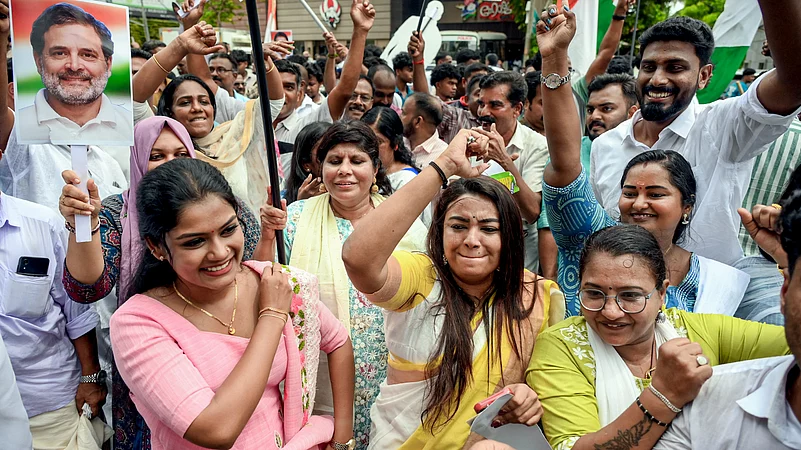
Congress-led UDF crosses 90 seats in Kerala, returning to power after a decade
Party trails by 63 seats in Assam and over 200 in West Bengal
Marginal presence in Tamil Nadu highlights widening regional gaps
The Indian National Congress struck a mixed note on Monday as assembly election results showed a decisive victory in Kerala but significant losses in Assam, West Bengal and Tamil Nadu, underscoring the party’s uneven national footprint.
In Kerala, the Congress-led United Democratic Front (UDF) secured a clear majority, winning over 90 seats in the 140-member Assembly, comfortably above the halfway mark of 71. The Congress itself won 63 seats, while key ally IUML added 22, anchoring the alliance’s return to power after a decade. Congress-led UDF in Kerala is a coalition of several centrist and centre-right parties, primarily including the Indian National Congress (INC), Indian Union Muslim League (IUML), and various Kerala Congress factions. The UDF acts as the main opposition alliance to the Left Democratic Front (LDF) in Kerala
The scale of the win put the UDF far ahead of the Left Democratic Front led by Pinarayi Vijayan, with the CPI(M) restricted to 26 seats and its allies trailing behind. The margin, roughly 20 seats above majority and over 40 seats ahead of the principal rival, marks one of the Congress alliance’s strongest recent performances.
Senior leaders including Shashi Tharoor and K. C. Venugopal described the result as a mandate for change, with celebrations breaking out at the party’s state headquarters.
At the national level, however, the party acknowledged setbacks. Congress general secretary Jairam Ramesh thanked Kerala voters for a “resounding majority” but admitted that “with the exception of Kerala, the election results elsewhere have fallen short of our expectations.”



Nowhere was the gap more pronounced than in Assam. In the 126-member Assembly, the BJP emerged dominant with 82 seats, while the Congress was limited to 19, trailing by 63 seats. Even when combined with allies such as BOPF (10) and others, the Congress-led bloc remained far behind the ruling formation.
The defeat was compounded by the loss of senior leader Gaurav Gogoi in Jorhat, as Chief Minister Himanta Biswa Sarma consolidated the BJP’s hold on the state.
In West Bengal, the Congress’s presence was reduced to near insignificance. The party won just 2 seats in the 294-member Assembly, while the BJP surged to 205 seats, leaving Congress trailing by a staggering 203-seat gap. Even the ruling Trinamool Congress, with 82 seats, remained far ahead. The result highlights the continued erosion of the Congress-Left space in the state.
Tamil Nadu presented another setback. The Congress, contesting as part of the DMK-led alliance, managed just 5 seats in the 234-member Assembly. The alliance itself was outpaced by actor Vijay’s TVK, which secured 108 seats, and the AIADMK with 45.
The Congress thus lagged over 100 seats behind the leading party and remained a marginal player in a rapidly shifting political landscape. While the DMK secured 61 seats, the alliance as a whole fell well short of contention.

Reacting to the Kerala result, Venugopal said it reflected a rejection of divisive politics and reaffirmed the state’s commitment to secular values. He credited the party’s campaign and the involvement of leaders such as Mallikarjun Kharge, Rahul Gandhi and Priyanka Gandhi.
At the same time, the Congress signalled that it would review its performance across states. Ramesh said a “comprehensive analysis” would be undertaken, while maintaining that the party remained committed to a longer ideological struggle.
Taken together, the results underline a stark contrast: a commanding win in Kerala versus steep deficits elsewhere, 63 seats behind in Assam, over 200 in West Bengal, and more than 100 in Tamil Nadu.