






Free travel for women in public transport buses from June 15.
Special department announced for welfare of elderly; Chief Minister claims it will be the first such department in India.
A white paper on the state’s finances will be prepared by a team of experts to outline the condition of Kerala’s economy.
The V. D. Satheesan government, sworn in on May 18, got off to an expected start by announcing welfare measures promised in its manifesto. Chief Minister Satheesan said Kerala would constitute a special department for the welfare of the elderly. He also announced that free travel for women in public transport buses would come into effect from June 15.
The first Cabinet meeting also decided to increase the honorarium of ASHA workers by Rs 3,000 and that of Anganwadi teachers and cooking staff by Rs 1,000. The Chief Minister said other demands raised by ASHA workers and Anganwadi teachers would be considered in due course as the state’s financial situation improves.
Satheesan, along with 20 ministers, was sworn in today in Thiruvananthapuram in the presence of Congress chief ministers and senior party leaders.
Outgoing Chief Minister Pinarayi Vijayan and BJP State president Rajeev Chandrasekhar also attended the swearing-in ceremony.


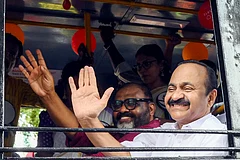
Congress chief ministers including Siddaramaiah, A. Revanth Reddy and Sukhvinder Singh Sukhu, besides Congress president Mallikarjun Kharge and Leader of the Opposition Rahul Gandhi, were also present to witness the swearing-in of a Congress-led ministry in Kerala after a decade. Three South Indian states are now ruled by the Congress.
The Central Stadium, which was filled by thousands of Congress and UDF workers, erupted in joy as Chief Minister V. D. Satheesan and the other ministers took oath. The Congress-led UDF has returned to power after a hiatus of 10 years.
Health of state finances
The Chief Minister, after chairing the first cabinet meeting, said the State’s sinancial situation was in a bad shape and that a white paper on Kerala’s financial condition would be issued shortly. “The white paper will be prepared by a team including financial and economic experts,” he said.
While the UDF had accused the earlier LDF government of financial mismanagement, the latter had consistently painted a rosy picture of the State’s economy. Chief Minister V. D. Satheesan, who is also holding the finance portfolio, however, did not delve into the composition or mandate of the committee that would prepare the white paper on the economy.
The announcement assumes significance as the new government has come to power promising expansive welfare measures at a time when Kerala continues to face severe fiscal stress, rising debt and constraints on public spending. By promising a white paper prepared with the help of financial and economic experts, the government appears to be attempting to build a political and administrative case for difficult fiscal decisions in the months ahead. The exercise could also become the basis for the UDF’s efforts to contrast its economic approach with that of the previous LDF government.

Political Symbolism
The decision to increase the honorarium of ASHA workers and Anganwadi staff in the very first cabinet meeting also carries political symbolism. ASHA workers in the state had staged an indefinite sit-in protest outside the Secretariat in Thiruvananthapuram for 265 days during the LDF rule, turning the agitation into one of the most visible labour protests witnessed in recent years. The previous government’s handling of the agitation drew criticism from sections of civil society and the opposition, with the UDF repeatedly accusing it of insensitivity towards frontline welfare workers.
By acting on the demand in its first cabinet meeting, the Satheesan government has sought to signal a political break from the previous administration and reinforce its welfare-oriented image, even while acknowledging the precarious financial condition of the State.
The decision to create a special department for the welfare of the elderly was also among the key promises made in the UDF manifesto. The move assumes significance as Kerala is among the fastest-ageing states in the country, with the demographic transition increasingly shaping public policy and welfare priorities.
According to official estimates in 2021, nearly 16.5 per cent of Kerala’s population was above the age of 60, significantly higher than the national average of 10.1 per cent at the time. The United Nations Population Fund India Ageing Report had projected that the proportion of people above 60 in Kerala would rise to 18.7 per cent by the end of this year.

The government’s decision to constitute a separate department for the elderly appears to stem from this changing demographic pattern, which has brought issues such as geriatric healthcare, social security, palliative care, loneliness among senior citizens and long-term caregiving into sharper focus. With rising migration of younger people from the state and increasing life expectancy, policymakers have increasingly argued that ageing can no longer be treated merely as a welfare issue but as a structural social and economic challenge requiring dedicated institutional attention.
In the 21-member Cabinet, 12 ministers are from the Congress, while five are from the Indian Union Muslim League. The ministry has two women ministers and as many as 11 members, including Chief Minister V. D. Satheesan, are first-time ministers.
The composition of the Cabinet reflects the Congress leadership’s attempt to balance experience with generational change, while also accommodating different group equations within the party and the broader UDF alliance.
The new Assembly will be convened on May 21.















