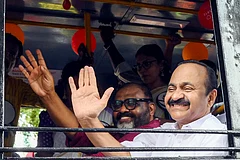
V. D. Satheesan served as the Leader of the Opposition during the Left government’s tenure in Kerala.
K. C. Venugopal and Ramesh Chennithala lobbied strongly for the Chief Minister’s post.
Public support, along with the backing of allies such as the Indian Union Muslim League, proved crucial for V. D. Satheesan.
In 2011, when the Congress-led UDF scraped through to power with a slender majority, there was little doubt about who would lead the government — former Chief Minister Oommen Chandy. But in the fierce battle against the popular Communist Chief Minister V. S. Achuthanandan, it was V. D. Satheesan who emerged as one of the sharpest voices against the government.
For many political observers, Satheesan was the natural choice for a cabinet berth once the UDF won. Senior leaders had assured him of a ministerial post, and he left Thiruvananthapuram for his home constituency of Paravoor, expecting to be sworn in. But when the final list was announced, Satheesan’s name was missing.
“I have lost many things between the cup and the lip,” Satheesan would later remark.
But recognition finally came after the Congress suffered a second consecutive defeat in 2021. A beleaguered party entrusted Satheesan with the task of reviving both the Congress and the UDF in Kerala. Over the next five years, he recalibrated the party’s approach on several issues, reached out to marginalised communities, and reshaped the Opposition’s campaign narrative.



The Popular Choice
Ahead of the election, Satheesan repeatedly told the media that if the Congress-led front failed to win, he would take responsibility and quit public life. After voting concluded, he confidently predicted that the UDF would win more than 100 seats in the 140-member Assembly and that more than a dozen ministers in Chief Minister Pinarayi Vijayan’s cabinet would be defeated.
The May 4 verdict showed that his claims were no fluke.
The natural choice for the chief ministership appeared to be V. D. Satheesan. But that is not how events unfolded. With K. C. Venugopal, the organisational general secretary of the AICC, emerging as a serious contender for the top post, his proximity to the Gandhi family created a strong impression that he would eventually be picked as Chief Minister.
“But the Congress leadership could not ignore the groundswell of support Satheesan commanded across sections of the public,” says columnist M. P. Basheer.
Satheesan, a five-time MLA, has never served as a minister in any cabinet. When asked whether this lack of administrative experience could become a handicap, he cited the examples of Prime Minister Narendra Modi, who had never been an MP before assuming the PM’s office, and former Communist Chief Minister V. S. Achuthanandan.
Over the last ten days, the Congress high command held extensive consultations with legislators and former PCC presidents before finally zeroing in on Satheesan.
“Most of the MLAs were backing KC Venugopal. But the scale of public support for VD Satheeshan has been unprecedented in Kerala politics,” says political observer Damodar Prasad.
Backed by Intellectuals
In a significant political signal, several prominent cultural figures — many of whom have traditionally identified with Left politics — publicly urged the Congress high command to choose V. D. Satheesan for the Chief Minister’s post. Writers, poets and cultural activists came together to endorse his leadership, reflecting a larger shift within Kerala’s intellectual space.
In recent years, many cultural figures in Kerala who once broadly aligned with the CPIM have gradually distanced themselves from the party, amid growing criticism of its functioning and leadership style. Their open support for Satheeshan, therefore, carried both political and symbolic significance.
A voracious reader, Satheesan has, over the last few years, managed to connect with diverse social groups. The support of the Indian Union Muslim League, the second-largest constituent of the UDF, proved crucial in tilting the balance in favour of the 62-year-old leader.

“He has shown a genuine interest in understanding the issues faced by marginalised sections, including Dalits,” says historian Vinil Paul.
But formidable challenges lie ahead. “With KC Venugopal in the race, an impression has been created that support from the party’s central leadership may not come easily,” says Basheer. “Moreover, how legislators loyal to Venugopal behave within the government and the party will also be crucial,” he adds.
Beyond the political challenges, Damodar Prasad points to the administrative hurdles before the new Chief Minister. “The UDF’s principal campaign plank was the five ‘Indira Guarantees’, including free bus travel for women and expanded health insurance. Given Kerala’s fragile financial condition, implementing these promises will be far easier said than done,” he says.
With Satheesan’s elevation, Kerala politics is witnessing more than just a leadership change. For the first time, a leader born after Independence is poised to become Chief Minister, marking the gradual end of an era dominated by leaders shaped by the state’s early post-Independence political movements. His rise also signals the Congress leadership’s attempt to reposition itself beyond traditional factional and community equations that have long defined Kerala politics.
But whether this generational shift can translate into a structural political shift remains uncertain.
Challenges Before New CM
Satheesan inherits a state burdened by severe financial stress, high welfare commitments and a deeply entrenched political culture where caste organisations, coalition compulsions and bureaucratic inertia continue to wield enormous influence. Expectations from him are unusually high because his political appeal was built not merely on anti-incumbency, but on the promise of a different style of politics and governance.
The real test, therefore, will not just be electoral success or administrative stability, but whether Satheesan can convert his personal credibility and public support into lasting institutional and political change within both the government and the Congress party.