Vijay’s shift from “Ilaya Thalapathy” to “Thalapathy” marked a deliberate move aligning his cinematic image with political ambition.
Tamil cinema has historically fused stardom with political power, shaping leaders like MGR and creating a culture where film heroes transition into politics.
Vijay’s rise, from a family-friendly mass star to launching his party in 2024, reflects both a leadership vacuum in Tamil politics and the continuation of Dravidian political traditions.
In 2017, during the release of Mersal, Vijay dropped the prefix to his moniker and rechristened himself as Thalapathy. For more than two decades, since 1994, he had been introduced as Ilaya Thalapathy (The Young Commander), a moniker that suggested succession to the industrial Superstar Rajinikanth, himself seen as inheriting the MGR formula hero. With Mersal, the prefix disappeared. The posters simply addressed him as Thalapathy—The Commander.
In most Indian film industries, such renaming would pass as branding. In Tamil Nadu, it does not. Here, monikers carry layered political and cultural memory. ‘Periyar’ (The Greatest) was not merely a title for E.V. Ramasamy; it held a political imagination. C.N. Annadurai as ‘Arignar’ (The Scholar), M. Karunanidhi as ‘Kalaignar’ (The Artist), M.G. Ramachandran as ‘Puratchi Thalaivar’ (The Revolutionary Leader), and J. Jayalalithaa as ‘Amma’ (The Mother) did not just inherit honorifics; they grew into them until their title and personality became indistinguishable. Stardom in Tamil Nadu has never been separate from power; it has been one of its most persuasive languages.


Vijay’s dropping of his prefix was a declaration. For years, his films had flirted with politics without ever fully stepping into it. They had dealt with corruption, welfare, the failure of the state machinery, and Tamil pride as fragments and punchlines. By becoming ‘Thalapathy’, that long rehearsal on screen began to align his off-screen persona. To understand why this shift matters, one has to go further back in Tamil Nadu’s history, not to Vijay, but to the grammar of the cinema that produced him.
Film industries from the rest of India, including Hindi cinema, produce economically viable stars. Tamil cinema additionally prepares them for power. This difference has been structural since the inception of Tamil cinema in the 1940s, when film stars were well-connected to the Indian national movement. Later, Dravidian cinema was developed by Dravida Munnetra Kazhagam (DMK) stalwarts; the films addressed Tamils living under the postcolonial Indian state as a unified Tamil community.
Theatres became the only spaces where Tamils divided by various social stratifications felt themselves to be a collective body. Tamil films developed a film language in which the villain was not just a lone man but an institution that transcended the individual. When the hero defeats the villain, his triumph is endorsed and amplified by the film’s crowds and extended beyond the film. At key moments, the hero could address the audience directly, under the pretext of speaking to the characters in the story.
Tamil cinema encountered modernity through this cinematic medium, in a supposedly strange language, thereby training the spectators to see themselves as participants in a larger political drama. This was the system that produced MGR, who began his life as a drama actor, went on to become the largest star of the Tamil film industry, and eventually was elected chief minister of Tamil Nadu three times.
This is the world that Vijay enters in the 1980s as a debutant child artist in films directed by his father, S.A. Chandrasekar. When Indian cinema was majorly based on the ‘Angry Young Man’ archetype, one of the most successful tropes that generated humongous success during the 1970s and 1980s, with Amitabh Bachchan as the lead, S.A. Chandrasekar became one of the pioneers of similar films in Tamil cinema.
Like the ‘Angry Young Man’ films of Hindi cinema, his films criticised the postcolonial Indian state and its institutions through the figure of a heroic individual, especially through Rajinikanth and Vijayakanth in Tamil cinema and Chiranjeevi in Telugu cinema. All three of these stars have had their share of political forays in their future careers, which is noteworthy here.
The archetypal Angry Young Man played by Amitabh Bachchan during the 1970s was often named ‘Vijay’ in his films, which coincidentally, was further transferred to Chandrasekar’s son. The name ‘Vijay’ in Indian popular film culture became established as the identity of a new heroic form, representing the postcolonial Indian male who stood against corrupt institutions with individual moral force.
When S.A. Chandrasekar introduced his 18-year-old son Vijay in Naalaiya Theerpu (1992), he played by the same old Angry Young Man template, and he audaciously cast his son as ‘tomorrow’s judgement’, signalling the construction of another leader figure through the star material after MGR’s demise.
Vijay has acted in a handful of films directed by his father since his debut. He was cast as Vijayakanth’s younger brother in Senthoorapandi (1993), and his subsequent film Rasigan (1994) carried the moniker ‘Ilaya Thalapathy’ (The Young Commander), derived from Mani Ratnam’s film Thalapathi (1991), starring Rajinikanth, through which Vijay was symbolised as his younger version. Vijay’s initial star image was borrowed from Vijayakanth and Rajinikanth, yet the films that placed him as a political project never materialised.
Vijay’s initial breakthrough was with Poove Unakaga (1996), followed by Kadhalukku Mariyadhai (1997), Thullatha Manamum Thullum (1999), and Kushi (2000), all blockbusters. They introduced a soft-spoken, vulnerable, young man who represented the post-liberalisation Tamil generation. The significance of this phase lies in the audience—a newer generation introduced to television.
Vijay’s stardom was built primarily through television, through repeated viewings in households newly plugged into a liberalised media economy. His audience was mainly aspirational, non-elite commoners, who were negotiating new economic realities while remaining rooted in older social structures. This demographic would later form the backbone of his fan base.
Most biographical accounts of Vijay state that he shifted to mass cinema during the 2000s. But what Vijay did was more precise. He carried the audience that he had cultivated to the mass film. With films like Ghilli (2004), he had become a successful mass hero. His scale expanded further. He catered to a family-mass audience, distinct from that of MGR and Rajinikanth. His protagonists were not just heroes for the street or the theatre crowd. They were equally celebrated within the domestic space, where women, children and young men could all consider him as an extended member of their respective families. This composite family-mass image remains central to his political persona.
Apart from box-office success, his stardom was built on his image as a family guy and, simultaneously, as a figure of representation. This trope was repeated on screen, as he converted his fan clubs into a people’s movement—Vijay Makkal Iyakkam—during the late 2000s, and in an off-screen move dedicated to philanthropy and social causes.
Vijay’s protagonists continued to confront different villains on screen. They were terrorists who threatened national security, corporate systems that control water and displace farmers and more often, corrupt politicians. In 2012, his film Thalaivaa was banned for security reasons. Still, the open secret was that the film got into trouble over the tagline ‘Time to Lead’, which irked the then Chief Minister Jayalalithaa because of his political ambitions.
After the demise of Jayalalithaa in December 2016 and the retirement of Karunanidhi from active politics, Tamil Nadu encountered a vacuum in its popular politics. It broke down as the jallikattu protests in January 2017, bringing hundreds of thousands of young people to the streets of major cities. Vijay participated incognito among the youngsters in Chennai’s Marina Beach.
The jallikattu protests were on a vast scale and kept established political parties such as the Dravidian parties DMK and All India Anna Dravida Munnetra Kazhagam (AIADMK), at a distance. They asserted Tamil identity but without a clear political custodian. The protests ended with police violence unleashed by the then AIADMK government under O. Panneerselvam, who is now affiliated to the DMK.
Around the same time, Vijay announced himself as ‘Thalapathy’ for Mersal (2017), in which he played three roles: a doctor, a magician, and a good-hearted landlord who also plays jallikattu. A sequence in Mersal criticised the Goods and Services Tax system, prompting attacks on Vijay’s religious identity. Vijay asserted himself as ‘Joseph Vijay’ during the controversy, and the Tamil community still backed him. Even before he entered politics, it had entered his cinema.
Unlike MGR’s fan base, which comprises party cadres, Vijay’s fan base is mainly citizens who are post-liberalisation, digitally fluent and institutionally disillusioned.
After Mersal, his films consistently positioned him as a leader figure. In Sarkar (2018), he played a corporate CEO who fights corrupt politicians by developing a political party run by activists. Bigil (2019) featured him in dual roles: one, as the coach for the all-women’s football team, which he leads to victory and the other, as a local gangster from North Chennai who protects the marginalised. Interestingly, Bigil opens with a stunt sequence that symbolically seeks justice for the police brutality unleashed during the last day of the jallikattu protests. Simultaneously, Vijay reduced his off-screen visibility, creating an aura of exclusivity, especially during the digital era when one has to watch the film to see the star.
It is important to understand how politics has functioned in Tamil Nadu before asking about the possibility of Tamils mistaking a film star for a political leader in the wake of his ‘leadership’ roles. MGR became the chief minister as his audiences were trained to recognise authority and leadership in cinematic form. The audience was not gullible, but the political culture that had long fused image and power enabled MGR’s emergence.
Vijay inherits this tradition but under different circumstances. Ironically, he has also positioned himself as the neo-MGR in almost all of his films since his Thalapathy image makeover. Unlike MGR’s fan base, which comprises party cadres, Vijay’s fan base comprises mainly citizens who are post-liberalisation, digitally fluent and institutionally disillusioned, having watched the DMK and the AIADMK alternate in power for decades, producing a dynasty and institutionalised corruption with remarkable consistency. By this point, Vijay’s arrival in politics should be questioned in light of the mature Dravidian political system that produced him at a significant moment.
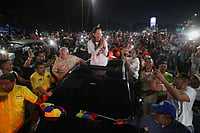
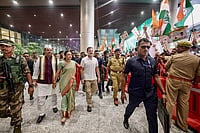
In 2024, when Vijay announced his political party, Thamizhaga Vettri Kazhagam, he announced that he entered politics as the ‘son of Tamil soil’. His campaign rhetoric consistently emphasises a familial bond with the common Tamil households. His current political image, blended with a cinematic one, has been inseparable from extremely large crowds who gather to get a glimpse of him, carefully curated by his absence from public appearances for over a decade. In September 2025, during his rally in Karur, over 41 people, including nine children, were killed in a stampede caused during Vijay’s political rally, revealing the limitations of the infrastructure that his cinematic fandom has produced.
By clearly associating himself with the Dravidian ideology, Vijay represents the leadership vacuum in Tamil politics sought during the jallikkattu protests, thereby becoming an extension of it. By no means does Vijay represent a change in Dravidian politics. He does not rupture the 70-year-old tradition of politics but instead has emerged as the culmination of the populism produced through extensive cinematic grammar. Whether this culmination succeeds or fails remains a question Tamil Nadu must answer.
(Views expressed are personal)
Ilyas R. Muhammed is a film and media researcher based in Chennai, whose work engages with Tamil cinema, popular culture, politics and society

MORE FROM THIS ISSUE


This article appeared in Outlook’s May 1 issue, 'Dravida Banga Ltd' which looked at the states going into elections and the issues facing them including delimitation and special intensive revision