The narrative traces Tamil Nadu’s shift from early Congress dominance under leaders like Kamaraj to the rapid rise of Dravidian parties, particularly the DMK.
Social change, caste dynamics, charismatic figures like MGR, and shifting political alliances played a crucial role in weakening Congress and strengthening regional forces.
The 1967 elections marked a turning point, as the DMK capitalised on growing discontent and cultural mobilisation to end Congress rule in the state.
It is impossible to imagine Tamil Nadu separately from the Dravidian parties—even for those who are viscerally opposed to them. The remarkable achievements of the state over the last 60 years are undoubtedly theirs, though these were made possible by the solid foundations laid by the Congress in the early years.
The upcoming assembly elections have set me reminiscing about the days when the Dravida Munnetra Kazhagam (DMK) was dismissed by many as a rattling bag of irritating nobodies. Even now, it seems almost unbelievable that the Dravidian parties were able to capture power in Tamil Nadu within just four assembly elections, at a time when the Congress was led by largely incorruptible leaders who were also highly competent administrators.

I was barely six when the first assembly elections were held in 1952, but a few fragments from that time remain vivid in my memory. I remember rice paste being prepared in large vats in our backyard. It was used to stick up the two-colour posters, and copper sulphate was added to make it deliberately inedible.


The Congress candidate, S.N. Somajulu, was a friend of my father’s and a fellow freedom fighter. He had little money and relied on friends like my father—then a successful lawyer—for support. It was a different world. Most people walked barefoot. Electricity was uncertain, almost a rumour in some places. Radios were rare and treasured; ceiling fans, rarer still. Telephones belonged to a distant, privileged realm. At home, idli and dosa batter was ground on a heavy stone mortar. I, too, would take my turn at it—a small contribution until I left for Delhi in 1973.

Newspapers circulated, but literacy was sparse—around 28 percent among men and barely 9.5 percent among women. Yet, democracy found its way. People voted, guided not by manifestos but by symbols that were instantly recognisable. Two stood out: the Congress symbol of the yoked bullocks and the Communist emblem of ears of corn and a sickle. The Communists had only recently emerged from prison, and their aura among the people was unmistakable.
My father’s friend, however, won the election. Many years later, I asked my father whether they had paid voters. His answer was candid: “Yes, we did—not everyone, but the desperately poor. We would give one or two rupees for an entire family to come and vote for the Congress. It wasn’t organized; it was done privately, by individuals.”
March 1957, Tirunelveli
These were the halcyon days of the Congress. The party was led by Kamaraj, with C. Subramaniam and R. Venkataraman assisting him. The Communists were fizzling out. Education in the state was thriving. With pioneering welfare schemes, the male literacy rate rose to around 40 per cent, and the female literacy rate to about 16 per cent. Incidentally, this trend continued until 1967. In that year, Tamil Nadu led the rural electrification scene in the whole of India. The male literacy rate was around 57 per cent and female literacy 28 per cent.
This time, too, one of my father’s friends, Rajathi Kunjithapatham, stood for the Congress. Her victory was a foregone conclusion. Yet, there were rumblings in the Brahmin streets. Many were upset that Periyar E.V. Ramasamy’s frenzied campaign against them was reaching a peak, and that Kamaraj was doing little to restrain it.
Periyar, meanwhile, was locked in a running feud with his former disciples, who broke with him in the 1940s to found the DMK. He openly supported the Congress, though in 1952 he had supported the Communists. The buzz around the DMK was ever-present. It had spellbinding speakers in alliterative Tamil and, more importantly, a magnetic crowd-puller in M.G. Ramachandran, who had delivered a string of runaway hits in the preceding years—films like Alibaba, Malai Kallan and Madurai Veeran.
Even so, the DMK was not yet officially recognised as a political party, and its candidates contested the elections as independents. That they won 15 seats was, under the circumstances, nothing short of remarkable.
February 1962, Tirunelveli

I was in my pre-university year when the elections of 1962 took place. At the national level, Nehru was reigning supreme. He marched into Goa, much to the delight of students like us, and we were confident that he would be able to handle the Chinese with effortless ease.
There were counter-voices across India against his socialist programmes, the most prominent among them being Rajaji, who formed his Swatantra Party. My father was not happy with socialism, but he was too loyal a member of the Congress to resign from it.
The same lady stood for the Congress again. The caste dynamics in southern Tamil Nadu were changing. The Mudukulathur riots of 1957, which resulted in the killing of 42 Dalits, were a turning point. Kamaraj took very strong action against the Thevars, and about 20 of them died in police firing.
This caste churning saw the emergence of the DMK as a very strong contender. It made an alliance with Muthuramalinga Thevar, who was a towering Thevar icon. Of course, MGR was now unstoppable. He made a film titled Nadodi Mannan, in which he listed a number of good things he would do for the people if he came to power. The message went home strongly. The Congress still won handsomely, but with a reduced majority.

February 1967, Chennai
The intervening five years were the most momentous not only for India but also for Tamil Nadu. The Chinese aggression of 1962 and the defeat of the Indian Army came as a huge shock to all of us. Nehru never recovered from it and died in 1964. By then, the DMK had given up its demand for separation and promised to serve the cause of a united India.
Then came the war with Pakistan and the eventual demise of Prime Minister Lal Bahadur Shastri in 1966. But what truly changed the Tamil Nadu scene was the anti-Hindi agitation of 1965. The state went up in flames.
I was studying at St. John’s College, Palayamkottai, at the time and though I had begun gravitating towards the Communist movement, I was livid that the Central government could be so insensitive. I, too, participated in the agitation, and it was a miracle that I was not arrested.
When the 1967 elections came along, I was at Presidency College, Madras, pursuing my post-graduation in Physics. The Congress looked weak, no doubt, but the opposition alliance did not appear particularly strong. It was a strange combination—regional assertiveness represented by the DMK, the unabashed free-market advocates of the Swatantra Party, the Muslim League, and the Communist Party of India(Marxist), which claimed to be more revolutionary than its paler rival.
My friend and I were CPI(M) supporters, but we were so disillusioned that we decided to campaign for the Congress. Yet, the entire city seemed to be in the grip of the DMK wave. My friend narrated an incident: he had seen a man begging for alms in a local train, repeating, “You need not give me anything, but don’t forget to vote for the DMK in the coming election.”
The final twist came with a shooting incident involving MGR. Another actor shot him in a fit of madness on January 12, 1967, just a day before the Test match against the famous West Indies team led by Garfield Sobers was to begin. Any mishap would have meant the cancellation of the match, and we were desperate to watch Sobers in action. Fortunately, fate was kind. The match ended in a memorable draw, with Sobers scoring a near-century in the first innings and holding off the Indian spinners in the second. MGR survived, and soon all of Tamil Nadu was looking at posters of him with a bandage around his neck, appealing to voters not to forget the DMK alliance.
I remember the day Tamil Nadu changed. I was stepping out of YMIA, Madras, where I was staying, when I saw a huge banner right in front of me. It proclaimed: “Hande Wins.” Hande was a Swatantra Party candidate.

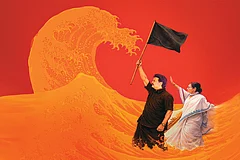


This article appeared in Outlook’s May 1 issue, 'Dravida Banga Ltd' which looked at the states going into elections and the issues facing them including delimitation and special intensive revision.
P. A. Krishnan is an author in English and Tamil.