Dravidian iconography has a dissident beginning and has gradually evolved.
Rajarajan’s monument, named after the king himself, stood as a symbol of both resistance.
Kannaki represents a powerful female symbol in Dravidian iconography.
Drawing on the century-old legacy of the Dravidian movement, the DMK-led Tamil Nadu government has, in recent years, made significant effort in creating iconic public libraries, museums, and parks. They can be seen as forms of counter-monumentality, emerging in response to a broader iconographic politics today. What provokes the southern state is not a familiar challenge to cultural identity, but the fear of a possible erosion of a social base shaped over centuries by scientific thinking, rationalism, inclusivity, and social justice. In this context, the new iconographic projects are educational as well as political in intent. They aim to cultivate an educated, secular public capable of critical engagement and resistant to communal mobilization.
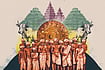
Dravidian iconography has a dissident beginning and has gradually evolved. Art historians consider the visual features of the Siva temple built by the Chola king Rajarajan at Thanjavur represent a mature phase of Dravidian iconography. Thereafter, a distinct Dravidian school emerged across all forms of visual arts. Rajarajan’s monument, named after the king himself, stood as a symbol of both resistance and syncretism. It signified resistance because it was a monumental visual representation of Tamil Bhakti. Bhakti, in contrast to Vedic Hinduism, advocated social egalitarianism—possibly an early medieval prototype of mobilization for social justice. The syncretism, however, provided official sanction to certain sastric-puranic elements with opposing social implications. These dual aspects always integral to Dravidian temple culture.


Despite various interpretations, especially the political motives of the king, Rajarajan’s monument was a spectacular visual, known for its verticality and monumentality, and incomparable with any other contemporary stone structure in South Asia. He is said to have employed the best minds available at the time, and ‘there was a clear intention of doing everything on as grand a scale as was humanly possible’. During the post-Chola period, social stratification expanded, and the caste hierarchy gradually consolidated along the lines of the Varna system. Temples continue to remain a dominant form of visual representation. Yet, this did not prevent iconographic forms from taking a pluralistic and secular turn.
Interactions and cultural exchanges with outsiders, including Islam and Christianity, had a considerable influence. Muslim heroes became the guardian deities of folk Hindus. Virgin Mary was seen in the form of Mariyamma. Similarly, Dravidian art and architecture were widely adopted in building mosques and churches, as well as in representing divinities. By the end of the eighteenth century, Serfoji II, an orthodox Hindu Maratha ruler, erected a commemorative statue of the Protestant missionary Schwarz at Thanjavur. Modern Dravidian iconography is rooted in this legacy.
The architecture of reason and justice
The modern phase of visual culture began alongside the rise of the Dravidian movement in the nineteenth century. Coming at a time when state and religion were being separated, it embraced classicism, rationalism, secularism, and ideals that challenged caste and class hierarchies. Symbols and images from classical texts that resonated with modern Dravidian aspirations were integrated into visual programmes. Anything that could represent a rationalist antecedent received prominence.
Thiruvalluvar and Kannaki were two such classical images, central to Dravidian visual culture. Thiruvalluvar, the author of the Tamil text Thirukkural, focused on ethics, virtue, conduct, and governance—without any explicit reference to God or religion. Discovered during the colonial period, the text became an important philosophical guide for the evolving Dravidian politics. Today, there is hardly any public space—whether educational institutions, government buildings, public buses, or school textbooks—that does not display the image of Thiruvalluvar or his text. Thiruvalluvar is portrayed as a bearded man in a white drape, with his hair knotted on top, holding a bundle of palm-leaf manuscripts and a stylus.
Among the many representations, two monuments dedicated to Thiruvalluvar stand out. In 1970, right-wing organizations mobilised support to build a memorial for Swami Vivekananda on a rock in the Bay of Bengal at Kanyakumari, where he is believed to have meditated. In response, the Tamil Nadu state under M. Karunanidhi erected a 133-foot-tall statue of Thiruvalluvar on an adjacent rock in 2000. Another important memorial is the Valluvar Kottam, completed in 1976, with its 39-foot statue of Thiruvalluvar on a monumental stone chariot.
Both structures, which combine elements of early and modern Dravidian architecture, effectively communicate the early Tamils’ rationalist outlook on various aspects of human life. In recent years, these monuments have been renovated and aesthetically enhanced using modern technology. Aruvu Thiruvizha—a festival of reason—was held at Valluvar Kottam last month. The event featured speeches and performances highlighting ethical and rationalist values.
Similarly, Kannaki represents a powerful female symbol in Dravidian iconography, embodying reason, dissent, and justice. She is the central character in the Tamil epic Silappathikaram, which portrays her transformation from an innocent family woman into a determined rebel. She brought down the mighty Pandya Kingdom by challenging the injustice done to her. In 1968, the statue at Marina Beach was erected to capture this defiant moment, portraying Kannaki holding her anklet aloft as a demand for justice. More recently, when communal tensions arose at Thirupparankunram (Madurai) following a contested court judgment, Kannaki’s symbolism of justice was invoked once again.
Over time, Dravidian iconography expanded from honoring rationalist thinkers, social reformers, and literary figures to commemorating Dravidian ideologues, anti-caste activists, chief ministers, martyrs of the anti-Hindi agitations, and many lesser-known local leaders across Tamil Nadu. In 2023, a statue of V. P. Singh, the former Indian Prime Minister, was installed to commemorate him as the ‘guardian of social justice.’ These icons, in general, are shown reading, writing, or teaching, holding a pen or a book, or addressing the masses. These gestures symbolize knowledge, education, and critical thinking.
Even before the Dravidian parties came to power in the 1960s, a form of subaltern iconography had already begun, notably influenced by the political left. The Victory Statue of Labour, erected at Marina Beach in Chennai in 1958, commemorates the first May Day celebration at this location. While statues of communist leaders symbolizing working-class movements are found across Tamil Nadu, the current government has recently announced a statue of Karl Marx at the entrance of Connemara Library Complex.
Libraries and museums as counter monumentality
Among various public structures, libraries and museums stand out, representing the contemporary phase of Dravidian counter-monumentality. As Indian political discourse took a communal turn and became preoccupied with the destruction and construction of religious structures, the Tamil Nadu government under DMK rule expanded its public library network. The state announced several large-scale, monumental library projects. In their verticality and monumentality, these libraries echo the ambition and architectural achievement of the Chola king Rajarajan.
The nine-storey Anna Centenary Library, established over an area of eight acres in 2010, stands as a memorial tribute to the Dravidian ideologue C. N. Annadurai. Similarly, a new library initiative began with the construction of the eight-storey Kalaignar Centenary Library in Madurai in 2023, dedicated to M. Karunanidhi. Built at a cost of approximately ₹234 crore, it is intended to serve as ‘an intellectual beacon of South Tamil Nadu’. These are among the largest libraries in South Asia. In addition to the aesthetically designed buildings, they feature visual galleries, pictorial panels, paintings, and other displays representing the cultural past of the Tamils.
Other mega library projects, for which foundation stones have been laid across Tamil Nadu with substantial financial allocations, include the Kamarajar Knowledge Centre in Tiruchirappalli, the Periyar Library and Science Centre in Coimbatore, and the Quaid-e-Millat Library in Tirunelveli, among others. Once completed, these libraries will stand as temples of modern Dravidian rationalism.
Further, faced with many challenges, the Tamil Nadu government placed strong emphasis on promoting a reading culture. The state highlighted its educational achievements as much as its economic progress. Learning was presented as a counter to the rising communal conservatism. Alongside the expansion of existing district, block, and village-level libraries, new special libraries have been established at metro stations, railway stations, bus stands, hospitals, government school and college hostels, and other public spaces. A book park at Chennai central metro station includes facilities such as reading spaces, and a conference hall. Virtual and digital libraries also received significant enhancement. More than mere storehouses of books, these libraries serve as powerful sites of knowledge.
The need to scientifically establish the Tamil civilizational past led the Tamil Nadu Archaeological Department, perhaps for the first time, to receive adequate funding. Excavations began at sites that had been identified but remained unexcavated for several decades. The artifacts were scientifically analyzed and dated by world-renowned laboratories. As a result, two mega museum and heritage centres—at Keezhadi in 2023 and at Porunai in 2025—were established. Both museums, housed in consciously designed buildings on vast sites near the excavation locations, showcase rich visuals narrating Tamil material culture dating back to the sixth century BC. They also feature libraries, reading rooms, conference halls, and amphitheatres.
The emphasis on libraries, museums, and botanical parks (such as Semmozhi poonga and Tholkapiya poonga) did not overlook early temple monuments. They, rather, were renovated and beautified using modern technology. More than serving merely as religious institutions, temples have now become invaluable cultural artifacts, standing as witnesses to Tamil knowledge traditions across various fields. According to the report, over 3,500 temples underwent Kudamuzhukku (consecration) in the past four years after renovation. Essential reforms, such as the appointment of priests from all castes and genders, have integrated Tamil temples into the rationalist tradition of the Dravidian movement.
In fact, when the emblem of the Madras government was designed in 1949, a temple gopuram—possibly that of the Vaishnavite female saint Andal, known for her feminist interpretation of Bhakti—was chosen as the representative image, accompanied by the motto Vaaimaiye Vellum (Truth Alone Triumphs). At the time, it was argued that Tamil temples represented the secular culture of the people, rather than solely their religious significance in Hinduism.
Beyond temples, non-religious structures such as the Tirumalai Nayakar Mahal in Madurai and the Marathas’ Serfoji Mahal library complex have also received significant attention and are being enhanced. The same applies to colonial monuments, including the Ripon Building and Victoria Hall. Victoria Hall, which reopened to the public this month after restoration, holds a special place in the Dravidian political movement, as it was considered the birthplace of the Justice Party, from which current Dravidian parties trace their origins. Built in the Indo-Saracenic style, the hall—long known for vigorous political and intellectual exchange—will continue to serve the same purpose in the future.
Who is afraid of educated electorates?
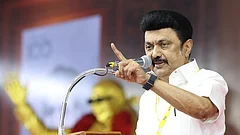
The remarkable building activities of the DMK government may be attributed to the unusual challenges it faced. The challenges M. K. Stalin confronts are quite different from those of previous Dravidian ideologues and leaders. The need to foster an educated, rational, and secular public grounded in Tamil linguistic and cultural identity is now greater than ever. The electoral strength of Dravidian parties such as the DMK has historically been linked to their ability to cultivate educated electorates. If this electoral base is undermined, it could threaten the very existence of Dravidian ideals.
The public visuals and libraries promoted by the DMK government suggest that it recognizes both the significance and urgency of this task. Creating an educated electorate is, however, a double-edged sword. It may even challenge the creator, but it would certainly prevent the consolidation of conservative and communal social elements. Moreover, political legitimacy need not rely on uncritical support. It, rather, rests on engaging electorates who are capable of questioning and critically evaluating governance. As it appears, the DMK government is not afraid of taking this risk.
Growing up in rural Tamil Nadu in the 1980s, I recall how occasional visits to nearby towns left a lasting visual impression—statues and images of leaders shown with a pen in their pocket, a book in hand, or engaged in reading and writing. These visuals played a significant role in shaping our aspirations. They may continue to play this role. In fact, during the initial stage of the M. K. Stalin government, a proposal was made to construct a mega statue of a pen at Marina Beach, resembling the Thiruvalluvar statue at Kanyakumari, to commemorate the intellectual legacy of M. Karunanidhi. However, the project was withheld, perhaps due to criticism of dynastic politics and environmental concerns. While the pen statue would have been an ideal symbol of Dravidian politics, the government appears to have redirected the project into mega library initiatives. In many ways, this is even more powerful than the pen.
S. Gunasekaran teaches history at Jawaharlal Nehru University, New Delhi.