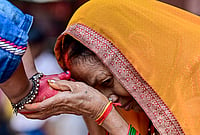
In an election that saw many kinds of identity conflicts, muscle-flexing and the battle of nerves have emerged as the key to victory.
Prime Minister Narendra Modi spent nearly a week in the state, savoured jhal muri (hot puffed rice), the popular Bengali snack, visited Kali temples and enjoyed boat rides on the Ganga.
While the fish politics gave people comic relief, a hateful caricature shared by a self-described right-wing social media user sparked widespread outrage.
Mithun Chakraborty is confident that the Mamata Banerjee government in West Bengal is going. “Baap ashbe,” the Bollywood star said in a cryptic statement in his signature style after casting his vote in Kolkata on April 29, a saffron scarf around his neck. If it were a Hindi movie scene, he would have said, baap aayega (the boss is coming), and his audience would have applauded with thunderous claps.
Chakraborty, 75, sweated it out on Bengal’s electoral turf in the sweltering summer of 2026 as one of the Bharatiya Janata Party’s (BJP) star campaigners. But gone are the days when he was the maestro of throwing filmy dialogues to charm the political audience. There are new kids on the block.
In an election that saw many kinds of identity conflicts—Bengali versus ‘cow belters’, Bengal versus Uttar Pradesh, Bengal versus Gujarat, Hindutva versus Bengali pride, vegetarianism versus non-vegetarianism, secularism versus communalism, and broadly, ‘our culture’ versus ‘their culture’—muscle-flexing and the battle of nerves have emerged as the key to victory.



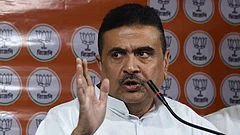

Stressful situations led to leaders indulging in dialogue-baazi. “If he is Singham, I’m Pushpa. Jhukega nahi,” said Jahangir Khan, a candidate from Chief Minister Mamata Banerjee’s Trinamool Congress (TMC), referring to Ajay Pal Sharma, the ‘encounter specialist’ from Uttar Pradesh Police, who has been deputed in Bengal as an observer.
On April 26, Sharma walked through a narrow lane in filmy style. Clad in plain clothes, he led a team of central armed police forces to Khan’s residence in Falta, roughly 40 km south of Kolkata, in South 24-Parganas district—a TMC bastion. Sharma did not carry a loudspeaker, but his voice was loud enough to disrupt the quiet afternoon.
“Listen carefully,” Sharma shouted at the top of his voice. He talked straight, like one of those rough and tough cops in movies. He said he has been receiving complaints about Khan intimidating voters and his family members, who were listening to Sharma, better warn him to correct his course. “Don’t cry later (if I act),” said the IPS officer sternly.
Soon, the video clip of Sharma in action outside Khan’s residence went viral on social media platforms, leaving BJP supporters ecstatic.
“The message is loud and clear: the era of intimidation and impunity is over,” tweeted Amit Malviya, the BJP’s IT cell chief. He contended that now that the “encounter specialist” and ‘Singham’ (lion) of Uttar Pradesh Police was in action in Bengal, law and order would prevail, and those attempting to influence the electoral process would be held accountable.
Within hours, video clips showing a man resembling Sharma dancing with scantily dressed women in a dimly lit setting went viral on social media. “Their Singham is top-to-bottom immoral,” wrote TMC supporters in social media posts and WhatsApp messages. Party spokesperson Riju Dutta called Sharma “Yogi’s favourite trigger-happy cowboy” and highlighted past corruption charges and disciplinary actions that he faced.
The next day, Khan’s supporters shouted the TMC’s Joy Bangla (Hail Bengal) slogans as Sharma’s convoy passed through. The TMC supporters said that when even the mighty Mughals failed to subdue Bengal, “how can Yogi’s Uttar Pradesh?” Khan told the media, “If he (Sharma) has started the game, we’ll end it.”
This enthused TMC supporters not only within the constituency but across the state. “The BJP’s central forces cannot scare us,” says Raghunath Samanta, a TMC worker in Chinsurah, a town roughly 40 km north of Kolkata.
In an election that saw many kinds of identity conflicts, muscle-flexing and the battle of nerves have emerged as the key to victory.
He was tense nonetheless. It was 10.30 in the night. Quite unusually for the town, most shops shut by 9 PM on the eve of the election. A team from the local police station, accompanied by central forces, was stopping every 50 to 100 meters and using their hand mikes to warn everybody against trying to cast false votes, intimidating voters or jamming booths.
“It is a strange vote, absolutely remarkable in nature. I don’t know if we are living in a war zone!” filmmaker Anirban Dutta wrote in a Facebook post on April 29, when Kolkata voted. He noted that BT Road, one of the busiest in Kolkata’s north, was completely empty on polling day, leaving no shop, except a few stalls selling tea and cigarettes, open. “It is called a festival of democracy. What a farcical irony! If this is (being called) peaceful voting, I surely live in a banana republic or under emergency,” he wrote.
More than 2.5 lakh central paramilitary forces are in Bengal to ensure the state police do not favour the state’s ruling party. Union Home Minister Amit Shah, whose ministry manages the central armed police forces, has been lodging in the state for over a week. Over three dozen Union ministers and chief ministers from different BJP-ruled states are carpet-bombing the state with rallies. The Election Commission of India (ECI) has literally taken over the state administration by transferring officials from the top to the block and police station level. Shah has said that the central forces will be staying in Bengal for another two months after the polls—a message being seen as a word of assurance to anti-TMC voters for protection from post-poll violence. The BJP has gone all out, all guns blazing, in a no-holds-barred attack.

Political scientist Zaad Mahmood, a professor at Kolkata’s Presidency College, believes that the BJP is showing its desperation because they know it’s their last chance for conquering Bengal. “If their tally stops below 100, it would mark the beginning of their downward journey and the revival of the Left,” he says. Besides, Mahmood points out, winning Bengal is ideologically important to the Rashtriya Swayamsevak Sangh (RSS), the BJP’s ideological-organisational parent. “Bengal, being the birthplace of Hindu nationalist politics, is to the RSS what Jerusalem is to the Zionists,” he says.
And the BJP has left no stone unturned. Prime Minister Narendra Modi spent nearly a week in the state, savoured jhal muri (hot puffed rice), the popular Bengali snack, visited Kali temples and enjoyed boat rides on the Ganga. He promised to restore Shonar Bangla, the golden Bengal, by ending the TMC’s misrule. But his Bengali pronunciations often became weapons in the hands of the anti-BJP camp to portray how Modi has not an iota of understanding about Bengal.
As the TMC and the Left parties highlighted how the BJP government ‘imposes vegetarianism on non-vegetarians’ and how the top leadership of the RSS and the BJP “belittle non-vegetarianism”, BJP candidates carried large fishes during their campaign to assure voters that they, too, are fish lovers. Actor-turned-BJP candidate Rudranil Ghosh even helped a fish seller cut fish.
After BJP supporters widely circulated a video showing Union minister Anurag Singh Thakur savouring fish during a break amid his campaign in Bengal, the TMC and Left supporters flooded the comment section. They asked how Thakur would justify consuming non-veg on a Tuesday, a day dedicated to Bajrangbali worship, to his north Indian vegetarian voter base.
If the fish politics offered people some comic relief, a vile caricature posted on social media by a self-proclaimed right-wing social media user and shared by their ilk triggered widespread anger. Titled, this is ‘Momta Culture’, it depicts some Muslims passing through Banerjee’s open legs. “The meme is not only violent and misogynistic, it is also viciously anti-Muslim,” says a statement signed by over 1,800 academics and activists. This came at a time when one of the BJP’s key poll pitches in the state is ‘women’s safety.’ Both the TMC and Left supporters hit out at the Hindutva camp for this caricature, though BJP leaders maintained silence, neither approving nor condemning it.
Large-scale voter deletions have made this election difficult to call from several perspectives. Approximately 91 lakh names were dropped from the list, while seven lakh new voters have been added. Resultantly, the state’s voter roll shrank by 84 lakh—down from 7.66 crore in 2025 to 6.81 crore.
According to the BJP’s estimates, the vote margin between the TMC and the BJP in the 2019 Lok Sabha elections was a mere 17 lakh (three per cent). They held the lead in 121 out of the 294 assembly segments. Although this vote gap widened to 60 lakh (10 per cent) in the 2021 Assembly elections, it subsequently narrowed, once again, to 42 lakh (seven per cent) in the 2024 Lok Sabha elections.
Going by the number of seats, the BJP won 77 of the state’s 294 in 2021 and led in 90 in the 2024 Lok Sabha elections, still quite far from the majority mark of 148 seats.
The BJP believes the voter deletions and the rise in anti-incumbency sentiments have narrowed the gap further and the ECI’s strict conduct of the polls with heavy security will ensure wiping out that gap.
The TMC thinks otherwise. “People will vote to save Bengal from outsiders,” Banerjee says.
According to political scientist Sobhanlal Datta Gupta, a former professor at Calcutta University, one of the ECI’s declared goals has been to make the election free from fear and intimidation. However, its overdrive and overzealousness have ended up leaving a good section of the voters feeling scared. “Senior Union ministers are repeatedly linking the voter roll revision with citizenship screening drive for deportation. This has left many voters anxious,” he points out.
Issues and equations have changed from region to region and social and age groups. Youths, both urban and rural, have expressed their frustration over the lack of job opportunities. Many in Kolkata, mostly from the upper classes, expressed fear of ‘demographic change’—echoing the BJP’s narrative that Muslims will take over Bengal if the BJP did not come to power this time. Corruption remains an issue in many rural and urban areas, especially the southwestern part of the state. In areas with a high Muslim population, particularly in northern and central Bengal, many were caught between the oppression of the SIR and the ‘misrule’ of the TMC.
At the same time, many in the rural belts also expressed satisfaction over the TMC government’s welfare schemes. Banerjee’s support among women from lower income groups appeared strong. In some areas of southwestern Bengal and northern Bengal, some people are also disenchanted with the BJP’s performance since 2019.
Meanwhile, the extraordinarily high polling rate has left both camps perplexed, even though both argue that it favours them. In the 2021 Assembly election, 5.96 crore of the state’s 7.34 crore electorate voted. In 2024, 6.05 crore of 7.6 crore electors voted. This time, as of data till 8 PM on the final polling day, 6.29 crore of 6.81 crore electors voted—that’s roughly 92.36 per cent and it’s expected to rise a little bit as more turnout figures from booths are updated.
This means, 34 lakh more people than 2021 and 24 lakh more voters than 2024 exercised their voting rights this year. Despite a shrunken electorate. “If we consider nearly 27 lakh voters have been kept away without solving their disputes, we have about 50 new voters who usually do not vote but came to the polling station this time,” says a senior BJP leader. These irregular voters are the biggest X factor this time.
While the ECI thumped its own chest for this high polling rate, political observers think otherwise. The polling rate would have gone up in any case due to a shrunken electorate. Besides, as Datta Gupta points out, “The high voter turnout is due to widespread anxiety that one may lose voting rights if they do not exercise it this time.”
One of the interesting points is that despite a higher rate of deletions of women’s names during the SIR, women still turned up at the stations at a higher rate than males. Female polling rate stood 1.5 percentage points above the male turnout rate, a pattern similar to the 2021 Assembly election.
On April 29, a majority of exit polls predicted a BJP victory. If that indeed happens, Bengal awaits a tectonic shift. Banerjee, though, appeared confident and showed the victory sign as the polling ended. May 4 will tell whether Bengal sees a change or brings a new twist to the national political scenario.

MORE FROM THIS ISSUE
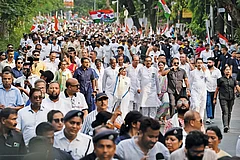


Snigdhendu Bhattacharya is a journalist, author and researcher.
This article is part of the magazine issue dated May 11, 2026, called 'Maach, Muri, Manush' about Assembly Elections 2026 and how West Bengal may prove to be the toughest battleground for the Bharatiya Janata Party.