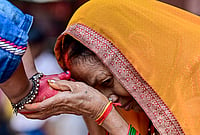
After a Holi killing sparked tensions, over 100 Muslim families fled Uttam Nagar amid threats of a “blood-soaked Holi” on Eid
Residents across communities say a personal dispute has been given a communal colour, even as shops are demolished and fear spreads
Heavy police deployment and court intervention aim to ensure peace, but uncertainty continues to define life on the ground
Just two days before Eid-ul-Fitr, Rashida Khatoon packed two pairs of clothes for herself, her husband and three children in a haste along with some other essential things to quickly run away before the threats would come true.
For the past week or so, she had been at home, overthinking and worried about whether these were just threats or reality until she started receiving worried calls from her relatives living in other parts of Delhi, telling her that it was no longer safe to stay in Uttam Nagar with chances of a “khoon ki Holi - a blood-soaked Holi” on the day of Eid.
50-year-old Khatoon, just like at least 100 more Muslim families living in Hatsal Colony in Uttam Nagar, did not have time to sit down, process, or pack properly. The “calls for blood” were escalating, the holy month of Ramzan just coming to an end, and their lives uncertain, Khatoon and many others decided to leave everything else behind, put locks on their doors and flee.

“They said they would complete their ‘unfinished Holi’ on the day of Eid. How could we continue living here with our children under such circumstances?” asked Khatoon, as she walked toward the nearest metro station with her children, who also carried important things of their lives in small bags.


The immediate trigger for the tensions lies in the death of 26-year-old Tarun Bhutolia, who was fatally assaulted following a dispute on March 4 during Holi celebrations.
Residents say the altercation began with a water balloon thrown by a child that accidentally splashed a passing woman. What followed was an argument between two neighbouring families, which later escalated. Bhutolia, according to his family, was not part of the initial confrontation but was attacked later when he was returning home, resulting in his death and a series of threats and violence in Uttam Nagar.
As of now, Khatoon is not sure if these threats will actually result in violence again, but uncertainty now defines everyday life. “This kind of hatred cannot just develop suddenly. People have lived together as neighbors for years, how can such deep hostility emerge overnight?” she said.

Making of a communal flashpoint
Bhutolia’s mother, Laxmi Devi, sitting inside a house now surrounded by police and barricades, is clear about one thing, “Our issue was only with that one family. Other Muslims are not at fault.”
She speaks of loss, not revenge. “Those who are guilty should be punished, not everyone,” she said, her voice steady but heavy. In the narrow lanes around her, that distinction, between a personal dispute and a communal narrative, has become the central tension.
Several residents insist the conflict had a history rooted in local disagreements. “There had been fights between them earlier too. It was between neighbours,” said one man. “But now it has been turned into a Hindu-Muslim issue.”
Even among Hindu residents, there is unease at the scale of what followed. “Punish the person who did it, you cannot blame everyone,” said Darshan Singh, who has lived here for over five decades. “We have lived together like family.”

Yet, in the days after the killing, the locality saw large gatherings, sloganeering, and the circulation of videos threatening violence. Residents say rallies and “akrosh sabhas” drew crowds, with some speeches calling for retribution. Muslim women in the area describe how that rhetoric has translated into daily intimidation.
“When we stand in the lane, people pass by and abuse us,” one woman said. “They are saying Eid won’t be allowed. How are we supposed to feel safe?” Another added that videos are circulating online in which terrible things are said about Muslim women.
“They even went on to say they will kill pregnant Muslim women and take out the babies. They often claim Muslims have many children but I just have two. How do I not feel scared?” she asked.
Opposition MPs, led by Congress MP Mohammad Jawaid, have written to Home Minister Amit Shah expressing concern over threats and hate speech targeting Muslims in Uttam Nagar following the Holi killing of a 26-year-old man. The letter flags inflammatory slogans, intimidation, and social media content creating fear among residents, while alleging a selective or inadequate police response that risks emboldening those seeking to disturb communal harmony. The MPs have urged the Centre to ensure immediate, impartial action by Delhi Police to protect residents and uphold constitutional rights, warning that the situation reflects a broader pattern of rising hostility rather than an isolated law-and-order issue.
The impact has cut across communities. Several shops of Hindu members of the community have also been partially or even fully razed in the process. Neighbours said that had the authorities given them time to explain, the Hindus might have been spared.
Tansen Gupta, a Hindu shopkeeper estimates his losses at several lakh rupees, savings that cannot easily be recovered. “Action was taken against everyone. But the loss is huge.”
But for many Muslim residents, the demolitions have reinforced a deeper sense of vulnerability. Children have stopped playing outside. Conversations have turned into hushed exchanges behind closed doors. Tenants, especially, have begun leaving in significant numbers. “More than 100 people have left,” said one resident. “People are going to relatives, anywhere they can feel safer.”
Some departures are quiet, almost secretive. A family, speaking through a half-open door, confirmed they would leave before Eid. “We will go to Jaipur,” a member said. “Safety is more important than Eid,” she told Outlook.

‘Safety more important than Eid’
The physical landscape of Uttam Nagar’s neighbourhood tells its own story. Where festive lights and stalls would usually line the streets in the final days of Ramzan, there is now debris. Broken shutters hang loosely from shops. Piles of dismantled structures lie along the roadside. The space that once hosted a bustling Eid market stands deserted.
“Every year, this area used to be decorated,” said Saddam Sheikh, pointing to an empty stretch of road. “This time, there is nothing.”
In the days following the incident, municipal authorities carried out demolition drives in parts of the locality. Residents allege that little to no notice was given.
“They came suddenly,” said Noor Jahan, a 60-year-old widow whose small shop was razed. “Others had partial damage, but mine was completely destroyed. This was my only source of income.”
Anwar Ahmad, 62, questioned both the timing and the process. “There was an old notice, but why act now? Why not give us time? They didn’t even allow people to remove their belongings.”

Amid rising concerns, the Association for Protection of Civil Rights (APCR) approached the Delhi High Court, seeking urgent intervention to prevent potential communal violence and to address instances of hate speech targeting Muslims in the area.
The petition flagged rallies and speeches where calls for violence, including threats of a “khoon ki holi” on Eid, were allegedly made. It argued that despite Supreme Court directions mandating suo motu action in such cases, enforcement had been inadequate.
Hearing the plea, the Delhi High Court directed the police and civil administration to take all necessary steps to ensure that Eid passes peacefully. It emphasised that authorities must create an environment where citizens can observe their religious practices with dignity and without fear.
The court also noted that security arrangements, including heavy police deployment and monitoring, should instil a sense of safety. It ordered that vigilance continue through upcoming festivals, including Ram Navami, and scheduled further review after Eid.
On the ground, the scale of deployment is unmistakable. Every road seems to end in a barricade. Police personnel stand at almost every turn. In several lanes, officers can be seen installing surveillance cameras. Central forces have been deployed alongside local police.

“There is round-the-clock monitoring,” said a police officer present there. “The aim is to ensure nothing happens again.” He added that heavy deployment has been put in place to prevent any fresh violence, and that cameras are being installed across the locality so that, in case of any future incident, there is clear record of what actually transpired.
Civil rights activists argue that the fear is not just about physical violence, but also about the climate created by unchecked rhetoric.
Nadeem Khan of APCR said the fear on the ground is reflected in the unusually high number of people leaving ahead of Eid. “Even those who don’t usually go… are also leaving—just because they are scared,” he said, adding that many feel they will only return “once all this is over.”
He alleged that despite police presence, inflammatory rhetoric has continued unchecked. Referring to gatherings in the area, he said, “hate speeches were delivered, hateful slogans were raised,” and questioned why such events were allowed in the first place.
Khan said this inaction prompted APCR to approach the Delhi High Court, especially as locals were too afraid to come forward. “For one post, you are arresting Muslims. But there are dozens… saying ‘we will play Holi with blood’, and there is no action,” he said.
Welcoming the court’s intervention, he noted that it has now directed preventive measures and removal of over 170 such posts, adding that “earlier, there was no accountability… now there is.” While arrests have already been made in the case, Khan argued that the continued mobilisation appears “less about justice and more about… vitiating the environment,” though he expressed hope that the court’s oversight would help restore confidence and allow those who fled to return.


Between co-existence and fear
For many who have lived here for decades, what is unfolding feels alien. Sharda, a Hindu vendor from Gujarat sets up a stall every Ramadan, on which she sells dates, dry fruits and even fenni or vermicelli for her Muslim customers. The same sentiment is echoed across the locality. “Muslims treat us like family. No one has ever questioned us,” she said.
Until recently, Uttam Nagar was among the few neighbourhoods where Hindu-Muslim solidarity was never in question. Residents recall a shared rhythm of life, sweets exchanged during Diwali, sevaiyan during Eid, small rituals that quietly sustained coexistence. “This was our way of life,” said Jahan.
Saddam Sheikh, who has been in the area since 1990, insists the situation changed only after external elements intervened. He pointed to gatherings near the police station and viral videos as key factors in escalating tensions. “There is law here, there is a police station right here. If something happens, go to court. Why incite violence?” he asked, pointing toward the local police station located just at the entrance of the locality.

As Eid approaches, Uttam Nagar stands at a crossroads between what it has been and what it is becoming. The signs of both coexistence and fracture exist side by side. A saffron flag flutters atop one house, while next door a locked gate signals a family that has already left. A police barricade divides what was once an ordinary lane.
Some residents insist life will go on. Others admit they haven’t slept in days. “They call us ‘jihadi’ and ‘traitor,’” said one man. “But we have lived here all our lives. We respect this country.”
He paused, then continued, drawing a broader comparison, “you take oil from countries like Iran, Iraq, Saudi Arabia, you depend on them. Then how do you decide which Muslim is acceptable and which is not?”