Witnesses allege that Pandav Kumar was shot by the Delhi police constable on April 19 for speaking loudly in Bhojpuri and being a Bihari.
Kumar died on the spot; his friend Kishan is in the hospital fighting for his life
While the family is asking for compensation and strict punishment for the accused cop, people in the locality are demanding safety for Bihari migrants
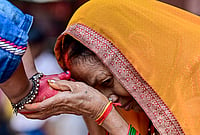
Meena Devi lays unconscious as her daughter mixes glucose in an almost crushed plastic bottle. The group of around ten women sit on the floor on a dari in a shrine in honour of their murdered son, 22-year-old Pandav Kumar. A poster with Pandav’s face has the slogan, “Kya Bihari Hona Gunaah Hai? (Is it a crime to be a Bihari)”. He was allegedly killed for the “crime” of being a Bihari, according to the family.
The already cramped street is almost taken over by this shrine turned protest site in Kumhar colony of Uttam Nagar in West Delhi. An open sewer leaks black sludge close to the group, almost touching the dari.
In the poster hanging above, Pandav looks happy and full of hope. “He loved Chinese food, hanging out with us, and he helped the whole family,” says Rahul Kumar, an older cousin. Four brothers moved to Delhi from Bihar in the late 1990s, and now each of their families is settled here. Rahul and Pandav are sons of these migrants.
“Akad me maar diya (the cop killed him out of arrogance),” says, a witness to the murder on April 26. A Delhi police officer shot Pandav in the chest, point blank. The bullet pierced through him, hitting Kishan sitting behind him.



It was Rupesh who invited Pandav and ten others to his home in Jafarpur Kalan, some 20 kilometres away from Uttam Nagar. “It was my son’s second birthday. We were all so happy.”
It was outside Rupesh’s home that the group waited for an Uber. “Some family members took the cab, which was booked by Pandav. We had to come to the main road because cabs cannot enter my street,” explains Rupesh. Six men stayed behind, three on a motorcycle, two on a scooty, and one standing by them. Rupesh’s plan was to see them off and return home.
It was around 2 AM when the friends and cousins started to laugh and joke among themselves, speaking in their native tongue, Bhojpuri. Being a largely commercial street, there were empty shops and shuttered godowns around them, with some farmlands on the opposite end of the road. There was a real estate shop—RK Properties—and above it lived Neeraj, a Delhi Police constable.
Neeraj did not like the group making merry outside his home. As the witnesses’ recall, it was the Bihari language which enraged this man and he came running down the metal stairs, toting a gun in hand.
“He was angry, abusive, and immediately hated us for being Bihari,” says Krishna, who was on a scooty. “He said we, Biharis, have taken over the area. He abused us,” adds the youngest cousin. Neeraj reportedly threatened the group with the gun, saying: “You may have a Rs 2 lakh plot, I have Rs 6 lakh gun,” allegedly raising the government assigned service pistol. Neeraj, allegedly drunk, claimed Biharis have taken over the area. He alleged Biharis have ‘made the area dirty’, adding that Biharis are buying all the land here.
Krishna, spooked by the gun and expletives, tried to get away. This angered Neeraj further, who allegedly followed the scooty, only to return and point the gun at Pandav’s chest. Rupesh says at this point, Pandav started to request Neeraj to stop with the threats and abuses, but Neeraj pulled the trigger nevertheless.

The First Information Report (FIR) mentions that the whole conflict and murder was captured on the CCTV cameras of RK Properties shop. The FIR also registers the anti-Bihari abuses spoken by the accused at the time of the crime. It mentions how the accused (unidentified at the time of incident) reached the group and tried to threaten them for being Biharis in ‘his area’. The owner of this property is Deepak Sehrawat. When he was reached out for a comment, he said: “He is 37 and is posted in Malviya Nagar thana. He must have been drunk at the time. He is a very amiable and kind guy. Would I drink with him if he was a bad person?” Neeraj lives alone; his family lives in a village in Haryana.
When we visited the house, it had a lock hanging outside. Deepak says Neeraj has surrendered. The police corroborated this. The family believes it is a lie. “They are protecting their own. We have no hope. If he is in custody, why is there no evidence or pictures?” ask Rupesh and Rahul.
Denying allegations of a regionally biased attack, Deepak says we have nothing against Biharis, we have Bihari friends with whom we get drunk. He adds, “I apologise on his behalf for this misfortune, but he is not hateful towards Biharis, he is just a cop who was unfortunately drunk.”
He says Neeraj, who was returning from duty, was drunk and claims the victims were also drunk. “It is not like he held a gun at these people, it was an accidental shot,” claims Deepak. When asked why Neeraj even took a gun to confront neighbours over noise complaints, he says Neeraj always carries his service weapon to prevent ‘miscreants in the area’. “I have ensured his family back in the village that we will help Neeraj,” says Deepak in whose house Neeraj has lived for 17 years.

There is a sense of apprehension in the neighbourhood about Neeraj; some shift their gaze; some want nothing to do with it. But some come forward. “He ordered food from us. He would shout the order from the top. We never interacted much,” says the owner of the restaurant next door. “His anger is known,” says one shopkeeper. Another shopkeeper hints at regular abrasive behaviour and aggression on account of his cop stature. It is hinted that being a police officer gave him a sense of superiority and ownership of the lane.
On the other hand, the family left behind by Pandav can barely breathe. His elder sister Gunjan is married and lives in Shahdara. “Maut ka saza maut chahiye (we want death for death),” says a shocked Gunjan. Her aunt, trying to hold the grieving family together, demands death by hanging. “We have no doubt he was killed for being a Bihari. We don’t know that cop, there is no previous enmity, nothing. It was their Bihari identity which enraged the cop,” she alleges.
Pandav’s elder cousin takes us to the room where the family lives. On the terrace of a commercial building, there are five single rooms which share one bathroom. Each single room compartment houses a family. The room is 10 by 12, a cement platform acts as a kitchen and the walls are covered with jholas and bags containing their whole lives.
“He worked as a food delivery agent. He left his studies to sustain the family,” he says. On the terrace is an earthen chulha, on account of LPG shortage.
Five people live here. The family moved to Delhi from Khagaria, Bihar in the early 2000s. Pandav was the sole breadwinner. His father and mother, both in their 60s, do not work. Pandav, his parents, and his niece and younger brother live in this room in Uttam Nagar.
The family now demands the government should pay compensation for his death. “Those meant to protect killed our boy,” says Pandav’s uncle, demanding strictest punishment for the police officer. This is not the first killing in this family. Pandav’s aunt recalls how the eldest daughter of the family, Kajal, was allegedly killed by her in-laws back in Bihar. The family believes it was a murder, though Kajal’s in-laws claim it was a suicide. Within this backdrop, Pandav decided to fight for his niece, Kajal’s daughter. He managed to bring her to Delhi and promised to raise her as his own. “Pandav wanted to educate his niece and give her a good life. All of that is gone now,” says elder cousin Rahul.
While we were talking to the family, a Delhi Police member arrived, sat and observed for a few minutes and left. The family has alleged police have been hesitant to help, as the accused is ‘one of their own’. Pandav’s cousin, one of the key witnesses in Jafarpur Kalan, claims the cop just wanted to establish his power ‘over the poor Biharis’.
The government has been largely absent. Manoj Tiwari, BJP MP, visited the family three days after the killing and promised to ensure penalty for the accused. Meanwhile, in Pandav’s home state, former Chief Minister Jitan Ram Manjhi, during a media interaction, said: “He was killed, so what?” However, other leaders, like Tejashwi Yadav, have demanded quick justice for the family.
“Who will raise the family now? The younger brother?” asks the aunt. The younger brother is still studying. He too survived on Pandav’s earnings. Kishan, the other victim, is still in the hospital, fighting for his life.
“The cop had no remorse. He said this one (Pandav) is already gone, try to see if you can save that one (Kishan), then he walked calmly to his room,” recalls Rupesh. People sitting around demanded safety for Biharis in Delhi.
The area, around the protest and Pandav's house in the Kumhar colony, is dominated by Bihari migrants. Some have been here for decades and watched Delhi evolve around them. One thing that hasn’t changed is the regional bias against Biharis. “We work; we earn. We are not criminals. Will we be killed for being Biharis, too?” asks a neighbour.