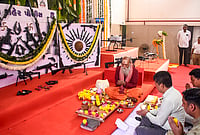
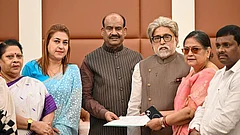
Kakoli Ghosh Dastidar claims the support of 20 TMC MPs, though party loyalists dispute the figure.
Under the anti-defection law, the rebels need the support of at least 19 Lok Sabha MPs to avoid disqualification.
Questions over a formal merger and the rebels' actual numbers could complicate their plans.
Amidst the ongoing tussle within the Trinamool Congress’ (TMC) parliamentary party, one number that has often been invoked is 20. The leader of the rebel faction, Kakoli Ghosh Dastidar, claims she has the support of 20 MPs while Mamata loyalists within the TMC refute her claims stating that she has the support of only 13 or 14 MPs.
But the magic number, as it is often called, for Dastidar lies a step below at 19. The rebels remaining a part of the Lok Sabha is contingent on their faction receiving the support of 19 MPs from their party.
This follows a playbook that has been used time and again in Indian politics, recently showcased by Raghav Chadha, by politicians to switch sides midterm.
The Anti-Defection Law
The Tenth Schedule of the Constitution, popularly known as the anti-defection law, provides the provisions for the disqualification of Members of Parliament and Members of Legislative Assemblies if they switch political parties or defy their party’s directives.



In simple terms, if you are elected to the Parliament or a Legislative Assembly on a party’s symbol and then leave to join another party or defy a party whip (instructions), you can be disqualified.
The provision was inserted through the 52nd Amendment to the Constitution in 1985 to curb horse trading and political defections.
But there is still a way for politicians to switch sides. If at least two-thirds of a party’s legislators agree to switch sides then the members are protected against disqualification. Earlier, the required number used to be one-third of the legislators, but the provision was strengthened in 2003.
Raghav Chadha in April used these same provisions to break away from the Aam Aadmi Party (AAP) and join the BJP. Chadha enjoyed the support of 7 of the 10 Rajya Sabha MPs from AAP allowing him to comfortably breach the two-thirds requirement.

The Anti-Defection Law
The Tenth Schedule of the Constitution, popularly known as the anti-defection law, provides the provisions for the disqualification of Members of Parliament and Members of Legislative Assemblies if they switch political parties or defy their party’s directives.
In simple terms, if you are elected to the Parliament or a Legislative Assembly on a party’s symbol and then leave to join another party or defy a party whip (instructions), you can be disqualified.
The provision was inserted through the 52nd Amendment to the Constitution in 1985 to curb horse trading and political defections.
But there is still a way for politicians to switch sides. If at least two-thirds of a party’s legislators agree to switch sides then the members are protected against disqualification. Earlier, the required number used to be one-third of the legislators, but the provision was strengthened in 2003.
Raghav Chadha in April used these same provisions to break away from the Aam Aadmi Party (AAP) and join the BJP. Chadha enjoyed the support of 7 of the 10 Rajya Sabha MPs from AAP allowing him to comfortably breach the two-thirds requirement.

The Maharashtra Model
In 2022, Eknath Shinde engineered a similar split in the Shiv Sena, then the head of the ruling coalition in Maharashtra. He led a group of rebel MLAs and withdrew support from the ruling Maha Vikas Aghadi (MVA) coalition in the state causing their collapse. After a prolonged legal dispute, Shinde’s faction was awarded the use of the Shiv Sena name and party symbol.
This series of events entered the lexicon of Indian Politics as 'The Maharashtra Model'.
When Ritabrata Banerjee led a group of 58 MLAs and installed himself as the leader of opposition in the assembly, ‘The Maharashtra Model’ was once again called on by West Bengal Minister Tapas Roy. Though there has been no official split in the party and the rebel MLA’s even called on Mamata Banerjee to be their advisor.
The same playbook is in use by the BJP in the Lok Sabha, rival outfits allege. Though there are still multiple trials that the TMC rebels will have to go through before they can breathe a sigh of relief.
Problems for the Kakoli Faction
There are several hurdles that the rebel faction would have to navigate through before they could consider themselves safe.
The primary challenge stems from the interesting wording that Dastidar used in her statement saying that she had written to the speaker seeking seating arrangements as “a separate bloc”. The provisions of the anti-defection law only protect against disqualification in cases involving mergers. This could be a sticking point in the current dispute.
There is also an ongoing case in the Supreme Court challenging the movement of legislators before the political parties have merged.
Another, perhaps the most fundamental issue, is actually having the necessary numbers. Dastidar claims to have the support of 20 MPs while Mamata loyalist Kalyan Banerjee says that she is only in contact with 13-14 MPs.
Mahua Moitra, MP and another Mamata loyalist said in a post on X, “Mandate was NOT for NDA," and dared them to resign and contest on a BJP ticket.