Balochistan's conflict is decades-old political, beginning with the disputed accession of the princely state of Kalat to Pakistan in 1948.
Violence has intensified in recent years with increasingly sophisticated attacks by separatist groups on security forces and Chinese interests.
Pakistan has responded with military operations, even as analysts argue that a lasting solution will require political dialogue alongside security measures.
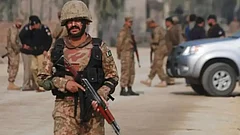
Pakistan's southwestern province of Balochistan has once again been thrust into the spotlight after militants killed 27 policemen in Ziarat, prompting Islamabad to launch Operation Shaban, a sweeping security offensive that authorities say has killed more than 120 militants.
The latest violence is part of a conflict that has simmered for decades. Despite being Pakistan's largest province and home to vast reserves of natural gas, copper and gold, Balochistan remains one of its least developed regions. The dispute today is no longer only about separatism; it also centres on questions of political representation, resource ownership, human rights and foreign investment, particularly China's expanding footprint through the China-Pakistan Economic Corridor (CPEC).
Why Is Balochistan So Important To Pakistan?
Stretching from the Arabian Sea to the borders with Iran and Afghanistan, Balochistan occupies nearly 44% of Pakistan's territory but is home to only a small share of its population. Its geography gives it immense strategic significance.
The province hosts Gwadar Port, a deep-sea port located near the Strait of Hormuz, one of the world's most critical maritime routes for global energy supplies. It also contains some of Pakistan's largest deposits of natural gas, copper, gold and other minerals, making it central to the country's economic ambitions.
Its importance has increased further because Balochistan forms the backbone of the China-Pakistan Economic Corridor (CPEC). Launched in 2015 as part of China's Belt and Road Initiative, CPEC seeks to connect Gwadar with China's Xinjiang region through highways, railways, energy projects and industrial zones, giving Beijing a shorter trade route to the Arabian Sea while helping Pakistan modernise its infrastructure.



Yet many residents argue that although the province generates enormous wealth, local communities continue to lag behind on jobs, education, healthcare and basic infrastructure.

How Did The Conflict Begin?
Before Partition, Balochistan was made up of several princely states, the largest of which was Kalat. Its ruler, Mir Ahmad Yar Khan, initially sought to remain independent after British rule ended in 1947. However, after months of political and military pressure, Kalat acceded to Pakistan in March 1948.
Pakistan considers the accession legally settled. Many Baloch nationalists, however, regard it as a forced merger that ignored the aspirations of the region's leadership. That disagreement became the foundation of a movement that has resurfaced repeatedly over the decades.
Balochistan has witnessed several insurgencies since 1948, but the current phase began in the early 2000s. Anger intensified after the alleged rape of doctor Shazia Khalid by an army officer in 2005 and the killing of veteran tribal leader Nawab Akbar Bugti during a military operation the following year. Bugti's death became a defining moment for many Baloch nationalists, strengthening support for armed resistance.
Why Do Separatist Groups Oppose Islamabad?
Although Baloch militant organisations differ in ideology and objectives, both believe that the province has been politically and economically marginalised.
Many Baloch argue that Islamabad controls the province's natural resources while local communities receive little benefit from the profits generated by gas fields, mines and ports. They also complain that senior positions in large development projects often go to workers from other provinces rather than local residents.
Some groups seek complete independence from Pakistan, while others demand greater provincial autonomy and more control over local resources within Pakistan's constitutional framework.
The conflict has also been fuelled by allegations of enforced disappearances. Human rights organisations and Baloch activists accuse security agencies of detaining thousands of people suspected of links with separatist groups, with many later found dead or remaining missing. Pakistan rejects these allegations, saying many of the missing joined militant organisations or crossed into neighbouring countries.
Why Has China Become A Target?
China's growing investments have transformed Balochistan into the centrepiece of one of Asia's biggest infrastructure programmes.
CPEC has financed roads, power plants, industrial parks and Gwadar Port, and China also operates the Saindak copper and gold mine while investing in the massive Reko Diq mining project.
Islamabad views these projects as essential for economic growth. Separatist groups, however, argue they represent the extraction of Balochistan's resources without meaningful local participation.
As a result, Chinese engineers, companies and infrastructure have increasingly come under attack. Since 2018, the Baloch Liberation Army has claimed responsibility for several high-profile assaults targeting Chinese nationals, including attacks on engineering convoys, Gwadar Port and diplomatic facilities.
Analysts say such attacks are intended to raise the cost of foreign investment, undermine confidence in CPEC and draw international attention to the separatist cause.

Why Has Violence Intensified In Recent Years?
Militant groups have become more organised, carrying out coordinated attacks on military installations, police personnel, Chinese interests and critical infrastructure. Pakistani authorities also say advanced weapons left behind after the US withdrawal from Afghanistan in 2021 have strengthened militant capabilities, while officials have alleged links between Baloch separatists and the Tehreek-e-Taliban Pakistan.
The government has responded with repeated military operations, arguing that force is necessary to dismantle armed networks. The latest example is Operation Shaban, launched after the killings of policemen in Ziarat.
Critics, however, argue that decades of security operations have failed to resolve the underlying issues. They say grievances over political representation, resource distribution, enforced disappearances and economic exclusion continue to drive unrest.
Can The Conflict Be Resolved?
Most analysts agree that Balochistan's geography makes it difficult to eliminate the insurgency through military means alone. The province's vast mountains and sparsely populated terrain provide militants with natural cover, while repeated cycles of violence have deepened mistrust between local communities and the state.
Pakistan maintains that separatist groups represent only a small militant minority and accuses India of backing the insurgency—an allegation India denies.
At the same time, many researchers argue that any lasting solution will require more than security operations. They say reducing violence will depend on political dialogue, greater provincial autonomy, fairer distribution of resource revenues, credible investigations into allegations of enforced disappearances and stronger local participation in decisions affecting the province's future.