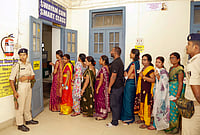
Families in Delhi's JJ camps receive eviction notice despite court stay, allege the notices are bypassing Supreme Court procedures for fair hearings.
Residents highlight generational ties, livelihood disruptions, and safety fears in relocating 40 km to Savda Ghevra's inadequate infrastructure.
Rehabilitation colonies such as Savda Ghevra are burdened by water costs, flooding, and disease, far from promised improvements.
On February 19, residents of B.R. Camp (Bhai Ram), DID camp and Masjid camp located near Race Course Road in Delhi received a final eviction notice by the Land and Development Office (L&DO), under the Ministry of Housing and Urban Affairs where they have been told to vacate their homes before March 6, giving them 19 days exactly to transfer to the flats allotted to them in Savda Ghevra (DUSIB Colony), according to the eviction notice.
According to the notice, these clusters are located on government land under L&DO management. A joint survey by the L&DO and Delhi Development Authority was conducted in January 2024 to determine eligibility for rehabilitation under Delhi Urban Shelter Improvement Board (DUSIB) policy.
The survey process was completed and eligibility was established for those who qualified, with allotments of permanent houses made.
However, this notice has come in the middle of ongoing legal proceedings.

Earlier notices dated 29 October 2025 — an eviction notice and a rehabilitation notice — directed residents to vacate within 15 days. These were challenged in the Delhi High Court by Khushnuma Khan and others in WP(C) 17239/2025, wherein the petitioners stated that the settlements are notified jhuggi clusters listed at serial numbers 191 and 201 in the DUSIB list of 675 JJ bastis, and have existed for several decades.


On 13 November 2025, the matter was last heard under Justice Sachin Datta. The petitioners argued two main points: first, that any dislocation must follow the rehabilitation procedure under the applicable policy as a necessary precondition; second, that the respondents must comply with procedural safeguards set by the Supreme Court in a demolition matter decided on 13 November 2024, which require a specific show-cause notice, reasonable time to reply, a personal hearing, and a reasoned order before eviction.
The court noted that the impugned notices appeared to seek dislocation without following these procedures. It issued notice to the respondents, allowed three weeks for their reply and one week for rejoinder, and listed the case for 13 January 2026. In the interim, the court directed that the petitioners shall not be evicted without adherence to the Supreme Court safeguards mentioned in the 13 November 2024 order.
The stay was extended on 13 January 2026 because the respondents failed to file a reply, with the next hearing scheduled for 13 May 2026.
The L&DO's 19 February 2026 notice states that it is issued in compliance with the Delhi High Court order dated 13 November 2025 and confirms allotment of permanent houses in Savda Ghevra, instructing eligible residents to take immediate possession of the allotted flats, and requires vacation of the current sites by 6 March 2026, wherein non-compliance will lead to eviction and removal of structures as per law.
Zeeshan Ahmad, a Delhi-based lawyer representing the JJ camps, says that the latest eviction notices issued by the authorities are a “deliberate” attempt to bypass the judiciary. He explains that the Delhi High Court had already granted a stay on 13 November 2025 regarding both eviction and rehabilitation notices issued in October 2025.

“This is a violation of the Supreme Court guidelines which came in the matter of that demolition matter in late 2024. There are certain procedures which have to be followed; it is clearly laid out: notice must be given, followed by a personal hearing and then a final order, which includes an opportunity of appeal and judicial scrutiny of the final order. The proceedings of demolition involve a very long list of requirements, and yet they are ready to bypass all that. How can you rehabilitate without abiding or adhering to the principle direction which has been issued by the Supreme Court?” says Ahmad.

How The Residents View It
When Outlook visited B.R. Camp and Masjid Camp, the two JJ clusters explicitly named in the 19 February notice, the mood on the ground was clearly tense.
Shaista Khan, resident of Masjid Camp, is a single mother whose family has lived in the camp for four generations since 1949. Khan alleges that the administration is showing a complete lack of compassion.
She fears that being uprooted would destroy the stability her family and other residents have built over decades. She was particularly distressed that eviction notices were served during board exams for children and the holy month of Ramadan. She has a question for the authorities, “Are you playing with the future of children?”
She described the proposed relocation site, Savda Ghevra, as a dangerous and isolated area approximately 40 kilometres away, where there are reports of illegal drug trade activity.
Khan also worries that moving so far would cut off the elderly and special-needs children from essential medical treatments that they undergo at AIIMS and Safdarjung Hospital which are the closest government hospitals..
Khan accused the L&DO of failing to provide any proof of land ownership in court, despite the ongoing legal proceedings. Furthermore, Khan described how officials used police force to intimidate residents into signing receipt notices, stating that the authorities “come with force” and threaten people until they comply.
“The residents have invested their life savings into turning these dwellings into permanent houses and simply wish to remain in the place that they have called their home for the last 75 years”, she insisted.
Bharat Prakash, a contractor for the CPWD and PWD, who has lived in the DID camp since his birth, represents the fifth generation of a family staying here since 1933. He contends that the community is perfectly settled, crime-free, and fully documented, with residents possessing Aadhaar cards, voter IDs and birth certificates, all tied to their current addresses. Prakash is frustrated over the eviction notices.
“The kids of camp residents go to nearby government and private schools, the residents are mostly formal sector workers, who travel everyday to their offices. If we are thrown 40 kilometres away from where we currently live, who will promise us livelihood and accessible education to our children? This relocation will end the lives they have built over nearly a century.”
Prakash emphasises that the proposed site is “absolutely zero in terms of safety” and that its conditions are “even worse” than the modest homes the residents currently occupy.
Akhtari, another resident for almost 60 years, recalls the hardships of building a life from scratch when the area consisted only of ditches and bushes.
“What crimes have we committed that now we are being asked to leave a place where more than 4 generations have lived peacefully? This is government land, right? It is a JJ cluster, during the elections we were promised of ‘Jahan Jhuggi Wahan Makaan’, was this promise made only to steal our votes and later discard us like trash?”
Akhtari is terrified that relocation to Savda Ghevra will lead to starvation, as the distance would prevent residents from reaching their private jobs. She describes the financial burden of the relocation as ‘impossible,’ since she is a widow whose sons earn barely 500 to 600 rupees a day.
“Where will we get such an amount?” she asks, referring to the 2-lakh rupee deposit required for a government flat.


The Big Picture
There are 675 slums or JJ camps in the Capital under DUSIB. Of these, 376 are on government land under DDA jurisdiction, while 299 fall under DUSIB. The DDA’s 2007 slum rehabilitation policy covers public-private partnerships in redevelopment, but implementation has been slow.
Outlook’s ground reportage over time reveals not isolated housing failures in Delhi but a continuous chain of displacement that runs from threatened eviction to deferred rehabilitation and, finally, to distress after relocation.
In recognised JJ clusters such as Partap Camp and Shaheed Arjun Das Camp, residents face hazardous conditions: homes along garbage-filled nullahs with cracked, damp walls, exposed wires, frequent flooding during monsoons, stagnant water, pollution causing illness, no clean water or toilets, and unsafe structures with collapsing walls.
In Partap Camp, residents paid over ₹1 lakh (plus ₹30,000 maintenance) in 2013 under JNNURM after eligibility confirmation, borrowing funds to avoid delisting. They hold provisional letters and electricity bills for flats in Baprola, Dwarka and Bawana — yet possession has been denied for over 12 years.
Savda Ghevra, where families from some JJ camps have been resettled since 2006, presents what life after relocation looks like. Families earning Rs 6,000–10,000 monthly spend Rs 500–1,500 on drinking water because municipal supply is unreliable, often muddy or contaminated. Residents depend on expensive private suppliers, canned water costing Rs 20–30 per can, inconsistent tankers and malfunctioning water ATMs. Seventy per cent cut food expenditure. Forty per cent report lost wages due to queuing. Widows like Shakuntala spend Rs 200 every two to three days on cans.
Broken sewage causes flooding and mosquitoes, collapsed community toilets lead to open defecation, roofs cave in injuring children, and stagnant wastewater breeds disease, conditions far worse than promised post-rehabilitation.
For the families in B.R. Camp, DID Camp and Masjid Camp, the big question is not whether flats have been allotted on paper? It is whether relocation, at this distance, under these timelines, and amid unresolved legal proceedings, secures livelihood, healthcare, education and safety, or merely shifts vulnerability from one edge of the city to another?