Ayatollah Alireza Arafi is serving in an interim leadership arrangement alongside President Masoud Pezeshkian and Judiciary Chief Gholam-Hossein Mohseni-Ejei.
The 88-member Assembly of Experts will convene to deliberate and appoint the next Supreme Leader.
Names being discussed include Mojtaba Khamenei, Alireza Arafi and Hassan Khomeini, though internal clerical and political dynamics will determine the final choice.
As the crisis in West Asia deepens with the confirmation of Iran’s Supreme Leader, Ali Khamenei, all eyes are set on the nation that is tasked with filling in a pivotal power vacuum urgently.
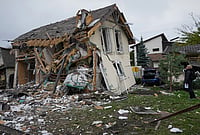
Khamenei led Iran for nearly four decades, making him the longest-serving head in West Asia. His rule came to an end in the early hours of Saturday as Iranian state media confirmed he was killed in the recent US-Israel airstrikes.
At present, Ayatollah Alireza Arafi has been appointed as Iran’s interim Supreme Leader following the reported death of Ayatollah Ali Khamenei, with a temporary leadership council assuming his duties until a successor is chosen.
With the death of the Ayatollah, Iran will have to move quickly to convene and deliberate on candidates before naming the next Ayatollah.

How it works
A clerical council comprising 88 members, known as the Assembly of Experts, will have to deliberate on candidates and appoint a new supreme leader. This panel also retains the power to depose one as well; such a case has never occurred.


The council is also made up of Iran’s sitting president, the head of the country’s judiciary and a member of the Guardian Council chosen by Iran’s Expediency Council, which advises the supreme leader and settles disputes with parliament.
The panel consists entirely of Shia clerics who are popularly elected every eight years and whose candidacies are approved by the Guardian Council, Iran’s constitutional watchdog. Shia Muslims make up the majority religion in Iran.
That body is known for disqualifying candidates in various elections in Iran, and the Assembly of Experts is no different.
The Guardian Council barred former Iranian President Hassan Rouhani, a relatively moderate whose administration struck the 2015 nuclear deal with world powers, from election for the Assembly of Experts in March 2024.
The assembly must choose a successor as soon as possible. In the meanwhile an interim leadership of the president, the judiciary chief and a Guardian Council member takes charge.
Currently, Ayatollah Arafi will temporarily be in leadership council alongside President Pezeshkian and Supreme Court Chief Justice Mohseni-Ejei.

Top Contenders for Supreme Leader
While no candidates are officially known, particular names are being watched by experts as the council deliberates on the next Supreme Leader.

Mojtaba Khamenei
Khamenei’s son Mojtaba Khamenei could be a possible contender. Previously, it was thought that Khamenei’s protégé, hard-line President Ebrahim Raisi, would take the mantle. But a helicopter tragedy in May 2024 claimed his life. Mojtaba, a 56-year-old Shia cleric who has never held public office, is one of Khamenei's sons and a possible contender.
However, a father-to-son transfer in the case of a Supreme Leader might infuriate supporters of the system as well as Iranians who are already against religious leadership. Some may see it as un-Islamic and in line with creating a new, religious dynasty after the 1979 collapse of the US-backed Shah Mohammad Reza Pahlavi’s government.
Additionally, candidates must have ‘political experience’ as per the law. Mojtaba reportedly fails on this account, the institute noted. This is because despite running the Office of the Supreme Leader, de facto, he's had no formal political roles in the regime.

Alireza Arafi
Arafi, the interim Supreme Leader, is an established cleric with a track record in government institutions who was also a confidant of Khamenei.
He served as deputy chairman of the Assembly of Experts and has been a member of the powerful Guardian Council, which vets election candidates and laws passed by parliament. He is also head of Iran’s seminary system.
According to the Council on Foreign Relations, his appointment would likely preserve the existing political structure.

Hassan Khomeini
Khomeini has religious and revolutionary authority as he is the grandson of Ayatollah Ruhollah Khomeini, the founder of the Islamic Republic.
Despite being the guardian of the Khomeini mausoleum, he has never held public office and seems to have little clout with the nation's governing class or security forces. He was prohibited from running for the Assembly of Experts in 2016 and is seen as less radical than many of his colleagues.


Reza Pahlavi
Meanwhile, on the side of the opposition, exiled crown prince Reza Pahlavi has made several public promises to the people of Iran if he is chosen to lead the transition.
Mohammad Reza Pahlavi, Reza Pahlavi’s father, was the last Shah of Iran. He was overthrown in 1979 during the Iranian Revolution. However, this father-son transfer also poses problems as the last Shah’s reign led to mass protests that ended in his eventual exile. Reza also has close ties with Washington and has promised to recognise Israel if given power.
With the interim leadership already in place, Iran’s only next step is to fill the position of the Supreme Leader amid the ongoing conflict.