Media reduced Phoolan Devi to a sensational figure—sexualised, dramatised and stripped of structural context.
Bandit Queen reinforced the revenge narrative, overshadowing caste realities and political transformation.
Writers like Mala Sen reframed her as shaped by caste and institutional failure, but the myth still dominates public memory.
Phoolan Devi did not enter the public imagination as a person so much as a spectacle. Media accounts cast her simultaneously as outlaw, beauty, victim and avenger, lingering on her body as insistently as on her gun, until a life shaped by caste violence and gendered oppression was repackaged into a consumable myth of blood, dishonour and revenge.
For decades, her story was told through this aestheticised lens, her appearance, sexuality, suffering, banditry and even her death turned into narrative devices—so that what circulated in public memory was not the complexity of her lived experience but a series of embellished, marketable versions of her.
One headline by OneIndia Hindi reduced her life to a sequence of sensational numbers, almost framing it as a crime-thriller hook: “11 saal ki umar mein shaadi, 21 din tak gangrape, 22 Thakuron ko line se bhuna—Phoolan ki khooni kahani” (Married at 11, raped for 21 days, killed 22 Thakurs in one go—Phoolan’s bloody story). Trauma became arithmetic, violence, a headline device.


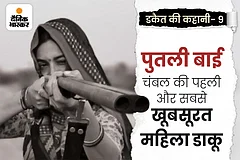
Similarly, another headline crowned her a “dasyu sundari”, a “bandit beauty”, a phrase that would echo across coverage. An AajTak piece read, “Phoolan Devi: Woh dasyu sundari jiske samarpan ke liye Indira ko appeal karni padi thi” (Phoolan Devi: The bandit beauty for whose surrender even Indira had to make an appeal). Another declared: “Dasyu sundari Phoolan Devi ki dil dahla dene wali dastaan (Bandit beauty Phoolan Devi’s heart-wrenching story).”
Across these headlines, a pattern emerges, sexualisation and aestheticisation operating alongside violence, packaging caste atrocity and sexual assault as spectacle. “Bandit Queen ki asli kahani: rape, badla aur siyasat” (The real story behind the Bandit Queen: rape, revenge and politics) positions sexual violence as teaser and revenge as plot, while her politics trails as an afterthought.
An article published in online encyclopedia—a collection of online encyclopedias providing reference entries from published sources like Oxford University Press and Columbia Encyclopedia—about Phoolan explains that many journalists seemed offended by her appearance, disappointed by the physical stature of this “short and dark” woman.

For her family in Sheikhpur Gurha, a small village in Uttar Pradesh’s Jalaun district, this translation from reportage to newspapers meant that the mediated Phoolan eclipsed the person they had known. “The media changed the narratives as per their own convenience when it came to Phoolan. She was shown in a very different light than how she really was,” says Indrajeet Singh, her cousin who still lives beside her dilapidated home in Jalaun.
The massacre at Behmai, a village in Uttar Pradesh; the spectacle of her surrender; the improbable journey to Parliament, all these became narrative anchors. Meanwhile, the girl from Jalaun who ran barefoot through paddy fields, the child forced into marriage, the Mallah daughter navigating a world structured by deprivation and upper-caste impunity, receded into the margins.
Phoolan was born into the Mallah sub-caste at the margins of the social order, her childhood was shaped by poverty, field labour and the intimacy of her mother’s kitchen. At 11, she was married off to Putti Lal, a man nearly three times her age, and she returned home marked by sustained physical and sexual violence. “He would beat her very badly. There were all types of violence involved. She was raped several times, and it became unbearable for her,” says Singh.
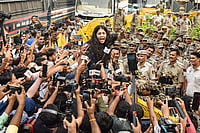
In a society that had long relegated women to the periphery of public life, Phoolan’s visibility unsettled expectations. She was no longer a side character in someone else’s narrative, and perhaps that is precisely why the media coverage insisted on framing her first and foremost as a woman who transgressed. Articles dwelt on her body, her skin colour, her hair, her beauty; curiosity shaded into voyeurism. The press did not merely report on Phoolan Devi, it produced versions of her, feeding a public appetite for a woman who had dared to step outside the script assigned to her by caste and patriarchy.
In her village, her “Devi incarnation” remains alive in public memory: a white statue at the entrance of her home, draped in a white saree, wearing bangles, her lips coloured pink, and vermillion in her hair parting. She smiles at villagers who come to seek her blessings. “Children take her blessings before exams, that’s how much she is respected here,” says Singh. Meanwhile, the memory of the girl who fought for herself has quietly receded, leaving behind only a palatable legend and one final choice that was taken from her, the right to define her own story.

These frames did not remain confined to print. They seeped into popular culture, where cinema fixed them in public memory with far greater permanence. Most notably, Bandit Queen, directed by Shekhar Kapur, translated the newspaper legend into a visual grammar of suffering and revenge.
The film foregrounded sexual violence with an intensity that turned it into spectacle, compressing the social world that produced Phoolan into a linear narrative of humiliation and retribution. In doing so, it echoed and amplified the media’s earlier reduction of her to two dominant identities, the dacoit and the rape victim, while her life as a Mallah woman negotiating everyday caste oppression receded further from view.
The impact was profound because cinema endowed these representations with the authority of realism. As Arundhati Roy argued in her essay ‘The Great Indian Rape Trick’, the film aestheticised sexual violence while claiming truth, creating what she called a condition of ‘Legenditis’, where multiple versions of Phoolan competed but the most sensational one prevailed: “Phoolan Devi the woman has ceased to be important… She’s only a version of herself.”
What newspapers had serialised as headlines and police description, the film monumentalised as a definitive image.
“Journalists, especially from Hindi newspapers, made her the villain. Then came the film, with many exaggerated, hard-to-watch scenes,” says Singh, noting that the family never knew how her story would be used in the newspapers.
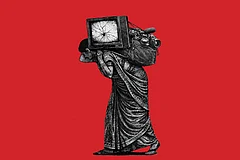
The making of the Phoolan legend was the cumulative effect of reportage, visual culture and popular cinema, each reinforcing the other until the representation began to stand in for the woman.

Amid this representation, Mala Sen’s book India’s Bandit Queen almost came as a breath of fresh air. It located Phoolan’s life within the intersecting structures of caste, gender and rural poverty rather than in the spectacle of crime and revenge that marked media portrayals.
She depicted Phoolan as a lower-caste Mallah woman shaped by land disputes, child marriage, sexual violence and social exclusion, for whom banditry was a consequence of the failure of family, village and the state to deliver justice. By foregrounding her resilience, leadership and political transformation after her surrender, while acknowledging the moral ambiguities of the ravines, Sen moved the narrative away from the ‘Bandit Queen’ myth to that of a woman forging agency within systemic oppression.
Sen writes in her book that there were multiple, often conflicting , accounts of what happened to Phoolan after Vikram Mallah’s death, but when Sen met her, Phoolan refused to describe the sexual violence in detail, referring to it only obliquely as “Un logo ne mujhse bahut mazak ki” (Those people humiliated me a lot).
Sen explains that this reticence was shaped both by the immediate setting—they were surrounded by relatives, prisoners and visitors, and by the wider social context in which sexually abused women are made to feel responsible for their own violation. In such a culture, she observes, speaking about rape risks deepening a woman’s sense of humiliation. “Phoolan Devi, like many other women all over the world, feels she will only add to her own shame if she speaks of this experience,” Sen writes.
For Dalit feminist activist Riya Singh, the sexualised portrayal of Phoolan was not incidental but structural. “By hyper-sexualising Phoolan, the media and upper-caste society attempted to reduce her life and struggle to a spicy, cinematic narrative,” she says, insisting that Phoolan must be understood “as a political subject to be studied”, not a spectacle.
Singh located her turn to armed resistance and later to electoral politics in the collapse of institutional justice: “Phoolan’s actions are an inevitable outcome of institutional failure. The police and local authorities were not neutral; they were extensions of dominant-caste hegemony.”

For marginalised women, she adds, “poverty wasn’t just a lack of money; it was a lack of recourse.” Recalling her father’s experience during Phoolan’s campaign, Singh describes her as “a very politically sound person… a leader who came from the ground and held clarity of how society operates,” arguing that the disproportionate focus on her criminality showed that “Phoolan was hated for her caste, class and gender.” For her, Phoolan remains “a towering figure of resistance.”
Commenting on the role of the media in converting violence into spectacle, women’s rights activist Ranjana Kumari says that Phoolan’s life became “very sensational… presenting her not only through her pain but also as an object of entertainment,” with coverage turning her into a “masala story” that foregrounded revenge, her body and her bandit persona while omitting structural context.
The reporting language of the time, Kumari notes, was “far more sexualised and sensational”. Her later entry into politics, she adds, was also mediated through caste arithmetic rather than her political abilities. Yet, in personal memory, Kumari recalls a woman marked by struggle and anger who had “managed to take her revenge, that became the core of the whole story,” even as the complexities of her life were left out.
The Girl Before the Legend
Phoolan’s childhood was shaped by poverty, field labour and the intimacy of her mother’s kitchen.
Home did not offer refuge. A land dispute with upper-caste Thakurs drew her into another cycle of domination, and in 1981 she was abducted by a gang and taken to Behmai. “We all begged them to leave her, but they took her to Behmai where she was raped and publicly assaulted by upper-caste men,” Singh recalls. Freed later by Vikram Mallah, she returned with what he described as a single consuming impulse, revenge, and with it the knowledge that institutional justice would not come.
“With no training and no roadmap except her own fury and wounded dignity,” she entered the ravines and formed a gang. Yet, as her family insists, this was compulsion rather than destiny. “Dacoity was not in her destiny; she was taken away because of compulsion,” says Moolan Devi. “Phoolan’s life of crime was not by choice, but forced upon her by circumstances she could not resist,” Singh adds.

Even at the height of her notoriety, she returned quietly to the village, sitting beneath a neem tree by the Yamuna, asking women if they were safe and urging girls to study. “She would tell young girls to not be scared, to seek an education,” Singh says.
Her return to Behmai in February 1981, where at least 20 Thakur men were shot dead, became the defining national image. This is also something that has been carried forward in Behmai, where Dharm Singh, an 84-year-old Thakur in Behmai whose elder brother was killed during the massacre, narrates the story of Phoolan, a “bad-charactered” woman. “She used to come to our village with her gang. We would offer her food and water. Then one day, during a fight between two gangs, she killed our men,” says Singh.
Two years later, she surrendered, spending 11 years in prison without trial. After her 1994 release, she reinvented herself as a political icon for the oppressed, winning Lok Sabha seats in 1996 and 1999 with the Samajwadi Party. She was assassinated outside her New Delhi home on July 25, 2001 by Sher Singh Rana, seeking revenge for the Behmai killings. “Dacoits become dacoits by choice; she was a baaghi (rebel). Rebels are made by circumstances,” says Anil Kumar, her childhood friend.
Back in her village, some women are willing to speak, but their words are guided by men, rarely straying from what they have heard. The silence has been maintained over generations. Yet, the men, who revere her as a hero, say with pride: “Jhansi ki Rani and Phoolan Devi are born only once. She was born as Phoolan Devi, and after the injustice she faced, she became a true Devi.”


Zenaira Bakhsh is an Assistant Editor at Outlook. She covers governance, minority rights, gender and conflict
This article is part of Outlook's March 11 issue Femme Fatal which looks at how popular media has shaped narratives of violence against women over the years and rewrites the language of male gaze in media which commodifies and condemns the women who make headlines.