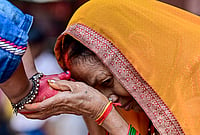
Women voters, nearly half of Bihar’s electorate, were central to Kumar’s political success.
Policies such as liquor prohibition, cash transfers and education schemes helped cement his support among women.
Analysts say the National Democratic Alliance will likely retain women-focused welfare to hold this crucial vote bank.
Three months after taking oath for a record tenth time in November 2025, Nitish Kumar’s decision to step down from the post of Bihar’s chief minister on Thursday morning, has triggered confusion and disappointment among the women voters in Bihar, a constituency that has been central to his political success for nearly two decades.
For most of the last two decades, serving as the chief minister of the state, Kumar cultivated one of the strongest women vote banks in the country through welfare schemes, reservations in government jobs and local bodies, and the controversial but widely supported prohibition on alcohol.
With the Bharatiya Janata Party-led National Democratic Alliance already in power after the 2025 assembly elections, many women say they feel uncertain about what Kumar’s departure will mean for the policies that shaped their lives. Across towns and villages, reactions range from disbelief to concern, particularly among working-class women who credit Kumar’s policies with improving household finances, safety, and educational opportunities for girls.
Kumar, 75, announced in a post on X on Thursday that the new government in the state would have his “full cooperation and guidance,” signalling his decision to step down as the chief minister. The move paves the way for a new chief minister, either from Kumar’s Janata Dal (United) or its coalition partner, the Bharatiya Janata Party. During the Bihar assembly elections, National Democratic Alliance won 202 of the 243 seats, making his decision a significant pause in one of the state’s longest-serving political tenures.


Liquor prohibition and household stability
One of the most widely cited reasons for women’s loyalty to Kumar has been the state’s prohibition policy, introduced in 2016 following sustained demands from women’s groups.
Pragya Singh, a 42-year-old resident of Motihari in East Champaran district, said many women in her community still struggle to process the news of Kumar’s departure. “Many people are still in shock. Some are saying this must be a rumour because they never imagined he would step down suddenly,” she said.
Singh said the prohibition policy, despite criticism over enforcement, brought visible changes in everyday life for women in poorer households.

“When alcohol was banned, a lot of nuisance was reduced,” she said, adding that women felt that the money men earlier spent on drinking started staying within the household. “In many homes, the economic situation became more stable.”
According to Singh, the policy also helped reduce domestic tensions in several families around her, making women feel that their lives were finally becoming “easier” as husbands stopped drinking daily.
Another voter, Sunita Devi from Darbhanga, echoed this sentiment, saying the ban had altered family dynamics. “For women like us, this mattered more than politics.”
While critics have questioned the policy’s effectiveness and pointed to a thriving illicit liquor market, many women continue to view it as a measure taken in response to their demands. “Women had asked for this,” Devi said. “That is why they stood by him.”
Welfare schemes and economic support
Beyond prohibition, Kumar introduced a range of policies that strengthened his appeal among women, particularly those from economically weaker backgrounds.
Bihar has roughly 35 million women voters, accounting for about half of the state’s electorate. In the 2025 assembly elections, women outvoted men by 8.8 percentage points. Election Commission data also shows that there were about 4.4 million more women voters compared with the previous assembly polls in 2020.
Among the most popular initiatives was the ‘Dus Hazari’ scheme, which transferred Rs 10,000 directly to the bank accounts of women from eligible families. The scheme benefited about 27.7 million women across the state. For many households, the cash transfer served as a rare source of financial independence.

“Women started to feel that the government recognised women’s role in the family,” said Riti Singh, a resident of Kishanganj. “Even if the amount was not very large, it helped with daily expenses or children’s needs.”
Singh said the scheme also changed how women were perceived within families. “When money comes directly into a woman’s account, people in the house start taking her more seriously,” she said.
Kumar’s government also expanded women’s participation in governance and employment through several structural reforms. These included 50 per cent reservation for women in Panchayati Raj institutions and 35 per cent reservation for women in government jobs.
The Mukhyamantri Balika Bicycle Yojana, which provided bicycles to school-going girls, and the Mukhyamantri Kanya Utthan Yojana aimed at improving girls’ education and enrollment, were among the initiatives that reshaped opportunities for young women in the state.
Nikita Kumari, a college student from Gaya, said these programmes had a direct impact on girls’ education. “Earlier, many girls would drop out because schools were far and families were hesitant to send them,” she said. “The bicycle scheme made a huge difference. Girls could travel to school on their own.”
Kumari said the government’s focus on girls’ education encouraged families to prioritise schooling.
“When the government talks about girls studying and gives schemes for it, parents start thinking differently,” she said. “It sends a message that daughters’ education matters.”
She added that while political leaders change, young women hope the focus on education will continue.
“For girls like us, education is the only way to move ahead,” she said. “We want whichever government comes to continue these schemes.”
Uncertain future for BJP
With the NDA already in power, Kumar’s exit may not change the political equation immediately. However, some observers believe the alliance will have to carefully manage the expectations of women voters who formed a crucial part of its electoral support.
There are also discussions within political circles that the BJP could consider appointing a woman chief minister in Bihar as a symbolic gesture to consolidate the women vote bank.
Many women, however, say their primary concern is not who leads the government but whether welfare schemes will continue.
“Elections are over and the government is already formed,” said one woman who did not wish to be named. “Now we just want the schemes to keep running.”
Senior journalist Aarti Radhika Jerath told Outlook that the political importance of women voters in Bihar has grown significantly over the past decade, adding that they emerged as “the most decisive voting blocs in Bihar.”

“Nitish Kumar understood this early and built a durable support base through policies that directly addressed women’s concerns.” She added that the BJP would likely seek to retain that support by continuing similar welfare programmes.
“Even if leadership changes, the political incentive to keep women-focused schemes alive remains very strong,” she said. “The BJP knows that this constituency has the potential to determine electoral outcomes.”
At the same time, Jerath noted that sustaining such welfare initiatives could become financially challenging. “Funding large-scale cash transfer schemes and social programmes will be a major challenge, particularly at a time when governments are dealing with economic pressures and global instability,” she said.
Despite the uncertainty surrounding Kumar’s departure, many women voters say their immediate reaction is still one of disbelief. “For years we saw him as the leader who listened to women,” Singh said. “That is why people are finding it hard to accept that he may not continue.”