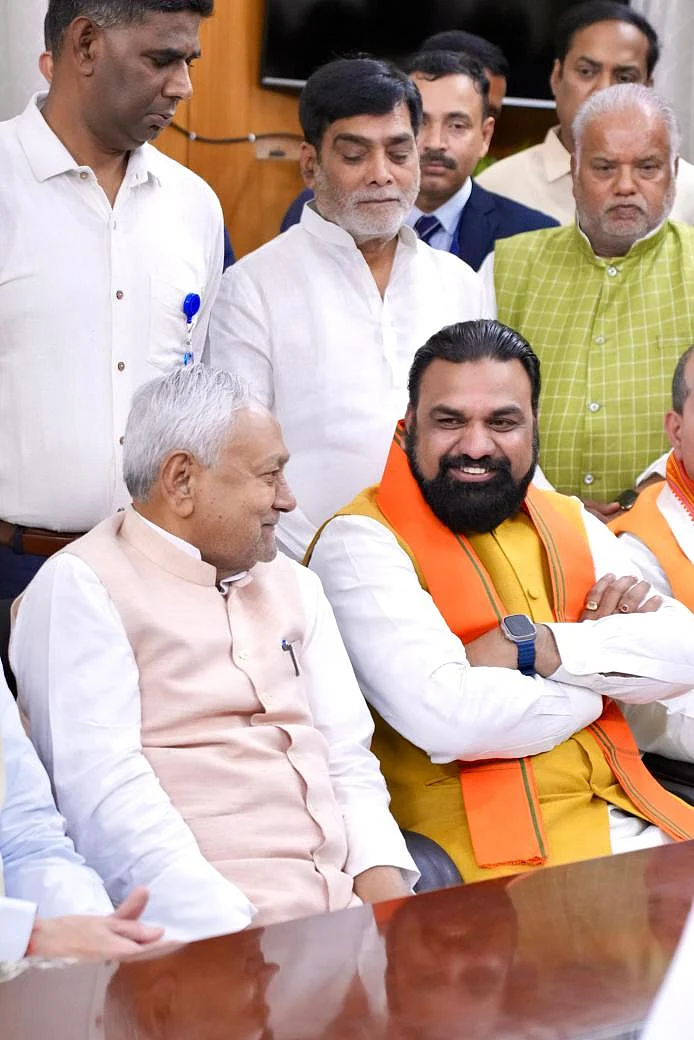
Bihar’s Deputy Chief Minister Samrat Choudhary is being seen as the strongest contender because of his active role both in the party organisation and in the government
Choudhary belongs to the Kushwaha (Koiri, Kurmi, Dhanuk) community, which is believed to make up around ten per cent of Bihar’s population.
Union Minister of State for Home Affairs Nityanand Rai is also a strong contender for the top post in Bihar
After Nitish Kumar filed his nomination for the Rajya Sabha, the change in leadership in Bihar has almost been confirmed. Although Nitish Kumar described the decision to go to the Rajya Sabha as one taken out of his own judgment in a post on social media, political circles believe that his exit plan has been scripted by Modi and Shah.
In any case, while Bihar’s politics has seen several changes in power over the years, this will be the first leadership change in the last two decades. In simple terms, the long-standing political ambition of the BJP now seems close to being fulfilled. That means that after coming into existence, the BJP may finally see its first Chief Minister in Bihar — the second largest political state in the Hindi belt — after nearly five decades. Now that this picture is becoming clear, efforts have intensified to decide the next one: who from the BJP will take charge of Bihar.


Among the faces being considered as contenders from the BJP are Samrat Choudhary, Vijay Kumar Sinha, Nityanand Rai, Mangal Pandey, Dilip Jaiswal and Giriraj Singh.
However, Bihar’s Deputy Chief Minister Samrat Choudhary is being seen as the strongest contender because of his active role both in the party organisation and in the government. The second name that is being discussed prominently is Union Minister of State for Home Affairs Nityanand Rai.
Both Samrat Choudhary and Nityanand Rai are considered strong contenders, partly because they have a solid social base in Bihar. Choudhary belongs to the Kushwaha (Koiri, Kurmi, Dhanuk) community, which is believed to make up around ten per cent of Bihar’s population. Nityanand Rai, on the other hand, comes from the Yadav community, which has roughly a fourteen per cent share in the state’s population. These two communities have had a strong influence on Bihar’s politics. For nearly 35 years, power in the state has revolved around these social groups, first through Yadav politics during the Lalu–Rabri era and later through Nitish Kumar’s “Lav-Kush” political equation.
In terms of political experience as well, both leaders are strong. Samrat Choudhary has served as an MLA, a minister and now as Deputy Chief Minister. Nityanand Rai was a four-time MLA before becoming a Member of Parliament from Ujiarpur and is currently serving as Minister of State for Home Affairs at the Centre. An important point is that both have also served as the state president of the BJP in Bihar, which indicates their hold within the organisation and their political acceptability.
Senior journalist Manikant Thakur, who has observed Bihar’s politics for nearly fifty years, considers Choudhary to be the stronger contender between the two.
Manikant Thakur says, “Samrat Choudhary has been promoted a lot in the last few years. If you look back, when Nitish Kumar was running the government with the RJD, Samrat Choudhary was made Leader of the Opposition and given a big responsibility. Later, when Nitish returned to the BJP alliance, Samrat Choudhary was made Deputy Chief Minister in the previous government. In the current government, apart from being Deputy Chief Minister, he has also been given the important portfolio of Home Minister. In other words, he has been placed second only to Nitish. I say this also because Samrat Choudhary has remained closer to Nitish Kumar. That is why the transition after 22 years of leadership is being managed smoothly.”
Manikant Thakur believes that Samrat Choudhary has had closer working relations with Nitish Kumar and there have been no serious disagreements between them. Somewhere, Nitish Kumar himself may have been comfortable with Samrat’s face as the BJP’s choice for Chief Minister after him.
There are also arguments being made in favour of Nityanand Rai. For instance, he is considered close to Amit Shah. Apart from that, Nityanand Rai is counted among the BJP leaders in Bihar whose political journey began with the student organisation ABVP. He was elected MLA from Hajipur four times between 2000 and 2010. Later, in 2014, he became a Lok Sabha MP from Ujiarpur and won again in 2019. From 2016 to 2019, he also served as the state president of the BJP in Bihar. Currently, he is Minister of State for Home Affairs in the central government, and the BJP sees him as its prominent Yadav face in Bihar.
Samrat Choudhary’s political journey, on the other hand, began with the RJD and later moved through the JD(U) before reaching the BJP. He was first elected MLA from Parbatta in 2000 and also served as a minister in the Rabri Devi government. Later, he joined the JD(U) in 2010 and again became an MLA. However, in 2018, he left the JD(U) and joined the BJP. After joining the BJP, he rose rapidly, first becoming a minister, then the BJP’s state president in Bihar in 2023, and in 2024, he was made Deputy Chief Minister. His father, Shakuni Choudhary, was also a prominent leader in Bihar politics and worked closely with Nitish Kumar for many years.
Journalist Vivekanand Singh Kushwaha says about this that Shakuni Choudhary was a major leader within his community and worked with Nitish Kumar during the Samata Party days. His son Samrat Choudhary was also among those leaders who were part of the Samata Party movement that worked to make Nitish Kumar the Chief Minister, and during that period, he even faced police lathi charges.
Vivekanand Singh Kushwaha considers Samrat Choudhary a stronger contender than Nityanand Rai, also because, from the perspective of caste equations, the Lav-Kush combination has been more beneficial for the BJP compared to the Yadav factor.
Vivekanand further says, “Nitish Kumar’s strongest social base has been the Lav-Kush combination — Kurmi and Kushwaha. Today, the strongest leader among the Yadavs is still Lalu, and his party remains dominant there. Even today, Nityanand Rai may not be able to shift even two per cent of the Yadav vote towards the BJP out of the community’s fourteen per cent population. On the other hand, the way the BJP has projected Samrat Choudhary has brought a large section of the Kushwaha community towards the party. Therefore, keeping future politics in mind, the BJP would not want to take the risk of sidelining Samrat Choudhary. Instead, by making him Chief Minister, the BJP may want to tap into Nitish Kumar’s Lav-Kush equation.”
This time 26 MLAs from the Kushwaha community have been elected to the Bihar Assembly, which is three more than the last time. Out of these 26, around 20 have won on NDA tickets.
Another question is whether, apart from these caste equations, the BJP might appoint a Chief Minister from the upper castes, as it has done in some other states. According to sources, that possibility also exists. It is also possible that instead of the big names currently being discussed, the party may bring forward a face from the EBC category. Among such names, Rama Nishad or Rajbhushan Choudhary from the Nishad community could emerge. At the same time, while playing the “upper caste angle,” the BJP could also make a Brahmin MLA the Chief Minister.
Political analyst Ashish Ranjan says that if the change in power and leadership is happening through coordination between the top leadership of the JD(U) and the BJP, then the BJP will naturally be in the leading position. However, he also believes that the Chief Minister will definitely come from the OBC leadership.
Ashish Ranjan says, “In my view, the BJP would not want to take the risk of making someone from the upper castes the Chief Minister. The big names are Samrat Choudhary and Nityanand Rai. Since Nityanand Rai is considered close to Amit Shah, it is possible that the BJP may make him Chief Minister to satisfy the Yadav community. But at the same time, it is also possible that other EBC groups may feel dissatisfied with a Yadav face. So it is difficult to say which OBC leader the party may choose.”
Ashish Ranjan also believes that if such a transition of power and leadership takes place, it will become very important for Nitish Kumar’s son Nishant, to enter Bihar politics for the JD(U).
He says, “I believe Nishant will enter politics and may be made Deputy Chief Minister. Because if Nishant does not come in, then it can be said for now that the JD(U) may break apart.”
Manikant Thakur believes that in the new arrangement, it is quite possible that Samrat Choudhary becomes Chief Minister, Nishant becomes Deputy Chief Minister, and Vijay Kumar Sinha continues as Deputy Chief Minister as before. He says the BJP will likely keep at least one leader from the upper castes in the Deputy Chief Minister’s position.
Manikant Thakur says, “The final lines of Nitish Kumar’s political career are now being written in Bihar’s politics. The end of such a long political journey of two decades in power does not appear pleasant to me. For Nitish, this seems to be a tragic phase, arising from the compulsions created by his declining health. As his mental condition appeared to deteriorate over time, the BJP found its biggest opportunity to make its move.”