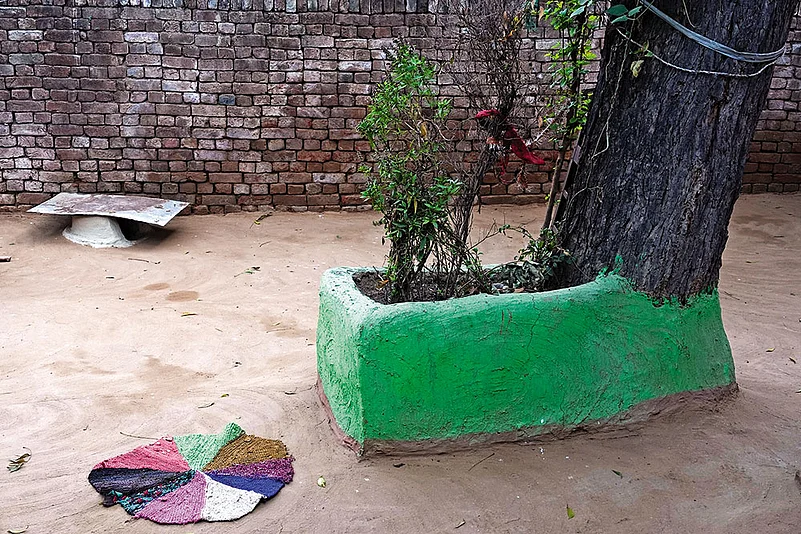
The tulsi plant is still alive.
Every morning in Bool Garhi village, a grandmother waters it with the same deliberate care she brings to prayer. Her granddaughter planted it. She was the one who loved growing things and who dreamed of the city. She was also the one who was burned by the police at 2:30 am five years ago. The plant is the only grief the grandmother permits herself in public.
Everything else, the loss, the litigation, the security escorts and the men with cameras, has been absorbed into survival.
At the lane’s entrance, Central Reserve Police Force (CRPF) personnel sit on plastic chairs beneath a tin shade. They have been there for five years. When the father tends fields somewhere nearby, where his daughter was found, two uniformed men accompany him.
When the brother goes to court, armed men follow. “Hum apne hi ghar mein qaidi ki tarah reh rahe hain (We live like prisoners in our own home),” he says quietly.
Inside, a photograph hangs on the wall. The mother looks at it for a long time. “We are still waiting for justice,” she finally says.
The brother’s phone contains a curated archive of media coverage of the case from October 2020. He scrolls through it with disbelief. “They turned her life into a story of doubt,” he says. “But it is not true. Why did they say such things?”




Visiting journalists asked the family if their daughter liked shopping, if she spoke to boys, if there was a “love affair”. For the family, she was a girl who had been raped and burned. For the cameras, she was raw material for character interrogation.

She was 19.
On September 14, 2020, she was dragged by her dupatta into a field near Bool Garhi, Hathras, and gang-raped by four men from the dominant Thakur community. She suffered a fractured spine. She gave a dying declaration before a magistrate on September 22, naming all four accused. She died on September 29. At 2:30 am on September 30, police cremated her body without her family’s presence. They claimed consent. The family denies this.
The numbers tell their own story.
In 2020, India recorded 50,291 crimes against Scheduled Castes (SC). Ten Dalit women were raped daily. The national rape conviction rate stood at 27 per cent. For Dalit women, it fell below two per cent. By the end of 2020, over 1.5 lakh rape cases were pending trial across the country.
This backlog ensures that most survivors wait years for verdicts that may never come. She was one of 50,291. She is the one case that the media remade into fiction.
Mainstream media chose the event frame, then abandoned it for something more profitable: conspiracy, character interrogation and narratives shaped by patriarchal assumptions.
On September 30, the day after she died, before her family’s grief had settled, Uttar Pradesh Police announced a finding. The forensic report showed “no semen or semen excretion”, implying rape may not have occurred. This assertion ricocheted across channels, into tickers, into primetime debates.
What disappeared, what was buried in smaller print, was a foundational principle of forensic medicine. Semen detection is time-dependent and days after an assault, it reveals nothing. Experts later corrected this, but the police statement had already travelled.
By October 5, a new narrative had crystallised. Call detail records showed frequent contact between a phone registered in the brother’s name and one of the accused. Major television news channels structured their programming around these records.
Visiting journalists asked the family if their daughter liked shopping, if she spoke to boys, if there was a “love affair”. For the family, she was a girl who had been raped and burned. For the cameras, she was raw material for character interrogation.
They ignored the social reality that in villages, dominant-caste and Dalit families often interact through work, land arrangements and everyday proximity as neighbours. Media coverage turned that familiarity into an argument for consent and put her character on trial.
Republic Bharat declared on air: “Agar isko hum gambhirta se samjhen, yeh rape ya gangrape ka maamla nahin hai (If we take this seriously, it is not a rape case)”. They called the incident a “manohar kahani”, a charming tale, suggesting it was aimed at destabilising the government. A girl’s death had become a political fiction.
Zee News aired ‘Hathras case ki sach katha’, the “true story”, implying all prior reporting was rumour and interrogated her character based on gossip, foregrounding a supposed ‘love angle’ while ignoring her dying declaration.
Times Now ran a “mega exposé” arguing that “the caste angle had been severely dented”, by evidence she knew one accused, as if prior acquaintance negates assault.
News18 alleged a “Hathras-Naxali connection”. Republic Bharat adopted the tagline “Danga gang benaqab (Riot gang unmasked),” transforming grieving family members into agents of civil unrest.
This does not appear haphazard, as media analysts have documented a four-stage pattern in the coverage of assaults on Dalit women: indifference, sensationalism, conspiracy allegations and victim-blaming. TV channel reporters were delayed in their arrival as most were covering the late Sushant Singh Rajput incident. When the cremation footage emerged, and then moved through all four stages in two weeks.
In Dainik Jagran, the framing of the case reveals how the Hindi print media focused on unrest and administration rather than caste violence. The headline ‘Hathras boils after daughter’s death’ foregrounded unrest, casting the village as a site of agitation. The emphasis was not on caste-based sexual violence but on the disturbance that followed. The use of beti invoked emotional familiarity, yet it also domesticated her identity, situating her within a patriarchal moral frame rather than as a rights-bearing individual. In a report, the headline, ‘District Magistrate says the victim’s tongue was not cut’ further illustrates this shift in authority.
Here, the District Magistrate’s denial became the focal point, transforming the violence into a matter of administrative clarification. The victim’s injured body was discussed through the state’s voice, not her own testimony.
What emerged in Bool Garhi was a feedback loop. Before cameras arrived, villagers knew what had happened. The dupatta, the fractured spine, the dying declaration. After the media departed, upper-caste voices began echoing studio language.
But after the cameras arrived and left, something had shifted. Upper-caste voices in the village began echoing studio language. “It was not something that big that we couldn’t have handled or suggesting it could have been handled quietly,” said one Naresh, who was standing near the school with a group of upper-caste men who spoke with contempt.
These formulations were not spontaneous. They mirrored what had been said, night after night, in primetime debates. The coverage did not merely report village attitudes. It circulated back into the village and reinforced them. Studio doubt became local certainty and local prejudice returned to the studio as evidence. The feedback loop was visible and consequential.
The Hathras case was treated as spectacle and containable. But this choice obscures the apparatus that enables impunity.
On March 2, 2023, a special SC/ST court convicted one of the four accused, Sandeep Singh, under Section 304 (culpable homicide, not rape) and the SC/ST Prevention of Atrocities Act. He received life imprisonment. The remaining three were acquitted. No one was convicted of rape.
Media treatment of the acquittals revealed the depth of doubt that had been constructed. The absence of rape convictions was treated as vindication of those who had questioned whether rape had occurred at all.
The family appealed to the Allahabad High Court. That appeal continues. Security personnel still guard the family home. The relocated house promised by the state government has not been delivered. The brother has not stopped scrolling through media archives. The mother continues to look at the photograph. Five years later, the tulsi plant is still alive.
Journalist Kalpana Sharma, the author of The Silence and the Storm: Narratives of Violence Against Women in India, says: “While it’s said that violence against women should not be politicised, it gets importance only when politicised.” She adds: “We, as journalists, are trained to treat violence as an event. But we must understand it as a process which is systemic, structural and part of a large pattern.”
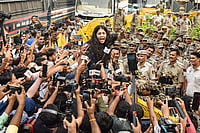
Also, when the case became political, when opposition leaders marched toward Hathras, cameras arrived. But they came to cover the event, not the structural violence. The victim’s testimony became one disputed item in a political argument rather than the central fact demanding investigation. This rewriting of the narrative when it comes to crimes against women and the creation of doubts did not begin in 2020. It has decades of precedent. “Victim-blaming has always been there,” Sharma says. She talks about the 1990s, when a rape occurred at the Tata Institute of Social Sciences in Mumbai. Six men had spiked a woman’s drink and assaulted her. The First Information Report (FIR) was explicit. The evidence was clear, but a leading media house published a headline suggesting, “Why did she go out with six men at that hour?”
The crime was documented, but the headline was about her. To make matters worse, the media outlet published the entire FIR, a clear violation of the law. “But facts must be followed up. The initial fact in Hathras was her dying declaration. Yet media treated it as one disputed claim among many.” Victim-blaming coverage determines whether survivors report shapes witness testimony and influences judicial decisions. When newsrooms prioritise a victim’s character over a perpetrator’s crime, they replicate, across millions of screens, the logic that lets rapists walk free.
Fozia Yasin is a journalist and researcher exploring the stories and lives at the margins. She is senior associate editor with Outlook



This article is part of Outlook's March 11 issue Femme Fatale which looks at how popular media has shaped narratives of violence against women over the years and rewrites the language of male gaze in media which commodifies and condemns the women who make headlines.