Coverage focuses on looks, beauty, motherhood, or “immorality” instead of evidence and law.
Women are judged for both the crime and for violating gender norms, unlike men.
Media either glamorises female accused or softens violence against women by obscuring perpetrators.
It was the “rarest of rare cases”. A first of its kind. It ended up being a spectacle.
In 2011, Neha Verma, a 23-year-old beautician, along with her two accomplices, both men, plotted and executed the murder of three generations of the Deshpande family in a posh locality in Indore, Madhya Pradesh. In 2013, the trial court sentenced the three to death. It was the first time a woman was given capital punishment by the Indore trial court.
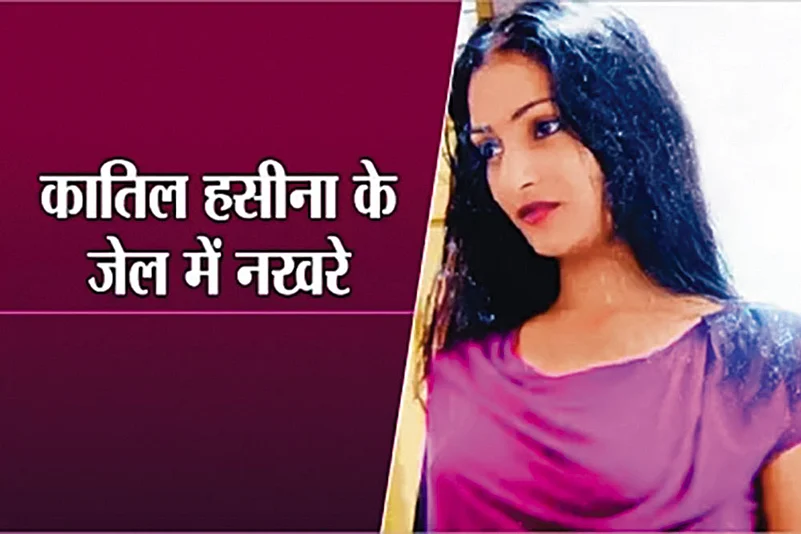
The local media went into overdrive. Follow-up stories focused solely on Verma. The crime was grave, but the coverage was frivolous. Sensational even. A “beautiful woman” had been sentenced to death, after all. Verma did not just become a convict. She became a headline. Not the evidence, not the legal reasoning, not the questions that the Supreme Court would later raise while commuting her sentence to life imprisonment; her “looks” led the story. The fact that a “beautician” had committed a grave crime gave the media a free hand to go overboard.
“Is katil haseena ko mil chuki hai faansi ki saza” (this beautiful damsel is set to be hanged), read a headline in Dainik Bhaskar, the Hindi news daily with the largest circulation in India.


“This extremely beautiful and merely 27-year-old girl is named Neha Verma,” wrote Jansatta, while reporting on her death sentence. In the very next paragraph, the paper added: “Dekhne mein khoobsurat Neha Verma Indore mein beauty parlour mein kaam karti thi” (good-looking Neha Verma worked at a beauty parlour in Indore).
Another outlet, Asianet News, wrote: “Khubsoorat ladki ne crime ke tode saare record” (Beautiful girl broke all the crime records). Television tickers and digital thumbnails used words like Vishkanya (poison maiden).
Her brother, while speaking to the mitigation team of Project 39A, a criminal justice research and legal aid programme at the National Law University Delhi, recalled reporters arriving at their home, consoling them, asking for her photographs, promising that would “help bring her back”. The next day, those images, her personal photos, were splashed across channels and newspapers. “We felt betrayed,” he says. By the time the trial formally began, public opinion had hardened.
Verma’s case reveals a pattern that repeats across Indian media—when women commit crimes, the storytelling often drifts from the act to physical attributes, the morality, and the idea that she has transgressed her expected role, a role assigned to her by society.
The stylisation is not new.
Navbharat Times, part of Bennett, Coleman & Co. Ltd, one of India’s largest and most diversified media conglomerates, with over 180 years of history, ran a series titled “Kaatil Haseena” (Killer Beauty) in 2022.
The series, on October 10, 2022, carried the story of Gauhar Bano, who became famously known as Putli Bai, one of the first recorded female dacoits in Indian history. She was a professional dancer (nautch girl) before turning to a life of crime. The moniker “Putli Bai” was given to her because of her grace and agility while dancing, comparing her movements to those of a puppet. She operated in the Chambal valley during the 1950s, leading a feared gang after being kidnapped by a bandit leader and eventually joining him.
The headline read: “Pehle adaaon se maara phir goliyon se bhoon dala! Pradhan Mantri ko khatt likhne wali Chambal ki sabse khoobsurat daaku” (First she killed with her charms, then riddled them with bullets! The most beautiful bandit of Chambal who wrote a letter to the Prime Minister).
The opening of the story was even more cinematic.
“When her feet danced, hearts would race… slender, kohl-lined eyes, fair face… In Chambal, where only the sound of gunfire echoed, the tinkling of anklets of this extremely beautiful girl filled the air with magic.”
Instead of foregrounding the alleged crime, the report lingered on her appearance—her eyes, her gait, her “charms”. She was framed not as an accused navigating the brutal politics of the Chambal ravines but as a spectacle. The language romanticised her, aestheticised violence and blurred accountability with glamour.
This, unlike other reports, was written by a female reporter.

That’s how most of the coverage related to her has been. She was referred to as “Chambal ki pehli daaku haseena” (Chambal’s first dacoit queen) and was branded a “roop ki rani” (the queen of beauty) as though beauty were the defining detail of her criminality. The repeated emphasis on her looks transformed the story into a fantasy narrative of seduction and danger, reinforcing a familiar media trope— objectification of female criminals.
Similarly, in the coverage of Muheena Begum, accused of orchestrating the murders of her first and second husbands, the headline of Crime Tak, a prominent Indian digital-first news platform and YouTube channel that specialises in crime-related journalism and storytelling, which is also a part of the TV Today Network, referred to her as “kaatil haseena” (murderous damsel).
“Yeh kahani ek khoobsurat Kashmiri mahila ki hai jo behad bholi-bhaali aur masoom dikhti thi… yeh kahani Muheena Begum ki hai jo asal zindagi mein heroine ki bajaye khalnayika bankar zamaane ke saamne aayi.” (This is the story of a beautiful Kashmiri woman who appeared extremely innocent. This is the story of Muheena Begum, who, in real life, emerged before the world not as a heroine, but as a villain).
British criminologist Frances Heidensohn called this reaction “double deviance”. Women who commit crimes are judged not just for violating the law, but for violating gender norms—nurturing, maternal, submissive.
C.P. Shruthi, senior mitigation associate at Project 39A, says this vilification is consistent across female prisoners she has interviewed. “There is always a narrative of ‘How could you, as a mother?’” she explains. “If you are educated and working, that will also be used against you. Anything that deviates from what society defines as ‘ideal womanhood’ becomes ammunition.”

Even mental illness disappears. Shruthi recalls a Telangana case where a woman sentenced to death for killing her seven-month-old child had a documented history of paranoid schizophrenia—hallucinations, delusions, and severe psychiatric distress. “That context vanished,” she says. “What dominated was—‘What kind of mother kills her baby?’”
The archetype overrides complexity.
And then there is the angle of gender that shapes narrative emphasis.
Consider the 2008 Neeraj Grover murder case.
Although naval officer Emile Jerome Mathew admitted to killing Grover, coverage frequently foregrounded Maria Susairaj as the “actress at the centre”, describing an “illicit love triangle”. Headlines labelled it a “crime of passion”. Her modelling photographs were used, amplifying glamour over legal fact.
Similarly, in the 2025 Meghalaya murder case involving Sonam Raghuvanshi, headlines repeatedly stressed “honeymoon bride”, “affair motive”, and “killer wife”.
When a male is accused of committing spousal murder, the vocabulary is often procedural: “Man arrested for killing wife.” The man is rarely stylised into a stereotype. There is no recurring “killer husband” genre.
India recorded nearly 4.5 lakh incidents of crimes against women in 2023, according to data from the National Crime Records Bureau (NCRB). Cruelty by husband or relatives under Section 498A of the Indian Penal Code accounted for the largest share, with 1,33,676 cases and a rate of 19.7 per lakh women. There is, however, no separate NCRB category that records cruelty against husbands.
Public discourse often magnifies the relatively rare cases of women who kill, turning them into spectacles, while the far more widespread violence against women recedes into statistical background noise.

“There is a magnification of the fact that she is a woman,” says Anuradha Bhasin, author and senior journalist, pointing out how women are still framed as symbols of purity and morality. When they are accused of crimes, the narrative often becomes: look at what she, a woman, has done.
If it fits a stereotype—greedy mother-in-law, ambitious wife, immoral girlfriend—it will be amplified.
In March 2025, when Muskan Rastogi was accused of killing her husband in Meerut with her alleged partner, the coverage focussed on the nature of the crime, but the follow-up stories deviated from the reporting structure.
On March 20, 2025, The Times of India ran the headline: “Cried throughout the night, did not eat food: How ‘killer’ Meerut wife Muskan Rastogi spent her first night in prison”.
Hindi digital outlets went further. Dainik Bhaskar ran a video with the caption: “Muskan 5 months pregnant—is the child the husband’s or the lover’s?”
One India Hindi captioned a segment on YouTube: “Meerut: Killed her husband and hid him in a blue drum, married Sahil Shukla and went on honeymoon; now Muskan’s daughter to undergo a DNA test.”
The report did not clarify who raised the demand for a DNA test, where the claim originated, or how it was relevant to the crime she was convicted of, or to the legal merits of her case at all.
The two-month-old video has 646,000 views on YouTube. The thumbnail carried an image, seemingly edited, of Muskan and Sahil holding a baby, dressed in the same clothes they wore on the day of arrest. The suggestion was clear: morality, sexuality, motherhood—all were on trial.
The crime had turned into a morality play.
The distortion operates differently, but no less powerfully, when the crime is against women.

When Bhasin began her career in 1989-90, she says, stories related to women were largely treated as “soft stories” and rarely reported with seriousness.
In Indian headlines, A drift towards The passive voice is common. A rape becomes a “horror”. A murder becomes a “tragic end”. The perpetrator often disappears from the sentence altogether.
She is equally critical of what she calls a “misplaced notion of neutrality and objectivity”, where media outlets feel compelled to platform the “other side” even in cases of gender violence—sometimes at the cost of empathy or evidence.
Reflecting on coverage from Kashmir in the 1990s, Bhasin points to how survivors’ credibility was judged not just by evidence, but by appearance and demeanour. She mentioned how the B.G. Verghese report commissioned by the Press Council of India, looking into the allegations in Kunan Poshpora noted that the women were seen “laughing and smiling”, and used this as a basis to doubt their claims. “To him, any survivor had to be soaked in misery,” she says, describing the reasoning as absurd. The report dismissed the rape allegations as not sufficiently substantiated and was used by the government to justify closing the case. “It’s not always just about clothes. It’s about body language, about how a woman speaks, about the words she uses. The onus is still placed on women,” she adds.
Journalist Jane Gilmore’s four-sentence illustration remains instructive: John beat Mary. Mary was beaten by John. Mary was beaten. Mary is a battered woman. With each shift in phrasing, responsibility subtly moves away from the perpetrator and settles instead on the victim. The grammar does political work; it determines who acts and who is acted upon, who is visible and who recedes.
In Indian headlines, this drift toward the passive voice is common. A rape becomes a “horror”. A murder becomes a “tragic end”. The perpetrator often disappears from the sentence altogether, while the woman is reduced to an identity marker of being a “killer wife”, “mother of two”, “beauty parlour girl.” Language sanitises violence on the one hand and sensationalises the woman on the other.

It’s not just misogyny, but market logic. Crime sells. Gendered crime sells more.
Shruthi sees the patriarchal gaze persisting. “We don’t expect women to be angry or violent or flawed. When they are, it becomes a spectacle.”
The UK-based feminist group Level Up has argued for a different approach to reporting. It calls for accountability by placing responsibility clearly on the abuser, accuracy in naming domestic violence for what it is, dignity in avoiding gratuitous or graphic detail, equality in steering clear of trivialising language, and care in the selection and use of images. Together, these principles suggest that the way a story is written is not incidental, it shapes how violence is understood.
When Verma is introduced as “extremely beautiful”, when Muskan’s pregnancy becomes central, when a dacoit’s anklets are described before her crimes, the message is subtle but powerful—her deviation from femininity is the story.


Mrinalini Dhyani is a senior correspondent at Outlook. She covers governance, health, gender and conflict, with a strong emphasis on lived realities behind policy debates
This article is part of Outlook's March 11 issue Femme Fatal which looks at how popular media has shaped narratives of violence against women over the years and rewrites the language of male gaze in media which commodifies and condemns the women who make headlines.