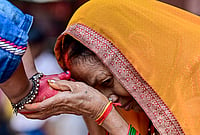
The legend of Phoolan Devi was shaped by media, cinema and politics, often turning a complex life into a simplified myth
From Sheikhpur Gudha to Mirzapur, Outlook’s reporting returned to the places that remember her differently, where pride, pain and controversy still coexist.
Phoolan was a real woman whose life cannot be understood through sanctification alone.
On International Women’s Day , stories of resistance often return to figures who refuse to sit easily inside a single narrative. Few in modern India embody that tension as sharply as Phoolan Devi—remembered variously as a bandit, a caste rebel, a survivor of brutal violence and a political symbol shaped by competing narratives.
In Outlook’s February 26, 2026 issue titled “Femme Fatale”, a special edition examining how media narratives have framed women associated with violence, we revisited the legend of Phoolan Devi. “For Phoolan Who Wasn’t A Devi,” written by Editor Chinki Sinha, strips away the aura of divinity that often surrounds her name. Instead of the mythic figure invoked in popular memory, the essay centres the woman beneath the legend—someone shaped by poverty, humiliation and systemic violence long before she became a national headline. The argument is simple yet stark: goddesses are mythological constructs, but Phoolan was a real woman whose life cannot be understood through sanctification alone.


Another article “Phoolan Devi, Caste Violence And The Burden Of A Manufactured Legend,” written by Zenaira Bakhsh examines how the woman behind the legend has long been refracted through sensationalised media portrayals that oscillate between victimhood and vengeance. Coverage often reduced her to spectacle, lingering on her body, sexuality and notoriety—while erasing the structural realities of caste oppression and gendered violence that shaped her life. Over time, these narratives were reinforced by cinema, literature and political rhetoric, flattening the complexities of the Mallah woman from rural Uttar Pradesh into a consumable myth.
But the figure of Phoolan cannot be understood through a single frame. Over the years, Outlook has repeatedly returned to the landscapes, testimonies and silences that surround her story.

One such return appears in the photographic essay “Phoolan Devi: Memory, Myth, And The Villages Left Behind,” which travels back to the villages that shaped her life. The images and reporting move through Sheikhpur Gudha and Behmai, places where memory survives not as a neat archive but as fragments, stories whispered across generations, memorials that hold both pride and grievance, and landscapes where villagers still negotiate the afterlife of a rebellion against entrenched caste hierarchies.
Earlier reporting by the magazine also explored how her legacy continues to fracture along lines of memory and caste. In “The Many Phoolan Devis of Sheikhpur Gudha,” Outlook’s September 11, 2024 issue titled “Lest We Forget” the story moves into the village where her life began. There, residents offer multiple and sometimes conflicting versions of who she was. For some, she remains a daughter of the soil who defied upper-caste domination and became a symbol of courage. For others, her story remains shadowed by the violence that followed in its wake. The reporting captures how even within one village, memory refuses a single narrative.
Across decades, these pieces also revisit how the media once branded her with the sensational label “Dasyu Sundari”, the glamorous bandit queen who dared to challenge caste power. The phrase simultaneously mythologised and trivialised her, transforming structural violence into spectacle while packaging rebellion as entertainment.
Even decades after her assassination in 2001, debates around her legacy remain unresolved. In places like Mirzapur and Behmai, memories of her life continue to divide communities: some see her as a figure of justice from below, forged in a landscape where institutional protection had failed; others remember her through the crimes attributed to her and the grief those events left behind.
Taken together, Outlook’s reporting across issues, from “Lest We Forget” (September 11, 2024) to the Women’s Day special “Femme Fatale” (February 26, 2026), traces how the life of one woman continues to echo through India’s debates on caste, gender and power. Between the myth and the memory lies a story that still refuses closure.