Baby Punch, a baby macaque rejected at birth, became viral after videos showed him clinging to an orange orangutan plushy toy while trying to fit in.
Internet concern intensified after he was attacked, and later turned to relief when a video showed an adult macaque hugging him.
His story has sparked self-care quote trends and wider conversations about loneliness and belonging.
There is something about Baby Punch that people cannot seem to shake off. A six-month-old macaque, living at the Ichikawa City Zoological and Botanical Gardens, Chiba near Tokyo, has somehow become part of everyone’s daily scroll. On Instagram, his videos appear between recipes, gym routines and political rants. And yet, when he shows up on the screen, people stop.
We all know the story by now. He was rejected by his mother at birth and taken in by humans. Given a plushy toy, an orange orangutan, to cling to for emotional support. That detail matters. It is not just any toy, it is bright, soft, almost comically large against his small frame. He carries it like armour, like a proof that something, at least, is his.
Earlier, when people first found out he had been rejected, there were actual tears in comment sections. Strangers writing that they felt a lump in their throat watching him. Because in the clips, you see him roaming in the compound alone, not hiding, not withdrawn, but just… trying. He walks towards other macaques, slows down, hovers, as though calculating whether this time will be different.


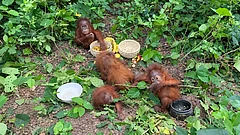

What is it about that image that hits so hard? A small being trying to become “one of them”. When you have never really been able to make friends, what does becoming “one of them” even mean? Is it copying their movements? Sitting near them long enough that you blend in? Pretending you are not holding something soft just to get through the day?
Everyone has their own coping mechanisms. Some of us overwork. Some disappear into our phones. Some keep ourselves permanently distracted so we do not have to sit with what hurts. Baby Punch has an orange orangutan plushy, which he grips before approaching others. He sleeps with it curled under his chin, for him it is less like a toy and more like a lifeline.
Then came the attack, an adult macaque lunged at him. The video spread quickly, and the mood online shifted from sombre grief and concern to anger. People were blaming the zookeepers, asking why he had been left alone, why no one stepped in sooner. There was a protective instinct that felt almost parental. As if the internet had collectively decided that this one small macaque must not be harmed again.
And then, just when the story seemed to be settling into a familiar pattern of concern and worry, a new clip surfaced. Baby Punch being hugged by an adult macaque. He was not brushed aside, not ignored, but hugged and properly held.

The internet has gone bonkers with happiness. Not exaggerated happiness but relief.
People are replaying the video, slowing it down, zooming in on the moment of contact. Comment sections filled with relief. “He’s finally accepted.” “He’s not alone anymore.” It is striking how much hope has been pinned on that embrace. As though a single hug could rewrite everything that came before.
But maybe that is the point. In a world where so many people admit to feeling lonely, even when surrounded by others — watching someone who has struggled to belong finally being held feels like a small victory, it is not dramatic, it is not cinematic. Just contact.
What has also been interesting is how Baby Punch’s images have travelled beyond simple updates. People have started making self-care quote posts using his pictures. There he is, clutching his orange orangutan, and across the frame are the words: “It is up to me to care for my pain.” Or: “Nevertheless I remain tender.” Another one reads: “Taking moments to rest and experience joy because they are radical acts of resistance.”
It would be easy to dismiss all of this as just another internet cycle. The timeline latches on, turns a face into a feeling, makes a template out of it, then waits for the next one. Before Baby Punch, there was the so-called nihilist penguin, a clip people captioned with jokes about dread and emotional numbness. The internet has always found animals to hold its moods.
That is often what makes such videos go viral. They are wordless and open to interpretation. An animal cannot correct you, a blank stair becomes despair, a pause becomes loneliness. Add a backstory, rejected at birth, raised by humans, and people fill in the rest. It is simple, emotional, and easy to share.
The relation between the penguin and Baby Punch lies in projection. The penguin stood in for detachment, a kind of “nothing matters” humour. Baby Punch, clutching his orange orangutan, represents something else: wanting to belong, trying again.

People are not just sharing a monkey video. They are attaching their own quiet confessions to it. Rejected once, maybe more than once, still trying, still tender.
There is something painfully familiar about watching him hover at the edge of a group. Many of us know that stance. The slight pause before entering a conversation. The internal calculation: do I fit here? Will this work? How much of myself do I have to edit to be accepted?
Baby Punch, raised by humans, learning to navigate macaque society, stands in for anyone who has ever felt out of step with the room. His plushy becomes symbolic not because it is dramatic, but because it is ordinary. We all hold on to something, be it a routine, a person or a belief. Something that steadies us while we attempt connection again.
The hug does not erase the earlier rejection. It does not undo the attack. But it complicates the narrative. It suggests that belonging might not be a permanent state denied to you forever. Sometimes it is gradual. Sometimes it comes after you have already decided you will have to manage on your own.
Why are millions so concerned for his safety back at the zoo? Why does his daily life feel like a shared storyline? Perhaps because in following him, people are following a question that sits uncomfortably close to home: if I keep trying, will I eventually be held too?
Baby Punch is still a small macaque in an enclosure near Tokyo. He still carries his orange orangutan. But now there is an image of him being hugged. And for many watching through a screen, that is enough to feel, at least for a moment, that tenderness survives.