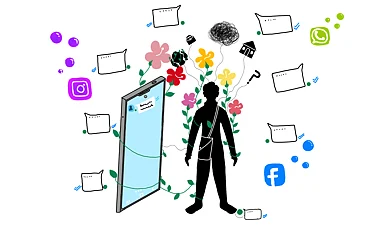
Memes are collective creations that build group identity, spread ideologies, and even fuel protests and political movements.
Most memes follow a predictable lifecycle: birth in niche communities, viral spread, mutation, and eventual death through corporate and authoritarian appropriation.
Despite their short life, memes act as modern soft power – capable of shaping collective consciousness and potentially driving social change
Long gone are the times when our mornings used to start with newspapers and coffee; now we wake up, frantically search for our phone and scroll our minds away. Amidst news about ongoing genocides and videos of people dancing, we scroll past a meme and share it with a friend, without giving it much of a thought. Oftentimes, we even get to know about important world events through memes. Memes thus have the power to simultaneously make us laugh and think.
Memes are also collectivist in nature; even if they were created by an individual, it is the collective hive mind of the internet which adds value to them. The masses make the memes; they give meaning to them. The meaning of a meme changes according to the beholder, new meanings are ascribed, with multiple layers added, sometimes context worth years is needed to understand a single meme, ‘elite ball knowledge’ to be precise. And over the years, somewhere in this game of Chinese telephone, the original meaning of the meme might get lost, and it might end up representing the exact opposite of its initial intent.



Memes thus hold stories, memories, and histories. The role of memes in the internet ecosystem is more than just to make people laugh. Since they are formed through collective efforts, they play a huge role in bonding and constructing group identity, and they eventually become an identity signifier. The memes that we like, post, and reshare become a part of our identity; they define our ideology and personality. Subcultures, communities and even political movements such as the Nepal Gen Z protest and the Myanmar Military Coup have been built on memes.

The Origins
If we go back to search the etymology of ‘meme’, it reveals an interesting story. Coined in 1976 by Richard Dawkins, an evolutionary biologist, the word originally meant to describe how cultural ideas are passed down through generations. In the book The Selfish Gene, meme is used to describe a unit of cultural information, such as tunes, catchphrases, or fashion that spreads from brain to brain through imitation, analogous to how genes replicate.
The word eventually entered cultural lingo and, with the rise of the internet, mutated into something else altogether.
Memes are a currency in this digital world, and like every commodity in this capitalistic world, memes also have market value. They are also widely gate-kept, and algorithmic visibility diminishes their value. The lifecycle of a meme is short, but eventful. A meme is born out of an ‘incident’. It doesn't necessarily have to be funny; the internet will make it funny.
The birthplace of memes has changed as social media platforms have come and gone. Back in the early early 2010s, memes were born in platforms such as tumblr, reddit and 4chan. Each of these platforms had their own signature styles and it was reflected in the memes they produced. As Tumblr was for girls and gays, the memes which had their origin in the platform were woke and progressive, depending on the subculture they belonged to. Reddit, on the other hand, is famous for its incel user base, which had memes of another kind, ‘dark humour’ as they call it. Facebook also, in its heyday, hosted meme page circuits. Nowadays, X, Tiktok and Instagram are places where memes are born.
After a meme is born, it quickly gains popularity among the early birds, the doom scrollers, the chronically online crowd. As the meme breaks rounds through these circuits, it gets even more popular and eventually enters the mainstream internet, where it is received by a wider audience. The meme undergoes mutation here, as this set of audience also ascribes their own meaning to it. The mutated memes might give rise to another set of memes and are often combined with previously existing memes to create even more absurd ones.
After becoming part of a wider consciousness and going viral, the meme enters the final stages of its life. The meme is reshared by social media handles of corporations; the underpaid interns have earned their paychecks. This corporate version of the meme almost drains the life out of it, and then the final nail in the coffin is struck: a billionaire CEO, or a fascist dictator, posts their version of the meme.
Thus, after a two-week life span, the meme ends up in the graveyard of the internet- YouTube Shorts. From here, there is no coming back. Maybe a few people will think of it, maybe the phrase resurfaces years later, like the ongoing 2016 meme reset, but the life of a meme as we know, has ended now.
How Memes Actually Die
What causes the death of a meme? As mentioned earlier, memes are a product of our collective consciousness. When multi-million dollar corporations and fascists appropriate them to further their agenda, this collective identity of the meme is erased. Its context and history (even if short-lived) are quickly rewritten to suit the capitalist world order. Alienated from the masses, the meme loses its charm and relatability, things which made it work in the first place. The meme at that moment is used as a marketing gimmick, to gain views, to sell products, it is a tool to dehumanise, and manufacture consent. The communitarian ethos that was inbuilt in the meme and the collective security it provided the group is now gone, and instead, these communities now become the butt of the joke. This is especially true for phrases that have in recent years dominated the GenZ lingo, since most of them have origins in the African-American culture. The tables have turned, the grave has been dug.
A recent example of this phenomenon was the nihilist penguin meme. The meme, which was born out of a resurfaced clip from a 2007 documentary, ‘Encounters At The End of the World’, directed by German filmmaker Werner Herzog. The clip featured an Adelie penguin walking away from its colony, the behaviour experts couldn't explain the reason. The internet was quick, while some interpreted the penguin as going on a suicide mission, others imagined it as the penguin embarking upon a journey to find its life's purpose. People all over the world saw themselves in the penguin, and sympathised with its misery.

Soon, the meme was then posted by the White House with a picture of Donald Trump walking along with the penguin to Greenland. Apart from the factual error that there are no penguins in the North Pole, a meme which was loved by millions was used to fuel hatred and the narrative of neocolonialism. The same rhetoric had been previously used by official handles of the BJP in India to demonise and persecute Muslims.
While it is true that the world shed more tears for a sad penguin than for dead children, in an age where ragebait and hate speech thrive, moments of collective grief are rare and offer a glimmer of hope. Marx did not account for the power of memes on the collective consciousness of the masses. But memes in this internet age are a form of soft power. They have the power to start and end wars. And they could be a potential weapon for the proletariat.
We see memes as posters in protests, even though corny and sometimes tone deaf, they can grab people’s attention, and bring on much-needed visibility. A deeply lonely generation that spends most of its time locking eyes with a screen can use them to build a better tomorrow. But before they maximise doom scrolling to bring on the revolution, they need to touch some grass.