A JNU student leader recounts her arrest during a protest and the violence and humiliation that followed before she was taken to Tihar Jail.
Inside the women’s ward, she encounters the everyday realities of incarceration and the unexpected solidarity of fellow detainees.
The experience raises deeper questions about justice in India, where class, caste and vulnerability often shape who ends up in prison.
Until that night, my knowledge of Tihar Jail came only from films. In my imagination it was always the same: a dark dungeon with no light, the stench of no freedom, and a plate with just enough food to keep one alive. In the early hours of February 27, at Kapashera Police Station the police officers informed us of our arrest. I tried to conjure a more hopeful picture of what lay ahead, but to no avail.
After a night in police detention, we were taken to Patiala House Court. I slipped on my right shoe and pulled up my left sock, as if it could make up for the missing shoe I had lost outside the JNU main gate, when police officers dragged me on all fours to a police van.
To explain how we arrived there, I must go back to February 2.
On February 3, the JNU Students’ Union, of which I am an office-bearer, called for a Mashaal Juloos (torchlight march) demanding UGC Equity Regulations and the Rohith Act. On the night of 2 February 2026, well after office hours, we received an unexpected email from the Chief Proctor’s Office. The email declared that the four union office-bearers and the former JNUSU president were rusticated for two semesters and barred from campus over a protest against surveillance in the university library.


In a campus like JNU, with its long history of struggle and protest, it was easy to join the dots. A JNUSU march demanding stronger regulations to address caste-based discrimination had clearly unsettled the administration enough to rusticate all of us, the elected students’ union itself.
Any lingering doubt was dispelled weeks later by the casteist and Brahmanical remarks our Vice-Chancellor made on a podcast. The attack was not merely on us or on the union. It was on the very idea of equity. If Babasaheb Ambedkar called on us to Educate, Agitate and Organise, the Vice-Chancellor did the opposite.
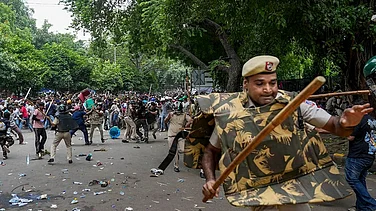
On February 26, JNUSU called for a ‘Long March’ to the Union Ministry of Education office. When more than a 1,000 students reached the main gate of JNU, Delhi Police was waiting. Barricades, locks, chains and heavy police deployment could not stop us. We marched on, carrying the portrait of Babasaheb.
That day they dealt with us not as police officers, but as the casteist and misogynist men in police uniform. First they deliberately broke the portrait of Ambedkar we were carrying. Then they unleashed their brute force. Male police personnel assaulted and dragged protesting women, including me, into detention vans to be taken to Kapashera police station. People often say that the process itself becomes the punishment. In our case too, the humiliating, fear-inducing and inhumane process was the punishment imposed on us.
The next day we were brought to Patiala House Court and soon we were taken for a series of torturous Medico-Legal Case (MLC), which were botched, mistaken and had to be repeated. For almost an entire day, not a morsel had passed our lips. The only thing we had was a bottle of juice our comrades managed to bring us inside Patiala House Court. By the time we reached the gates of the women’s prison in Tihar Jail, we were so drained that all we wanted was a small space on the floor, a sheet, anywhere to lie down and close our eyes.
I could hear my heartbeats echo as I took my first step inside the prison. Images flashed through my mind. Some were imagined, others feared. I thought of JNU, my comrades, my family, my sister and father consoling my crying mother, and again of JNU, my campus, my home. Two portraits hung at the entrance to the prison, one of Ambedkar and the other of Bhagat Singh.
“Khade ho! Yaha baithna allowed nahi hai! (Stand up. You are not allowed to sit here.)” a tall, intimidating policeman shouted. Lost in our thoughts, our exhausted bodies had already sunk onto the cold floor. Even that, it seemed, was forbidden. Crossing our arms was prohibited. Laughing too loudly was prohibited. Leaning against the wall was prohibited.
One by one we were called to the medical officer. Every inch of our bodies was scrutinised. We were then pushed into a dingy corner room where, in front of a female police officer, we were stripped naked and ordered to squat.
Such rituals of humiliation produce the docile bodies the prison system demands, bodies trained to comply with the feudal practices that govern life inside. At the desks of Delhi Prisons officers, the moment they learnt we were JNU students, we were met with smirks and open disdain.

“What were you protesting and sloganeering about now? Don’t you have anything to study?” They made it sound routine. Students protest, get arrested, and are sent to Tihar Jail to be taught a lesson. A lesson in compliance. A lesson in silence.
As we entered Ward No. 8, cheers and laughter rose from the barracks. Women stretched their hands out through the bars and called out to us. We were unsure how to react. Were they mocking us? Would they harm us? How were we supposed to survive among people we had been taught to see as criminals?
We were taken to Barrack No. 2. A policewoman handed us three or four sheets. In whatever small space we could find, we spread them on the floor and fell asleep without speaking much to the fifteen or so women inside.
The next morning I woke up but remained under my blanket. I could not gather the courage to face the reality of being a detainee inside Tihar Jail. When it became impossible to stay there any longer, I slowly got up.
“Bachon utth jao, bachoon (Wake up, children),” an elderly woman called out to us.
From that moment on, it was the quiet sisterhood of the women in Ward No. 8 that carried us through. They asked how we had ended up in Tihar. When they learnt that we had been beaten by the police for protesting, they responded with empathy and reassurance. In whatever small ways they could, they stood by us.
They shared what little they had. A little sugar. A little coffee. Shampoo, bhujia (a savoury snack), toffees, and above all, warmth.
They shared whatever little they could buy from the jail canteen. One woman worked as a gardener for a wealthy family. When her eighteen-year-old son was picked up for questioning over an alleged theft, she fled to her sister-in-law’s house in fear. The police later claimed to have recovered the stolen jewellery there and sent both women to Tihar.
Another woman landed in jail because her uncle used her social media account to scam people. A young entrepreneur who ran a talent hunt business for schoolchildren was imprisoned after her business suffered losses and she could not pay her employees’ salaries. Several other mothers and wives were there for crimes committed by their sons or husbands.
These women were not hardened criminals. Many were victims of a broken system, without the means to hire a lawyer for bail. It made me question the very meaning of ‘political prisoners’. In a system where class, caste and religion shape who ends up in jail, is there really such a thing as a non-political prisoner?
Those days in Tihar made it impossible to ignore how the prison system reproduces the inequalities of the outside world. Rather than reforming people, it often magnifies existing prejudices.
One day a government advocate visited the ward with prison officials. We were made to sit on the floor and explain our cases. His response to almost every woman was the same: “Bail mil jayega (You will get bail).”
When women from poorer backgrounds spoke about the difficulty of securing bail or legal help, he simply repeated the line, offering no guidance. The visit felt more like an obligation on his part. As if to test our patience, he told one woman, “Aapko aaye hue bas do hafta hue hai, bail mil jayega (You have been here only two weeks. You will get bail).”
Being inside made me realise that incarceration in India is rarely just about crime. It is shaped by class, caste and vulnerability. Those few days in jail altered my understanding of justice. It strengthened my conviction that the struggle we were waging outside the prison walls was also a struggle for many of the women inside. Drawing on what they knew of protesting students being jailed, they asked us to sing and raise slogans.
The prison seemed to echo with the songs we sang. Every slogan returned with a chorus of conviction. The women laughed, danced, sang and played. At times they cried quietly in corners, thinking of their families, hoping for bail and release.
On our third day in Tihar, a young woman from Kashmir invited us to her barrack for iftar. At 6 pm, after queuing with our plates for the jail dinner, we went over. With the few resources available, they had prepared a small but generous iftar. A broken plastic plate became a makeshift knife to cut vegetables. A mix of sauces turned into sandwich dressing. Chiwda and bhujia stood in for samosas, alongside the familiar Rooh Afza.
As they broke the fast, duas (prayers) were offered for bail, for the well-being of their children and families, and for the health of all the detainees. As a final dua, our friend, the young Kashmiri woman, prayed for the destruction of our enemies. We chuckled and exchanged glances. Each of us knew exactly which police officers and officials came to mind.
After thanking them for their kindness and hospitality, we returned to our barrack. As the night passed, hope slowly faded. We realised we would not be released that day either. A two-year-old toddler hopped between us and kept us company.
Just as we were about to pull our blankets over our heads, a police officer barged in. “Gopika, Gowri, Aditi, Neha… aapki rihayi ho gayi (you have been released)!”
The barrack erupted with cheers and prayers. The women hugged us, clapped for us and told us never to return. In the same breath, they urged us to keep the fight alive outside, to be their voice and to dream of a better tomorrow for all of us.
As we walked towards freedom, we raised the slogan, “Jail ke tale tootenge (The locks of the jail will be broken)!” From every barrack the women responded, “Saare sathi chhootenge (All our friends will be released)!”
As we passed the portraits of Ambedkar and Bhagat Singh, we wanted to shout “Jai Bhim, Lal Salam”. We held back. Once outside with our colleagues who were waiting with those same portraits, we raised our fists, held our heads high, and cried, “Jai Bhim, Lal Salam”.
Kizhakoot Gopika Babu is a doctoral researcher at the Centre for Law and Governance, Jawaharlal Nehru University, New Delhi. She is the Vice-President of JNU Students’ Union. Their research interests lie at the intersection of political economy, aesthetics, and cultural production, with a particular focus on questions of value, labour, and materiality.