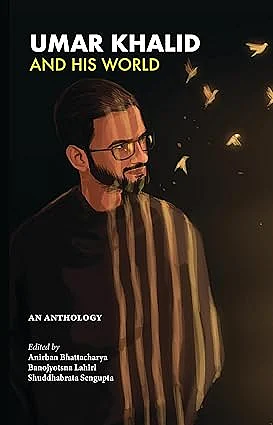
Umar Khalid and His World argues that political imprisonment is not merely a legal outcome but a composite process shaped by administrative routines, semantic shifts, and media narratives.
The book demonstrates how bureaucratic repetition and public vilification consolidate suspicion, normalising prolonged pre-trial incarceration.
It documents prison procedures (such as the mulakat system at Tihar) and examines media amplification around the Delhi riots and anti-CAA protests.
Some books attempt to defend a person. Others attempt to explain an event. Umar Khalid and His World attempts something more exacting: it documents how a political dissenter becomes legible to the state, the media and the public at once. It is neither a biography nor a legal brief. Nor does it read as hagiography, though its sympathies are clear. Its ambition is to assemble an archive of a political moment in which dissent, Muslim identity and protest vocabulary have been reframed within the expanding grammar of criminal law.
The book’s intellectual force lies in its form. By bringing together prison visit accounts, Khalid’s own letters, essays by historians and political thinkers, and analyses of media narratives, the editors construct a layered record of how political incarceration operates today. The anthology suggests—without overstating—that imprisonment in such cases is not only a juridical outcome but a composite product of administrative routine, semantic redefinition and narrative consolidation. The criminal case becomes only one element in a broader ecosystem that renders dissent governable.
The prison visit essays—descriptions of the mulakat system at Tihar—are central to this argument. They are written without melodrama. Visitors queue for appointments, submit identification documents, deposit money into controlled accounts, and surrender belongings for inspection. Conversations take place through reinforced glass, measured in strictly limited minutes. Clothes carried from outside are examined; time is regulated; access is rationed. The tone is observational, almost procedural. The state’s power appears not as spectacle but as repetition.


It is in this restraint that the essays acquire force. The anthology documents what might be called administrative carcerality: the mundane bureaucratic practices through which prolonged pre-trial incarceration becomes normalised. Bail hearings are adjourned; court dates shift; announcements are made; some names are called, others are not. In a constitutional framework where liberty is presumed and detention exceptional, duration itself acquires symbolic weight. The book does not make this claim in declarative terms; it lets routine accumulate into structure.
If the prison narratives map the architecture of confinement, Khalid’s letters provide the volume’s analytic centre. They are not confessional pieces dwelling on personal grievance. They are political reflections written under constraint. Khalid writes about the anti-CAA movement, about the reconfiguration of the “Muslim question” in contemporary India, and about the risks of responding to persecution with isolation rather than solidarity. He returns to Shaheen Bagh and similar protests not as episodes of outrage but as experiments in constitutional assertion, particularly by Muslim women and students who framed dissent in the language of citizenship rather than communal grievance.
One of the recurring concerns in these letters is the vulnerability of political vocabulary. Words, Khalid suggests, are no longer neutral vehicles of argument; they are potential evidentiary fragments. Speech can be excerpted, reframed and inserted into chargesheets. Protest can be redescribed as conspiracy. In this sense, the letters do not simply narrate incarceration; they reflect on the conditions under which speech itself becomes prosecutable. The prison cell becomes a site from which the fragility of language in a polarised environment is examined with unusual clarity.

It is here that Romila Thapar’s intervention assumes particular importance. Her essay situates present controversies within a longer history of semantic transformation. Words such as “azadi” and “inquilab,” once central to anti-colonial mobilisation, now circulate in altered registers. Thapar’s argument is not nostalgic; it is historical. Political vocabulary, she reminds us, is never fixed. But when words foundational to the Republic are recoded as markers of subversion, the struggle is not merely over meaning; it is over who possesses the authority to define the nation’s narrative. The anthology places Khalid’s predicament within this broader contest over language.
Anand Teltumbde extends the analysis into the domain of media and public discourse. His essay examines how vilification can precede adjudication. In the months following the Delhi riots, televised debates, selectively edited footage and speculative commentary often coalesced into narratives of conspiracy well before judicial processes reached conclusion. Teltumbde’s critique is not confined to partisan bias; it interrogates the structural alignment between sensational media cycles and expansive security legislation. In such an environment, reputational damage becomes difficult to disentangle from punishment. The legal process and the public narrative operate simultaneously, each reinforcing the other.
What the anthology ultimately offers is not simply testimony but a diagnostic method. It shows how dissent is rendered administratively manageable and discursively suspect before it is legally adjudicated. Procedure regulates access; vocabulary narrows interpretation; narrative stabilises accusation. Individually, none of these elements determine outcome. Together, they create an environment in which the criminal trial becomes only one stage in a longer process of political containment. By documenting these intersecting layers without rhetorical excess, the book invites readers to examine not merely the fate of one accused individual, but the mechanisms through which a democracy absorbs, categorises and disciplines its critics.
Taken together, these contributions yield a coherent insight: political incarceration today is sustained by intertwined processes. Administrative routines regulate the body; shifting vocabulary narrows the space of legitimate speech; media narratives harden suspicion into common sense. The anthology does not claim that Umar Khalid’s case singularly defines this pattern. Nor does it suggest that dissent has disappeared. Its claim is subtler: the terrain on which dissent operates has shifted, linguistically and institutionally. To understand that shift, one must look beyond court orders to the wider ecology in which they are embedded.

The book’s strengths, however, are accompanied by tensions. The editors’ sympathies are evident, and the volume presumes a degree of scepticism toward the state’s case. There is limited engagement with the prosecution’s narrative except as mediated through critique of media amplification. Readers seeking a detailed legal dissection of the charges will not find it here. This may narrow the circle of those it persuades. Yet it also clarifies the anthology’s intent. It is less concerned with courtroom strategy than with documenting the conditions under which political speech is criminalised and confinement prolonged. There is also the risk inherent in proximity. The anthology is anchored in a specific conjuncture—the anti-CAA protests, the Delhi riots, the subsequent arrests under anti-terror legislation. Its analysis is acute but shaped by immediacy. Whether its insights will endure depends on whether the patterns it identifies—administrative routinisation, semantic drift, media consolidation—prove durable features of Indian political life rather than attributes of a singular moment. Even so, the book’s contribution is unmistakable. It insists that political imprisonment cannot be reduced to a docket number. It must be read as a composite event in which procedure, language and narrative converge. By documenting the choreography of prison visits, the analytic texture of letters written under surveillance, and the shifting meanings of foundational words, the anthology offers more than solidarity. It offers a method for thinking about dissent when legality and discourse are tightly interwoven. For a politically informed readership, the value of Umar Khalid and His World lies not in emotional appeal but in analytic clarity. It slows the frame in an environment prone to instant verdicts. It directs attention to the small, repetitive acts through which exceptional measures become ordinary. And it asks—without rhetorical flourish—what it means to inhabit a republic in which accusation, vocabulary and confinement intersect so closely that the boundary between political disagreement and criminal suspicion grows difficult to trace. The book does not claim to resolve that question. It ensures that the question remains on record.
Sahil Hussain Choudhury is a lawyer and Constitutional Law Researcher based in New Delhi.
His X handle is @SahiHChoudhury and his Instagram handle is voxjuris_ & Linkden.