Fragments from Khalid’s own writings between 2020 and 2026—taken from his speeches, letters and interviews—constitute the core of this volume.
The anthology has poignant pieces from his comrades—Anirban Bhattacharya, Banojyotsna Lahiri and Shuddhabrata Sengupta.
Umar Khalid, Sharjeel Imam as well as several others, were accused of inciting communal hate and violence.
Umar Khalid and His World: An Anthology celebrates Prisoner 626720, incarcerated at Tihar Jail since 2020 under the ruthless Unlawful Activities (Prevention) Act (UAPA), and accused of inciting the Delhi riots of 2020. The charges have not been proved even after six years and after many protracted court hearings. The media, ever-faithful to the powers that be, has, nonetheless, declared him guilty, albeit without a shred of evidence. It has also managed to convince a large public of this—no evidence required once again.
The prisoner is otherwise known as Dr. Umar Khalid, budding historian and writer of great promise, a young man seeking social and economic justice, peace and equal citizenship rights. The book is edited by three of his friends and comrades. It is, indeed, a “testament of friendship and an act of solidarity” as the editors say—friendship and love forged, and held fast, under the most trying circumstances imaginable.
Fragments from Khalid’s own writings between 2020 and 2026—taken from his speeches, letters and interviews—constitute the real core of this remarkable volume. Instead of the ‘terrorist’ he is widely perceived to be, they reveal a rather frail young man who reads endless poetry and novels in prison, as well as books on history, politics and world events. He reflects with immense seriousness on the predicament of Indian Muslims, elite as well as marginal, as also about the possibility of a rainbow coalition of religious minorities, Dalits and Adivasis—Indian subalterns coming together to harvest the rights that the Constitution had promised them. He ponders deeply about his own identity, as Muslim and as Leftist. His political analyses and book reviews are full of acute insights—his article on the late Ranajit Guha’s scholarship is probably the most remarkable piece to appear after Guha’s death. The volume includes an article by Ramachandra Guha, a major historian of forests and forest people. Guha evaluates Khalid’s PhD dissertation ('Contesting Claims and Contingencies of Rule: Singhbhum 1800-2000'—Khalid had to fight a court case to get this examined) and admires his contribution to environmental, forest and Adivasi studies. The book also includes a piece by Khalid’s supervisor, Sangeeta Dasgupta.


Khalid muses on what incarceration does to one’s changing sense of time, to one’s perception of nature—glimpsed through the cell bars—to one’s relationship with the world outside. He plays with cats in the cell and misses the birdsong that used to enchant his mornings. He writes tenderly and sensitively about other prisoners—on how he, as a prisoner, experiences changes within himself, as time goes by. It seems to me that his letters are becoming more introspective; they reflect more on the prison realities around him than they did before. He fears he is becoming distanced from the world outside. Six years, after all, is a long time…
A vast and diverse range of contributors have written here about Khalid. Journalists have interviewed him; friends write about meeting him across a closed window and talking to him telephonically—no physical contact is allowed in Indian prison visits. His parents, grieving his absence but steadfast in their approval of what he stands for, write about their son. There is a piece from Sharjeel Imam, another bright PhD scholar from Jawaharlal Nehru University. Imam, too, has spent six years in prison, branded as co-conspirator and fellow anti-national on the basis of "evidence" that confounds reason. Shuddhabrata Sengupta parses the non-evidence to reveal its Kafkaesque bizarreness. Ex-prisoners like Devangana Kalita or scholar-activist Anand Teltumbde, who have shared the same UAPA-dictated fate, write about their prison days. There are voices from the past, too—poems by Father Stan Swamy and G.N. Saibaba, whose prison sentences led to their death. Messages and support have come from iconic historian Romila Thapar and from Zohran Mamdani, Mayor of New York. Most important are the vivid, poignant, loving pieces from his comrades—Anirban Bhattacharya, Banojyotsna Lahiri and Sengupta.

All write with anguish, anger and bitterness about the infinitely-deferred justice. But none writes with hatred—the murderous, visceral, unreasoning, obscene hate speeches that reverberate endlessly these days. Peace and love form an unwavering part of Khalid’s vision: “We will not respond to violence with violence… if they spread hate, we will respond to it by spreading love…”
Before he went to jail, he and Sengupta had planned to read the deep and complex philosophical traditions within Islam that few in this country know about. Along with his comrades, Khalid was developing a very new and a very creative vision of Left politics which would have ample room for love and desire without boundaries. He danced and sang and followed sports. His PhD thesis was waiting to be published as a monograph which would have left its mark on forest and Adivasi studies. His life was full of possibilities until it shrank into the indefinite prison sentence with ridiculously few and brief paroles—convicted murderers and rapists get to enjoy more of them. Prison has taken away physical contact with all those he loves, from the world that he feels so deeply connected to, from the archival resources he needs to turn his dissertation into a book. But it has brought him a deeper maturity and reflexivity. It has not quenched the person he has been.
Why is he in prison? In a riot where Muslim casualties outnumbered the Hindu ones, Khalid, Imam as well as several others, most with Muslim names, were accused of inciting communal hate and violence. The real issue, however, was their involvement with the memorable Shaheen Bagh women’s movement and the anti-Citizenship (Amendment) Act protests of 2020—when young and old, Hindu and Muslim, feminists and women in hijab, sat or walked together, holding the national flag, singing the national song and anthem and reading aloud from the Constitution. They peacefully protested the CAA with the conviction that making citizenship conditional on religious affiliation violates our constitutional provisions. Even the Khilafat-Non-cooperation movement of 1920-21 did not see such an explosion of Hindu-Muslim unity. And that was Khalid’s “crime”. In the eyes of the state, Muslims are to be feared most when they come together with Hindus in friendship, not when they practise violence.

The Rowlatt Act, enacted by the Imperial Legislative Council in 1919, had placed the wartime restrictions on Indian civil liberties on a permanent basis. The upper limit for detaining a person without trial was two years. But the UAPA knows no such limit.
Khalid had cited a line by Bhagat Singh to Apeksha Priyadarshini—“I am such a lunatic that I am free even in jail.” None can take his inner freedom away from him. But he must taste freedom in the world too, along with the others. Let me paraphrase a few lines from a song that German prisoners used to sing in a Nazi prison in wartime:
“…Winter will one day be past
One day you shall cry rejoicing…
Homeland you are mine at last…”
Tanika Sarkar is a retired professor, centre for historical studies, Jawaharlal Nehru University
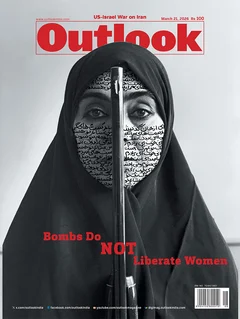




This article is part of Outlook 's March 21 issue Bombs Do Not Liberate Women which looks at the conflict in West Asia following US and Israel’s attacks on Iran leading to the assassination of Ayatollah Ali Khamenei, while the world wondered in loud silence, again, Whose War Is It Anyway?