Human beings' conception of love has evolved over years and is influenced by socio cultural norms.
Relationship styles form a spectrum which ranges from restricted, cis heteronormative monogamy, to relationship anarchy.
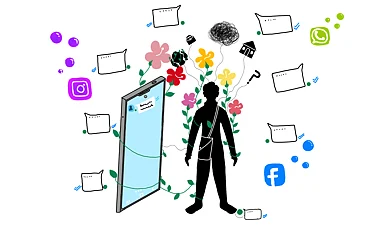
Polyamory in queer relationships is a rebellion against societal constrains on love and sexuality.
In an age where love and sexuality are increasingly commodified and marketed as easily digestible capsules, polyamory and its ‘immorality’ stand out and raise questions about what an ideal relationship is. From childhood, we are told a particular notion of love, by society, movies and books, a story where we find ‘the one’ and live a happily ever after. But love is never that simple. And the greatest love stories have all broken that mould and created sagas of their own. From breaking out of endogamous ideals, where we were confined to love only from the same race/caste, to heteronormative ideals, where love was between people of ‘opposite’ sex, all these social doctrines have been broken by humanity. Then comes the notion of monogamy.
Were human beings always monogamous in nature? Not really. Various non monogamous/ polyandrous/polygamous societies have existed throughout history. And if we go by the book, in his treatise ‘The Origin of the Family, Private Property and the State’, Frederick Engels opined that primitive human societies practised polygamy, and females enjoyed sexual freedom. It was with the origin of the concept of private property that monogamous heterosexual marriages became the norm. In order for the property to pass down to the next generation, it was necessary to control reproduction and thereby female sexuality. He thus ties together the creation of patriarchy and capitalism to private property.


While the theory has had its critics over the years, the feminarchy utopia of Engels’ dream has served as a holy grail for poly people worldwide. Further theorisation linked monogamy with colonialism, and that it was the spread of the latter that erased polyamorous relationships from the stolen lands. Thus, ideologically, polyamory is an essential step towards decolonisation for some. In the age of internet dating advice and TikTok feminism, as hetero fatalism and ideas of ‘having a boyfriend is cringe’, are increasing on one side, in a minute corner, we see polyamory also gaining its audience. ‘Having a boyfriend is conservative’/ ‘spiritually Israel’ goes one side, while the other says nothing is more conservative than not having sex. But if we look behind the jargon of theory, polyamory is just like any other relationship; it just needs more room to function.

The rules of monogamous, heteronormative, patriarchal societies are too rigid and constraining for queer and neurodivergent folks, and the fairytale of the one sometimes doesn't make sense. The definition of polyamory varies from person to person; unlike the societal and cultural guidelines for heterosexual monogamous relationships, there are no specific textbooks for polyamory. For some, it offers a way to have multiple love interests, while for some, multiple intimate partners, even solo poly where you prioritise yourself over other partners, exist.
Relationship styles can roughly fit a spectrum from more to less structural restriction: on one end, we have restricted, toxic cis heteronormative monogamy, and on the other end, there exists relationship anarchy. In this lawless terrain, it is every man for themselves. Personal boundaries define the nature of things that come under the larger umbrella of ethical non-monogamy. The ethical part is underlined in red here. Your cheating partner, who said he’s poly after getting called out, is not poly; he’s just a cheater and liar, best not to include him as a part of this discourse.
Poly folks often define their kind of relationships as not putting all their eggs in a single basket. Different partners in the relationship fulfil different needs, and many argue that this is a key to avoid relationship fatigue. Polyamory in cis-het relationships is entirely different from polyamory in queer relationships. In the former, cis men and their power within the capitalist patriarchal society end up affecting the relationship dynamics. In queer relationships, however, polyamory often is about finding community rather than physical intimacy. These relationships aim to create found families where love and intimacy intertwine, where boundaries and clear communication foster a positive atmosphere for queer people to embrace their sexuality free from societal prejudices. It also provides space for baby queers as newbies to queer dating, an opportunity to explore what works for them. There are many reasons why some queer people choose to be poly, and it is very important to remember that these two terms are not exclusive. There are queer people who follow strict monogamy, and there are cis het people who practice polyamory.
Krishna, a queer student, in her early twenties, says ‘‘I started thinking about polyamory 3 years ago when I was with my ex. I was feeling it's unfair to tie myself to a heterosexual relationship when I'm bi. I brought it up with my ex, but he couldn't agree. We were talking about it ever since, but weren't able to change anything’’. This eventually led to a breakup, and later she tried polyamory with her current partner, ‘‘We decided we won't talk about it to each other unless there is a need to. Not talking about it helped me with not feeling unnecessarily jealous and to not compare myself. It's tough to do with men. It will just be an excuse for them to not be accountable. But with women, I have felt it's liberating’’
Often, people mock poly folks for being greedy; they need all the love in the world, and still, it won't be enough. But if anybody who should be receiving a significant amount of love, it should be queer folks, who are, in most cases, estranged from their family. There are very few circles where they are accepted for their identity, where they can be themselves without fearing for their life, and if they are ethically being a bit greedy in those spaces, who is getting hurt?
Ishita Pradeep, a student at University of Hyderabad says, “To me being polyamorous comes from the belief that romantic relationships don’t deserve a higher position than friendships - just a different kind of relationship. So it makes sense that someone should have different relationships with multiple people instead of striving for one extra special romantic partner.” It is such personal values and rewriting of traditional relationships that makes every poly relationship different. Like snowflakes, each poly relationship is unique with its boundaries and practices.“It's essentially a rebellion against considering relationships and marriage as the ultimate goal in life. I guess once you are a lesbian and already know that you won't be married with a husband, this rebellion becomes easie,” says Ishita.

It is not that intimacy in these spaces is not complicated, like any other relationship; it is. Being poly doesn't mean that you are free from jealousy or that you are open to anything. It is an extremely complicated terrain, where things can go south quickly without proper communication and boundaries, just like any other relationship. Identities of the parties involved are also an important factor, and the power relationships emerging from that also have important repercussions in poly relationships. The faultlines of the society ends up reflecting even in such safe spaces, and one might end up coming out of a poly relationship with more damage. But that is the case in any relationship, it is the risk we take for love.
Is polyamory a recession indicator? Where do poly folks find time and emotional capacity to be with multiple partners, especially in such an extremely energy-draining world? Some polycules operate within a single household, and people who are staying together end up sharing bodies, love and rent. Amidst an increasing housing crisis, these found families are getting it. This fun sitcom as settings essentially serves as a support system, where the financial, physical and emotional needs of partners are met. But living together with multiple partners also adds another layer to the equation, and it might not work for everyone, but a ‘house of love’ is truly a dream indeed.
We live in an extremely lonely world. And for folks who are persecuted for their identities, the world is even lonelier. So sometimes they have to look for love and intimacy in spaces where they are the most comfortable. Some people say that it is more friends that we need, not more partners. Maybe they are right, but navigating friendships when you are fighting for basic survival might not be easy for some people, and relationships where they have control over the situations might ease their worries a bit. So yes, we do need more friends to make the world less lonely, but meanwhile it's okay to kiss your friends on the mouth occasionally (with consent of course).