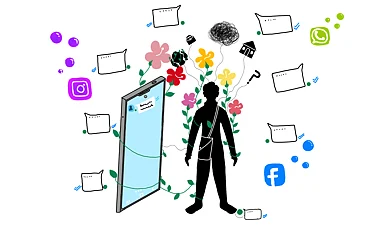
Emotional labour in marriages or relationships is not just related to a partner alone, but it often expands to managing extended families.
Often, men don’t understand that much of women’s emotional labour happens quietly and without recognition.
It includes anticipating moods, cushioning disappointment, timing difficult conversations and absorbing emotional fallout.
“Aurton ko chitka hua aadmi pasand hota hai” (women love broken men).
When stand-up comic Prashasti Singh said this line in one of her gigs, the joke landed, the clip went viral and was widely shared by women cutting across generations. The line clicked because it exposed a form of social conditioning that was ingrained long before modern dating, the one that taught women to see men’s emotional brokenness as a personal responsibility, a project to be completed.
Her joke, however, opened up a larger question: why does emotional growth remain so gendered, even as women’s social and economic roles continue to evolve?
I grew up hearing my mother’s stories about how she fixed my father and how her love, patience, sacrifice, and devotion turned him into a better man. She often spoke with pride about choosing not to leave him, about staying long enough to see him change. Through these stories, I learned to see emotional labour—listening, forgiving, absorbing anger, waiting for transformation, and not as labour at all, but as love. I internalised this deeply. As I grew older, I began to believe that my love could change a man, that fixing him without even realising it had become my purpose.


In her book The Dance of Intimacy, author Harriet Goldhor Lerner writes about how men often feel less compelled to pursue emotional growth within relationships. This attributes the tendency to old social conditioning, which puts the burden of emotional labour on women.

“In my marriage, I was constantly internalising my ex-partner's emotions. Along with managing my own emotions, I was always managing his. In addition, I was also managing his family’s emotions because the way they carried themselves affected me deeply. In effect, I was managing the entire family. Judgements were made based on what I wore, what I cooked, and how I spent my time. It was all encompassing,” says N, 32, a writer based in Madhya Pradesh.
“In terms of mental health, I went through two severe nervous breakdowns that required immediate medical intervention. After the separation, I lost nearly 12 kgs without any conscious effort or workout, and it felt as though my body was shedding the weight of prolonged emotional stress. Friends and family now tell me, somewhat strangely, that I have started to look like my ‘old self’ again,” she adds.
“I don’t want them to understand, honestly. If they haven’t grasped basic humanity by now, they’re not worth the emotional investment. Sometimes, the healthiest response is to recognise low emotional intelligence for what it is and let those people exit your life,” she argues.
N’s experience reflects how emotional labour in marriages or relationships is not just related to a partner alone, but it often expands to managing extended families, social expectations, and constant self-surveillance. And while managing all of these expectations, one rarely finds time for oneself.
“As a 21-year-old, I was still finding the vocabulary to articulate my discomfort around caste within a romantic relationship, even as I was constantly educating him on caste and gender. There were moments when caste-related remarks were made, or underlying biases surfaced, and I learned to sit with that discomfort because addressing it fully felt inconvenient to him because of his exam timeline,” says K, 30

“Over time, I noticed a pattern: I was always the one initiating difficult conversations, including the ones relating to accountability and hurt. What became clearer was how emotional harm was handled. When something he did hurt me, the focus often shifted to his guilt. Instead of my pain being centered, I found myself consoling him for feeling bad about hurting me. That’s when I started to understand that the emotional work was not just unequal, it was inverted. Even in moments where I was the one harmed, I was still managing his emotional response,” says K, talking about how draining it is to manage your partner’s emotions.
“Women are often socialised to believe that love is earned through endurance, patience, and emotional labour. We are taught to see emotional unavailability not as a boundary, but as a project. If we stay long enough, love hard enough, and accommodate enough, the man will eventually heal or change. In my own life, this showed up as a belief that staying was love. This conditioning was reinforced when my over-functioning was praised as my strength or maturity. I was valued for understanding him, but rarely asked whether I was being understood. If something broke emotionally, the responsibility to explain, soften, forgive, and repair always fell on me,” says K while explaining how women are raised to be fixers in romantic relationships.
“Carrying sustained emotional labour had a profound impact on my mental health. I lived in a constant state of hypervigilance, always monitoring moods, timing conversations carefully, and suppressing my own distress to prevent conflict or emotional collapse at his end. This left me chronically anxious and emotionally exhausted. My nervous system rarely felt safe. Perhaps the most damaging effect was how disconnected I became from my own needs. I learned to prioritise someone else’s emotional stability over my own wellbeing,” says K while talking about how emotional unavailability affected her mental health.
Often, men don’t understand that much of women’s emotional labour happens quietly and without recognition. It includes anticipating moods, cushioning disappointment, timing difficult conversations, absorbing emotional fallout, and sustaining connections when things feel uncertain. This work is often framed as care or empathy, but it is still labour, and it comes at a cost.
When this effort is one-sided, it leads to exhaustion, self-doubt, and erosion of self-worth. Emotional labour should not be a substitute for emotional responsibility. Relationships cannot be sustained on one person’s capacity to hold everything together, she added.
K’s experiences tell us that in intimate relationships, conversations around caste are often pushed aside as inconvenient. When men prioritise exams, careers, or stress over confronting bias, the responsibility of both explaining and emotionally managing the issue falls on the shoulders of women. They are doing extra labour, which leads to exhaustion. Her experience reinforces a familiar idea long promoted by popular culture and romantic narratives, which celebrate women who stay, adjust, and endure as symbols of devotion. Emotional endurance is framed as love, while leaving is framed as failure.

Cinema has also played a major part in shaping romantic expectations, and it has been teaching particularly women, what love looks like and what it demands. For decades, films have normalised the idea that a woman’s love can rehabilitate an emotionally unavailable man and fulfill his emotional needs. For Aditya, there is Geet, for Ved, there is Tara, and for Kabir Singh, there is Preeti. These male characters are portrayed as irresponsible, reckless, and emotionally unavailable, until a woman enters their lives and they are transformed into changed men.
“I crossed oceans to be emotionally available for him, giving everything I had, but none of it was returned. Slowly, I came to understand that my efforts were taken for granted, and in the end, I was deceived,” Pragya, 37, a media professional, says.
“I strongly believe that dishonest or manipulative men often evade accountability. When I asked for the bare minimum, he first avoided it under the guise of being busy with ‘professional commitments’. Over time, the avoidance turned into complete withdrawal, and he ultimately chose to walk away,” says Pragya talking about expecting emotional availability, honesty, or consistency from a man in a relationship.
“Gaslighting slowly becomes normal, until you’re made to feel miserable for simply having emotional needs. I was repeatedly told, ‘aap bohot innocent hain, sensitive hain, overthink nahi kiya kariye.’ It was a gentle-sounding sentence, but it worked as a quiet form of emotional snubbing,” she says.
“The trauma left me frozen in shock. To the outside world, I seemed okay, but inside, triggers followed me relentlessly. Each morning felt like a battlefield, I had to push myself to appear fine while quietly falling apart,” she says talking about her mental health. “I believe many Indian women are conditioned to see emotional exhaustion as normal in a relationship, as if not doing enough automatically means you don’t love your partner. Over time, I became the constant giver, an open book. The exhaustion peaked when I realised that respect, trust, and clarity were nowhere to be found. I once believed that giving more would strengthen the bond, but in the process, I completely forgot to prioritise myself. I had mistaken emotional exhaustion for love,” says Pragya talking about how women are expected to keep giving and that becomes exhausting.

The personal stories of women reveal how men often remain emotionally unavailable in intimate relationships. But what makes them so emotionally stunted? Social conditioning plays a major role. Just as women are raised to be the “fixers” in relationships, men are often raised to suppress their emotions and avoid expressing themselves.
Due to social conditioning, boys are often discouraged from expressing emotions. Masculinity is associated with control and restraint, while emotional expression is viewed as feminine. When men reach adulthood, many lack to engage emotionally. For them, intimacy feels threatening, listening feels unfamiliar, and vulnerability feels unsafe. Author Bell Hooks in her book, The Will to Change, demonstrates that male emotional education can be fostered through supportive and emotionally affirming environments. She also challenges the notion that men are inherently disinterested in relational dynamics.
Prashasti Singh’s joke resonated with women because generations of social conditioning taught them to fix emotionally unavailable men. When they failed, they blamed themselves. Her stand-up disrupts this conditioning and questions the status quo. Films trained women to stay, while society allowed men to hold back. Relationships became strained where this imbalance showed up.
Women’s personal experiences show that years of fixing men and meeting their emotional needs have drained them. Now, their cups are empty, and they are demanding change from men and not more effort from themselves.