On May 21, the ministry issued an SOP on Ebola preparedness and response. This was followed by guidelines on hospital infection control, isolation facilities and the safe handling of bodies of Ebola patients.
The government has also advised Indians to avoid non-essential travel to the Democratic Republic of Congo, Uganda and South Sudan until further notice.
Early Ebola symptoms, fever, weakness, headache and body ache, closely resemble dengue, malaria, influenza and COVID-19. In a country where these diseases are common, travel history becomes critical for doctors evaluating patients.
As Ebola cases continue to emerge in parts of Africa, Indian health authorities are insisting there is no reason for panic. But behind the reassurance lies a more complicated question: after COVID-19, how prepared is India’s health system to detect, contain and respond to one of the world’s deadliest viral infections if it reaches the country?
With no approved vaccine available for the rare Bundibugyo strain behind the current outbreak and memories of the COVID-19 pandemic still fresh, the Union government has stepped up surveillance at airports, issued fresh guidelines to states, and placed public-health agencies on alert.
The government maintains that there is no confirmed case of Ebola in India. Yet officials say preparedness measures have been activated nationwide to ensure that any imported case is detected and contained quickly.
"Ebola is serious, but there is no reason to panic," a senior health official told Outlook, adding that authorities are already monitoring the situation "to the maximum possible extent".


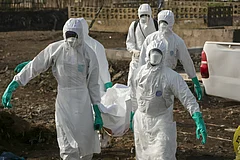

What is Ebola?
Ebola Virus Disease (EVD) is a severe viral infection that spreads through direct contact with infected bodily fluids, including blood, saliva, vomit, urine and stool. Depending on the strain and access to healthcare, fatality rates can range from 25 to 90 percent.
Unlike COVID-19, Ebola does not typically spread before symptoms appear, making it easier to control through isolation and contact tracing. However, once symptoms develop, transmission risk rises sharply.
Dr. Neeraj Nischal, a Professor of Internal Medicine and an Infectious Disease specialist at AIIMS, New Delhi, says Ebola remains a global concern despite being geographically confined to certain African regions.
"In today's interconnected world, an outbreak anywhere can become a threat everywhere," he says, noting that international travel means diseases are often only "one flight away" from crossing continents.

Government activates preparedness measures
The Centre's most detailed response came on May 25th after Union Health Minister Jagat Prakash Nadda reviewed the country's preparedness following the World Health Organization's declaration of the outbreak as a Public Health Emergency of International Concern (PHEIC).
According to the Health Ministry, enhanced surveillance has been initiated at airports and other points of entry. States and Union Territories have been issued standard operating procedures covering traveller screening, quarantine protocols, clinical management, laboratory testing and infection-control measures. The ministry has also directed agencies including the National Centre for Disease Control (NCDC), Indian Council of Medical Research (ICMR), Directorate General of Health Services (DGHS), civil aviation authorities and state governments to maintain readiness for tracking, testing and surveillance.
On May 21, the ministry issued an SOP on Ebola preparedness and response. This was followed by guidelines on hospital infection control, isolation facilities and the safe handling of bodies of Ebola patients. Airport Health Organisations and surveillance teams under the Integrated Disease Surveillance Programme (IDSP) have been instructed to remain vigilant and report suspected cases immediately. The government has also advised Indians to avoid non-essential travel to the Democratic Republic of Congo, Uganda and South Sudan until further notice.
Why are authorities not imposing mandatory quarantine?
Health officials argue that India's approach is guided by scientific evidence and WHO recommendations rather than fear-driven measures. The senior official, also quoted above, said there was currently no justification for mandatory quarantine of all incoming travellers from affected regions.
According to the official, the SOP provides for home monitoring of individuals with suspected exposure. If symptoms develop, they are shifted to isolation and tested. Further action is then taken based on the results. Drawing a distinction from the early days of the COVID-19 pandemic, the official said public-health measures must also remain humane and proportionate.
"We are acting according to WHO guidelines and the SOP framed by us. Everything is under control," the official said.
A rare strain with no approved vaccine
One reason that the current outbreak has drawn global attention is that it involves the Bundibugyo strain of Ebola, one of the rarest forms of the virus. Infectious disease expert and President-Emeritus of the AIDS Society of India and Governing Council member, International AIDS Society, Dr. Ishwar Gilada says this is only the third known outbreak linked to the strain, after previous outbreaks in 2007 and 2012.
He explains that six Ebola virus species have been identified, but only a handful are known to cause disease in humans. Most vaccine development efforts have focused on the Zaire strain, which has historically caused the largest outbreaks. "The vaccines available today are for the Zaire strain, not for Bundibugyo," Gilada said while speaking to Outlook.
As a result, there is currently no approved vaccine specifically targeting the strain involved in the ongoing outbreak. Even so, Gilada emphasised that Ebola's mode of transmission makes it far less likely to trigger a COVID-like pandemic.
Unlike airborne infections, Ebola spreads through close physical contact with infected bodily fluids. Its incubation period ranges from two to 21 days, and infected individuals either recover or die within a relatively short period, limiting opportunities for sustained transmission.
"This is why Ebola outbreaks tend to remain outbreaks and do not become global pandemics like COVID-19," he said.

India's strengths and vulnerabilities
According to Nischal, India has learnt some of its lessons from Covid-19 pandemic leading to stronger disease-surveillance systems, improved laboratory networks, airport-screening mechanisms and greater awareness of infection control.
He said rapid identification of suspected cases would depend on travel history, clinical suspicion and laboratory testing. If a traveller from an affected country develops symptoms and seeks care promptly, Ebola could potentially be identified within hours or days. Contact tracing, he added, remains one of the most effective tools against Ebola because the virus does not spread before symptoms emerge.
The biggest challenge, according to experts, would be preventing delayed diagnosis.
Early Ebola symptoms, fever, weakness, headache and body ache, closely resemble common illnesses such as dengue, malaria, influenza and COVID-19. In a country where these diseases are common, travel history becomes critical for doctors evaluating patients.
India's population density also remains a concern. Gilada warned that any infectious disease entering the world's most populous country carries the potential to spread rapidly if not identified early. He argued that authorities should maintain strict surveillance and continue investing in research, vaccine development and outbreak preparedness.
Experts also see the outbreak as a reminder of a broader public-health challenge: the increasing emergence of diseases that jump from animals to humans. Most new infectious diseases detected over the past few decades have been viral in nature, and most of these are believed to have originated through animal-human transmission. Gilada said the world must pay greater attention to the human-animal-environment interface, arguing that ecological disruption and increasing encroachment into wildlife habitats create opportunities for new pathogens to emerge.
For now, however, India's strategy remains focused on vigilance rather than alarm.