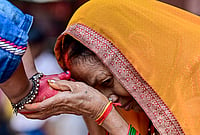
Several domestic helpers in Gurgaon and other cities have gone back home for elections, and this disrupts urban households.
The absence of domestic helpers shows how much cities depend on migrant workers for daily household chores like cleaning, cooking, and childcare.
Workers face uncertainty about identity, voter lists, and documents, while also dealing with low pay and insecure working conditions.
“The past few weeks have been especially difficult for households in Gurgaon,” says Paridhi Singhal, who runs a property advisory firm. As domestic workers return to West Bengal during the election period, many households in Gurgaon are struggling to cope with their sudden absence.
The shortage has disrupted daily routines, leaving families to juggle professional commitments, childcare and household chores without regular support. “There is a severe shortage of domestic workers, particularly those from West Bengal who have gone home during the elections. In cities like ours, everyday life depends heavily on household staff. When that support suddenly disappears, it becomes hard to manage work and family responsibilities. For me, balancing my job with childcare has been particularly demanding.”
She adds that app-based alternatives are either unavailable or charging much higher rates because of increased demand, while the quality of temporary replacements has also been unreliable. “If they are not Indian citizens, then the government’s SIR initiative is justified,” Singhal says. “Even within India, resources are limited, so how can we be expected to provide for others?”


Social media has reflected the growing frustration. Reels posted by women describe what many are calling a “crisis”, as they suddenly find themselves cooking, cleaning and managing their homes alone. Instagram user Himja Parmar shared a song about having to do all the chores herself, saying it represented many women whose domestic workers had returned to West Bengal for the elections. Similar posts continue to circulate online, with one popular caption reading: “Bengal mein election, Gurgaon mein tension.”

At first glance, these videos may seem comic, dramatic or even tone-deaf. Yet behind it lies a deeper story about life in India’s big cities and their heavy reliance on migrant labour.
The absence of domestic workers in places such as Gurgaon and Noida is far from random. Many have returned to their home states, particularly West Bengal, because of the ongoing elections and concerns over voter identity checks. Fears of being struck off electoral rolls during the Special Intensive Revision (SIR) have prompted many to travel back. Their departure has left countless urban households scrambling to manage daily routines without regular support.
For the workers themselves, going home is about far more than casting a vote. It is tied to survival, identity, uncertainty and citizenship. Many say they are increasingly branded as “outsiders”, “Bangladeshis” or “illegal migrants”, often without evidence. The situation raises troubling questions about dignity, belonging and who gets to claim a place in the country they call home.

“I may lose my job in Gurgaon, but I had to go back to cast my vote,” says Zainab, who travelled to West Bengal. “This election feels different. It is about my name on the voter list, access to benefits and my place in the community. I lost wages by returning, but staying away felt worse.”
Another domestic worker, Arjuman Khatun, describes the uncertainty surrounding this year’s election. “I came to Delhi around a year and a half ago because it had become impossible to survive back home in West Bengal,” she says. “There was not enough money for food or basic needs, so I left my village to earn for my children. I now work in four homes doing cleaning jobs to support my family.”
“Recently, there has been a great deal of confusion and fear over voter cards and the elections,” she says. “I went back to vote, as I usually do, but this time it felt different. People in my area said names were being removed from the voter list, while others were asked for several documents to prove their identity. No clear reasons were given. It has created real anxiety, because voting matters to us, and there is a fear that losing your name on the list could mean losing your identity too.”
That unease is not confined to those who returned home. It also follows workers who remain in the cities, shaped by troubling reports from their villages and towns. “We have not faced any direct problems in Delhi,” adds Khatun. “People here have treated us normally and we continue to work. But there is still uncertainty because of what we hear from home. Even so, we keep going, because we have responsibilities, our children depend on us, and survival comes first.”
The absence of workers such as Arjuman Khatun has been sharply felt in urban households.
“The sudden loss of domestic help has been hugely disruptive,” says Muskan, who lives in Gurgaon with her husband and works in advertising. “We both have demanding jobs and depend on outside help for daily chores. When workers leave without notice, everything is thrown off balance.”
She says there is rarely any transition period. “They simply say they will not be coming from the next day, and you are left to manage alone.” After long working hours, cooking, cleaning and running the home becomes exhausting.
Even replacements are not a quick fix. App-based services often have limited availability, and new hires need time to settle in. “For at least a week, you end up doing everything yourself while trying to keep up with work,” she says.
Her experience reflects a wider urban truth: many middle- and upper-income households depend heavily on domestic workers to keep daily life running.
While for the urban households it is a disruption from their routine, the conditions of the workers themselves remain largely unchanged—precarious, underpaid, and unprotected.
“I have worked with domestic workers and women labourers for more than two decades,” says Anita of the Shehri Mahila Kamgar Union. “What remains invisible in many city homes is both the scale of their labour and the vulnerability of their everyday lives.”
“Many of these women are migrants displaced by resettlement drives or the lack of work in their home regions,” Anita says. “They travel long distances, work in several homes and remain outside formal labour protections. Despite their essential role, they are rarely treated as workers with dignity or security.”
The problems, she says, are deeply entrenched. Low wages, long hours and almost no job security remain common. Live-in workers are often expected to work 14 to 16 hours a day, yet many have no written contracts, paid leave or social security.
Adding to this vulnerability is a growing climate of suspicion directed at migrant workers.
“Many from West Bengal are often labelled ‘outsiders’ or even ‘Bangladeshis’ without any proof,” notes Anita. “This strips them of dignity and creates fear in their lives.”
For workers like Khadija, anxiety persists even without direct confrontation. “I don’t go back to vote every year, only when I can travel to my village,” she says. “This time I returned to West Bengal for my children. I want their future to be secure, so they do not have to face this confusion later.”
She speaks of growing concern around documentation and verification. “People are saying papers are being checked more strictly now, and that has made many of us anxious,” she says. “I haven’t had any problems yet, but there is always the fear of what if something goes wrong with our documents? We depend on them for everything.”
This constant uncertainty shapes everyday decisions. “I have two children, and everything I do is for their future,” Khadija continues. “We keep working here in Delhi, managing our lives as best as we can. At the same time, we keep hearing things from back home about elections, voting, and document checks. It creates confusion because we don’t always understand what is happening, but we know it can affect us.”
Still, Khadija adds, the worry never fully fades. “Even without direct problems, this uncertainty stays with us. We just hope that our papers remain valid and that we can continue working without any disruption, because for us, stability and survival are the most important things.”