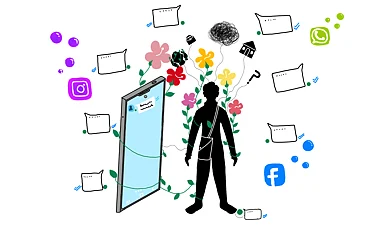
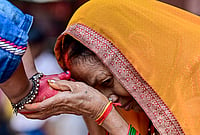
The scrutiny of Pujarini highlights how quickly people label content creators from rural backgrounds as “inauthentic” if they do not fit stereotypical versions.
Criticism of her brand collaborations and polished content raises concerns about who gets access to visibility, resources, and cultural capital in influencer spaces.
Questioning content creators is important, but it’s important to tell the difference between genuine curiosity and bias based on caste and class.
A young woman in a saree sits in her rural Bengal home, speaking calmly to the camera about films, books, and culture. There are no fancy and curated set-ups, but a simple background and a confident voice. This is Pujarini Pradhan, a young, married woman from rural Bengal whose Instagram handle, @lifeofpujaa, has captured widespread attention.
Pradhan’s content is gaining widespread attention because she speaks fluent English and discusses topics often linked to urban and elite spaces. In her videos, she recommends films by David Lynch and Stanley Kubrick, and talks about books from Munshi Premchand to Khaled Hosseini. She does not come from an elite background or a film school. Yet, from her home in rural Bengal, she is quietly challenging ideas about who gets to speak on culture online.
Her videos are shot inside a rural home in East Midnapore, West Bengal, with plain walls, simple furniture, and a domestic setting. What draws attention is the contrast between her surroundings and her views on politics, cinema, and literature. Her content also disrupts stereotypes that people from rural or non-elite backgrounds cannot access or engage with global knowledge.



In her videos, Pradhan also addresses issues like caste, a topic that is often overlooked or absent in urban spaces. Her take on feminism is equally thought-provoking, as it engages with intersectionality. She stands apart from many of her counterparts by not projecting herself as a "tradwife."
But as her popularity and follower count grows, scrutiny follows. The internet stands divided, with many viewers admiring and celebrating her content, while others remain sceptical. The debate began when she started recommending world cinema and books in her reels.

Influencers such as Niharika Singh and Aishwarya Subramanyam have questioned her authenticity, labelling her an “industry plant” because her content appears “too polished” to come from a rural background. Influencer-therapist Niharika Jain was among the first to raise doubts. She posted a reel asking whether Pujarini's highly polished content seemed unusual for someone from a rural background.
Her comments sparked a wider debate about exposure and privilege, with many questioning how a village girl could develop such refined taste and advanced editing skills so quickly.
The debate also revealed how the urban elite often decide who gets access to language and cultural capital and they quickly label those who don’t fit their expectations as inauthentic. Critics also point to her collaborations with platforms like Netflix and ChatGPT.
But this argument reveals another form of gatekeeping. Brand collaborations are common in the influencer ecosystem and creators routinely receive deals once their content goes viral. So why does she face such backlash? This reaction raises a larger question: do influencers gate-keep resources and restrict access to certain social classes?
Pujarini addressed these claims directly in a video, where she responded to questions about her authenticity and brand deals.
She said, “They questioned my consistency and time management, even though I have already talked about my supportive mother-in-law who cooks during the day, and my husband who cooks at night. They say I am not authentic, but I don’t know how to pretend to be authentic.”
She also clarified the issue of brand collaborations. She explained that she signed with an agency that now manages her deals. “On 27th January, I started working with another agency, which is my current agency. My brand deals became consistent after I signed with this agency. Before this, I never knew that money could come in so consistently in this field,” she said.

“They were fine until I started giving my opinions on feminism and politics. They want to see suffering in every video. They want me to complain about life. They want to see sadness. But the moment I started making money from my videos, and expressing liberal opinions, they saw me as a threat and began creating conspiracy theories," she added.
Some creators have come out in support of her. Aman Pandey, known by his Instagram handle @ghalibandKabir, posted a reel defending Pujarini. He wrote, “Pujarini is facing unnecessary attacks based on baseless assumptions and harmful stereotypes that some urban elites hold about what can and cannot emerge from a village. While they later backtracked and framed it as a critique of the system, their initial reactions casually targeted Puja’s integrity, honesty, and authenticity.”
Pujarini’s content is not new, but it resonates with many because of its simplicity. She documents her everyday life and deliberately uses a language that unsettles many influencers. English, despite being an official language in India, still belongs to a certain class. This raises important questions: Can simplicity be labelled an “industry plant”? Can authenticity be manufactured? Who decides what counts as authentic? Have we ever scrutinised influencers this intensely for receiving brand deals before?
“It’s also about urban gatekeeping, where upper-caste and upper-class groups try to restrict language and knowledge of art to themselves. Another thing I have noticed is the stereotype that married women lack agency, do not have a mind of their own, and are often viewed as damsels in distress,” says Sritama Bhattacharyya, an educator based in Washington, US.
Not just the social media world, but also the other industries have long worked to project and typecast rural people in narrow, often stereotypical ways. In mainstream Hindi cinema, many film directors are writing stories around rural life. Films and series like Bareilly Ki Barfi, Laapataa Ladies, Panchayat, and Dupahiya explore urban versions of rural India shaped by their imagination. In this portrayal, characters are often framed in ways that seek urban acceptance. The narratives frequently revolve around protagonists who are constantly struggling and their journeys are centred on climbing the ladder of success. These stories tend to focus on escaping poverty, entering elite professions, or achieving mainstream fame. Yet, even after reaching these milestones, the complete acceptance within the mainstream remains rare.

This is not the first time a person from a rural background has made a reel because rural content creators have always existed on social media. They have long shared unfiltered videos of everyday life, from cooking and farming to humour and dance. When TikTok was banned in India in 2020, actor Malaika Arora Khan wrote, “Finally, we will not be subjected to people’s ridiculous videos.”
This is also a part of a larger debate that people find cringe-worthy or not “intellectual enough” when it comes from a certain class. People have repeatedly labelled rural creators as “cringe.” They watch, laugh at, and circulate their content, but rarely respect it. This reaction reflects deeper social conditioning shaped by caste and class hierarchies. Even when rural individuals move to urban spaces, the divide persists. The boundary between rural and urban India continues to hold firm.
“‘Kya chapri dikh raha hai ye’ is a phrase we often come across while scrolling through reels on Instagram. Users usually post this comment on videos featuring people from non-metro or rural backgrounds, often mocking their appearance or fake branded clothes. Influencers frequently amplify this by targeting them with casteist slurs.” This reflects a deeper caste and class divide, where people from rural backgrounds must seek approval and acceptance from urban audiences.
There is a difference between curiosity and classism. Not every question is rooted in prejudice; some emerge from genuine concern or interest. To interpret all questioning as classist is to overlook nuance. In the digital ecosystem, multiple interpretations can coexist and critique is not always malicious, and defence is not always blind support. If someone finds content inauthentic, disengagement remains a valid option. As Shivani Nag, a faculty member at Dr. B.R. Ambedkar University, argues, the key lies in distinguishing intent and whether a question is driven by bias or by a desire to understand.
At the same time, there is a feudal undertone in declaring someone “inauthentic” simply because they do not fit a preconceived image. The assumption that a rural creator cannot be articulate, polished, or English-speaking reflects a narrow imagination of identity. It reinforces stereotypes instead of challenging them, she adds.
The conversation, then, should not be about silencing questions but about asking better ones. Curiosity need not be policed, but it must be mindful. And when classism does appear, it should be called out with precision rather than assumption.
However, a more pressing concern lies elsewhere, particularly with influencers offering health, skincare, psychotherapeutic, or diet advice without credible qualifications. We don't see such deep critical analysis of influencers offering expert advice where bad advice can be harmful or where any prejudiced view about groups being promoted, notes Shivani Nag.
In the age of social media, creators work around the clock, producing reels on everything from “get ready with me” routines to advice on moving on from an ex, all to gain views. While some struggle to gain traction, others achieve success overnight with a single viral reel.
Ultimately, this debate centres on who gets to appear polished, authentic, and intellectual on social media. Pujarini is simply trying to gain visibility in the same space as everyone else. Yet, a section of the audience dismisses her as “cringe” or not intellectual enough. They rely on rigid binaries and interpret everything through that lens. Pujarini does not fit their framework, and that is precisely why they struggle to accept her. There are far more pressing issues the world needs to address, and the focus should shift towards them rather than fixating on a woman who is simply claiming space in a domain that some still believe they have a monopoly over.