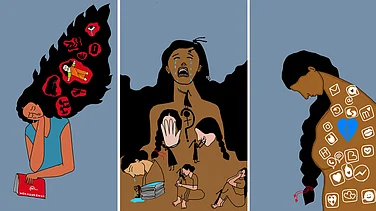
Women spend over five hours per day on unpaid domestic work, three times more than men.
Choosing to stay single is less about rejecting love and more about refusing unequal partnerships that demand constant compromise.
Women’s unpaid emotional and household labour affects career trajectories and decision-making power.
Anviksha Singh, 20, sits in the courtyard of Miranda House, New Delhi, a notebook open, ideas spilling across the page. She dreams of a PhD, of writing, and shaping a kinder, equitable world. She has decided to remain single for the “foreseeable future.” “Being in a relationship,” she says, “means constantly negotiating my time and emotions. I want to chase my freedom first. True companionship has to be equal. Intellectual, emotional and practical.”
For her, choosing not to enter relationships is not a rejection of love, but a refusal to participate in a system that demands women’s emotional, mental and domestic labour. “We’re looking for partnership that respects autonomy. That is hard to find.” Singh runs a newsletter ‘Children of Capital’ on politics and poetry, and volunteers at a local community library, building avenues of agency and visibility.
Her clarity is not fear or cynicism, but awareness about what intimacy has historically cost women.
Across age groups, women echo similar sentiments, though their paths have been more arduous. Deepthi Sirla, 43, from Hyderabad, knows the cost of unquestioned compliance. Married at 23 into a traditional patriarchal setup, she moved to a small town for her husband’s work, leaving behind the career she had built with an MBA. Between raising two children and managing the household, her identity slowly eroded. “The load, what I call ‘mankeeping’, drained me financially, physically and emotionally,” she recalls. “It’s not about rejecting men. It’s about refusing to vanish into a system that asks everything of women and gives nothing back.” Sirla works in development, runs multiple projects, and is part of an informal women’s collective, Junglee Women, discussing how to live life on their own terms.


For Jyothi, 38, the cost of relationships was cumulative, invisible and exhausting. Married into a traditional household, she spent years navigating expectations she hadn’t negotiated. “I did the emotional labour. Regulating his moods, protecting his image, absorbing blame. None of this was seen as work. I put my career on hold for my child. My personal time on hold for his comfort. The absence of emotional management felt like freedom.” Across India, women carry what feminist scholarship calls emotional labour: the unacknowledged mental and emotional effort required to sustain relationships. Arlie Hochschild’s seminal work extended the concept to intimacy, showing how women routinely monitor moods, anticipate conflicts and suppress personal needs to maintain relational harmony. In India, this is compounded by household responsibilities, cultural expectations, and deeply entrenched gender norms.
Social scientist Dr Ranjana Kumari, Director of the Centre for Social Science, notes that for decades, women have carried the invisible weight of caregiving for children, family, and the elderly, without recognition or support. Social norms made care work a duty, not a choice, and men often benefited without sharing the burden. Younger women now see this clearly and are unwilling to pay the emotional and domestic price in relationships. They refuse the guilt trips and the expectation to absorb emotional labour without reciprocity.

National data shows women spend three times as many hours on unpaid care work as men, underlining how systemic it is. Even younger women see the patterns early. Singh observes her mother and other women. According to the 2024 India Time Use Survey, by National Statistics Office (NSO), women aged 15-59 spend about 305 minutes per day (over five hours) on unpaid domestic work, compared with just 88 minutes for men, and devote roughly 137 minutes to caregiving, versus 75 minutes by men. Only 25 per cent of women participate in paid employment activities, compared with 75 per cent of men. These figures underline that the invisible labour women shoulder in households is not incidental but systemic, shaping the very options they perceive in relationships and careers.
Pre-Emptive Refusal And Global Movements
This pre-emptive refusal is not unfolding in isolation, but women are articulating similar responses to unequal intimacy. In South Korea, the 4B movement that rejects dating, sex, marriage, and childbearing with men, emerged as a reaction to deeply entrenched misogyny, workplace discrimination, and gendered violence. While often caricatured as radical, the movement reflects a collective reckoning with the costs women bear in intimate relationships.
Variants of this refusal are now gaining visibility in the US and Europe, where younger women delay marriage, opt out of heterosexual relationships, or redefine partnership. These choices are not driven by hostility toward men, but by an unwillingness to enter arrangements that demand disproportionate labour without reciprocity.
In Japan, as more women joined the workforce and refused traditional caregiving roles, marriage rates fell and the population began to decline. In Japan, the number of births in 2023 fell to 758,631, the lowest since records began in 1899, while marriages dropped below 500,000. Scholars link these demographic shifts to structural factors including gendered expectations in domestic and professional spheres, rising economic pressures, and women prioritising autonomy and career.
In India, the contours are different because caste, family structures, economic precarity, and social surveillance make refusal quieter and more negotiated. Yet the impulse is recognisable. Women are no longer willing to absorb inequity silently. What appears as individual choice is, in fact, a response to systems that have failed to adapt to women’s education, aspirations, and awareness.

Sirla describes waking at 5 am, managing children’s schedules, preparing meals, and balancing her job, often without recognition or relief. “I worked like a robot,” she says, “and it’s not that I didn’t love my family. Love became invisible work. Every decision, every emotional adjustment was on me.”
“The choices younger women are making are practical, political, and emotional,” Kumari explains. “They challenge a system that normalises unpaid labour, refuses to share responsibility, and weaponises guilt. These decisions are reshaping how women view relationships, family, and society itself.”
Beyond The Household
The World Bank notes that women’s labour force participation in India declines sharply after marriage, not due to lack of ambition, but because of invisible domestic and emotional responsibilities. In 2024-25, India’s female labour force participation rate remained at around 32.8 per cent, compared with about 77.1 per cent for men, underscoring how unpaid care work and social expectations continue to limit women’s formal economic engagement even when ambition and capability are present.
For many women, these constraints shape everyday life, restricting mobility, income, and autonomy after the domestic work.
Jyothi and Deepthi’s experiences are mirrored by women like Kavitha, a Dalit woman navigating life in an urban middle-class neighbourhood. For her, marriage was often about survival rather than aspiration. Partnership became another site of control, entangled with caste violence and systemic invisibility. She describes managing violence quietly by hiding injuries, protecting her children, and earning money she did not control. What feminist research names structural exploitation, she says, is simply lived reality.
Even in seemingly supportive households, women encounter invisible constraints. Deepthi recalls growing up in an orthodox Christian family where fathers and brothers ate first, while mothers and daughters ate later, a daily lesson in hierarchy. “It starts at home,” she says. Such cultural practices, repeated across class, caste, and faith, condition women to absorb inequity silently. Over time, autonomy, income, and decision-making power erode, even as society continues to celebrate women who “quietly endure.”
Younger women recognise these patterns early. Singh observes them around her—in families, classrooms, and relationships where emotional, domestic, and mental labour is still assumed to be a woman’s responsibility. “Even fathers who are supportive are part of the structure in subtle ways,” she says. Choosing autonomy, for her, is not about rejecting relationships, but about refusing to be treated as disposable scaffolding for someone else’s life.
This intersectional lens reveals how the costs of invisible labour are unevenly distributed. While some middle-class women may step away from relationships to reclaim professional or creative ambitions, for marginalised women, refusal can be a strategy for safety, bodily autonomy, or survival. “This isn’t ideology,” Kavitha says. “It’s survival. Some pity me, some blame me.”
Even women with education and relative privilege find it difficult to assert boundaries within marriage and family. Dr Shraddha Bhange, who works with girls’ education through the Think Sharp Foundation in Pune, notes that awareness alone does not undo conditioning. She describes the long process of unlearning the belief that women must silently endure, pointing out that small acts like hiring help, asserting limits, refusing to be consumed by domestic and emotional labour are often treated as transgressive. Yet these acts, she argues, are essential to preserving dignity and autonomy.
What Do Women Want? Equitable Relationships
Choosing to step back from relationships is often misread as bitterness or rejection. For women interviewed here, it is instead a statement of standards: refusing arrangements that demand disproportionate emotional and domestic labour without reciprocity.
Dr Bhange situates herself firmly within marriage while acknowledging its inequalities. Married, with a daughter, and having founded Think Sharp alongside her husband, she describes the years of unlearning and relearning it took to recognise subtle imbalances. Education provides young women with the language and confidence to question what has historically been normalised. She counsels girls to prioritise education, because it shapes every future choice like economic independence, emotional boundaries, and the ability to recognise red flags early.
For Bhange, stepping away from a relationship should come not from anger or revenge, but from the realisation that life is genuinely better and safer without someone who does not contribute to wellbeing. This approach can prevent years of quiet suffering and protect women from internalising emotional, economic, or even physical violence as “adjustment.”
Dr Kumari frames refusal as a broader social and generational shift. Education has changed how new-age women evaluate relationships. Marriage is now assessed as a structure that must be fair and equitable. Women with access to education and employment increasingly recognise unequal care work, emotional labour, and manipulation disguised as tradition.
They ask practical questions: Who shares domestic responsibilities? Who compromises professionally? Who absorbs emotional stress? This does not signal rejection of companionship or intimacy. Educated women are not anti-marriage. They are anti-exploitation. They reject inherited guilt, refusing narratives that cast them as naturally responsible for every failure or imbalance, says Dr Kumari.
In this context, delaying, stepping back, or choosing not to enter a relationship is not fear or bitterness, says Dr Bhange, it’s practical, political, and emotional realism.



A shorter, edited version of this appeared in Outlook's February 21 issue titled Seeking Equity which brought together ground reports, analysis and commentary to examine UGC’s recent equity rules and the claims of misuse raised by privileged groups.