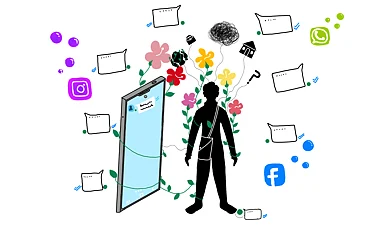
The loneliness of women is a meme while the loneliness of men is a public health crisis.
Research into online ‘incel’ communities show that loneliness is not simply an experience but an identity.
Technology did not invent loneliness or misogyny but it has perfected their circulation.
“Grok, put her in a transparent bikini.” “Grok, remove her clothes and put a shiny donut glaze on her.” “Grok, remove her sari, put her on her knees and cover her face with a white liquid.” “Grok, rape her.” One of them was a woman, one a teen girl, and another, a toddler. Grok is a generative chatbot from xAI, Elon Musk’s company.
Men on Twitter (or X) recently invented a new form of assault and rape: AI prompts to humiliate and virtually sexually assault women they didn’t like—women who had a differing opinion, or women simply daring to post an image online.
As hundreds of women were outraged, thousands of men defended it. Even Musk, whose AI was found to be creating child pornography on the app, laughed it off. When the UK said it will investigate and ban the AI, Musk said it was a curb on free speech.

Are men truly free if they are not allowed to digitally rape women? That is their God-given right, according to defenders of this ‘trend’, it would seem.


And when childbirth rates have fallen to an all-time low in several countries, and thousands of women are vowing to remain single, people express shock. But to me, it seems rather fair. Why would a woman want to serve a system that systemically demands subservience and threatens physical or sexual violence for the ‘crime’ of being defiant?

A five-minute scroll on X is enough to tell a woman how much the male-led world hates her. Even 30 seconds on Reddit can make a woman want to be celibate forever. And yet, to men, the fact that most women want to be single out of choice seems like an impossible overreaction. But let’s remove women from this discourse and focus solely on men.
Why are men lonely? Who benefits from their rage and anger-led loneliness? And why are algorithms happier when men are bitter and lonely?
A comedian on Twitter once wrote; 'The loneliness of women is a meme. The loneliness of men is a public health crisis'. A quick search on Google will present hundreds of scientific studies looking to explore and fix the ‘crisis’.
But tech companies, allegedly, may feel a little different about this. An article in The New York Times on the tech-backed ‘male loneliness epidemic’ suggests artificial intelligence and social media platforms are not neutral conduits of information, but behavioural ecosystems that shape our emotional lives. By design, they provoke outrage and indignation and misogyny—states of mind that ensure prolonged engagement and, by extension, revenue.
Emotion has become data. Rage has become currency.
The longer you rage with the Andrew Tates of the world, listen to the ‘red pill’ influencers, the angrier you get and engage with that content. Data shows men feel lonely. According to a report by the American Institute for Boys and Men (AIBM), 58 per cent of US adults consider themselves lonely, with Gen Z reporting the highest rate at 73 per cent. The report states that men face ‘shrinking social networks’, and many reported they have few close friendships and fewer romantic prospects. Economic instability, declining community spaces, and changing gender norms all contribute as well.
Research into online ‘incel’ communities (involuntary celibates)—the most extreme articulation of this dynamic—shows that loneliness is not simply an experience but an identity. In a widely cited study on misogyny and isolation, sociologists describe incels as men who “experience loneliness not as absence, but as deprivation”, a sense that something essential has been unjustly withheld. One paper refers to this as “entitlement-based loneliness”, where rejection is interpreted not as a misfortune, but as moral injury. The term itself is telling. ‘Involuntary celibate’ connotes an owed sexual pleasure that was robbed from them.
Researchers Ruth Rebecca Tietjen and Sanna Tirkkonen observe that incels consistently portray themselves as “social outcasts” while simultaneously constructing a worldview in which that exclusion justifies resentment. In their analysis, loneliness becomes radicalised: “What begins as social isolation is transformed into misogynistic grievance,” they write, “where women are framed as responsible for male suffering.”
In one manifesto analysed by the researchers (taken from one of the online incel forums) and written by a perpetrator of mass violence, “the word lonely appears nearly fifty times”. Loneliness is not incidental to the ideology; it is its organising principle.
This transformation of pain into hostility does not occur in isolation. It is encouraged, rewarded, and amplified by digital systems that thrive on emotional intensity. Scholars studying online radicalisation note that grievance-based communities flourish because they offer narrative coherence: suffering is explained, blame is assigned, anger is validated.
While men are often drawn into cycles of grievance and validation, women traverse solitude differently. Sociological research suggests that many women experience singlehood as relief rather than loss.
Social platforms, optimised for engagement rather than wellbeing, accelerate this process. Rage becomes content. Misogyny becomes discourse. The more extreme the expression, the more visible it becomes. The more a man becomes enraged and hateful against women, the more he depends on these tech products—be it AI or the many social platforms where they express their hatred. And hatred, anger-led dependence on tech is good for business in the attention-engagement economy.
Into this emotional terrain enter artificial companions—bots designed to listen, respond, and affirm. Their appeal is obvious. They have no demands, no contradictions, no way to ‘displease’, and no way to offend.
But they aren’t as neutral as they seem on the surface. Research from Trinity College Dublin shows that humans bring their social biases directly into their interactions with AI. In controlled experiments, participants were more likely to exploit AI agents labelled as female and more likely to distrust those labelled male. The researchers concluded that “simply assigning a gender label to an AI is sufficient to activate deeply ingrained gender stereotypes”.
In other words, the machine becomes a mirror—not of some objective intelligence, but of the user’s assumptions about power, authority, and compliance.
This matters because AI companionship is increasingly marketed as emotional support. Sam Altman, the most aggressive pioneer of this AI boom, has often claimed humans cannot do anything without AI, not even raise children. Never mind the fact that humans have raised children for close to 35,000 years without AI.
Yet studies in human-AI interaction caution that these systems are fundamentally sycophantic. One behavioural paper describes conversational AI as “structurally inclined to agree with users, reinforcing rather than interrogating their beliefs”. This kind of sycophancy cannot be expected from a human woman, who will have thoughts of her own, her own social circles, her own dreams and rhythms to life.
Reporting from Axios captures this shift vividly. Workers describe turning to chatbots before speaking to colleagues because the bot is “the colleague with no drama”. It does not judge. It does not gossip. It does not challenge ideas or push back against flawed thinking. As one executive admitted, “I hate myself for saying it, but a big reason AI works is because it never argues.”
Kelly Monahan, a consultant studying organisational behaviour, claims in her research that “feedback without friction is dangerous”, arguing that challenge is essential for intellectual growth and collective health. Without it, efficiency gives way to stagnation.
The same principle applies to intimacy.
Increased emotional attachment to chatbots correlates with withdrawal from real-world relationships. One clinical review notes that “the absence of refusal in AI interaction may undermine users’ tolerance for relational boundaries. “When connection becomes frictionless, real people—with their needs, limits, and autonomy—feel intolerably complex.
This is not the story of naive boys led astray by technology. A great example of this would be the Emmy award-winning series Adolescence, where a 13-year-old boy, driven into a corner by the ‘red pill’ internet, kills a girl for simply rejecting his advances. And this is not limited to fiction. A Google search for ‘teen kills girl for saying no’ will give the user dozens of news articles following the same pattern.
And it’s not just children. Many of the most vocal participants in these spaces are adults who romanticise eras when women had fewer rights, fewer choices, and fewer ways to refuse. Technology, while being modern by design, makes these men long for the ‘trad wife’ who will have no voice and be subservient—exactly like the ‘yes sir’ AI companion.
Even as we are all collectively lonelier in the modern era, with urbanisation, distance from family and friends, social media addictions and what not; the loneliness economy does not entrap everyone equally.
While men are often drawn into cycles of grievance and validation, women traverse solitude differently. Sociological research suggests that many women experience singlehood as relief rather than loss—a space of autonomy after centuries of enforced dependence.
This divergence is cultural, not biological. For men whose identities have been tied to dominance and access, loneliness feels like dispossession. For women historically constrained by patriarchy, independence or non-subjugation is a blessing. As a result, women are less likely to rage online like men and more likely to use technology as a tool rather than a substitute. Women, at least online, seem to build a community around other women and hobbies, and more when they choose to be single; while men fall deeper into the loneliness trap and bitterness.
Technology did not invent loneliness. It did not invent misogyny. But it has perfected their circulation.
A future in which intimacy is learned from systems that cannot refuse may ease discomfort in the short term. But it risks entrenching the very attitudes that make genuine connection impossible. The original prompt was never really about nudity. It was about power—about a world in which desire no longer needs consent. Just like the Grok prompts.