Every day practices on campuses continue to marginalise students and faculty through notions of “merit”, language, and cultural capital
Delayed degrees, stalled promotions, verbal abuse, professional isolation, and even deaths reveal that caste discrimination is not incidental but structural
Concentrated power among academic authorities and ineffective complaint mechanisms discourage reporting
“There will be outcastes as long as there are castes. Nothing can emancipate the outcaste except the destruction of the caste system.”B. R. Ambedkar
Article 17 of the Indian Constitution states that “untouchability” is abolished and that its practice in any form is forbidden. Article 15 further provides that the State shall not discriminate against any citizen solely on the grounds of religion, race, caste, sex, place of birth, or any of these. Yet, in everyday life, caste hierarchies persist. Across campuses, it re-emerges through everyday academic power.
The persistence of caste in schools and colleges, long believed to be sites of upward mobility and rational thought, turns these institutions into places where notions of “merit”, cultural capital, language, and access (or the lack of it) are highlighted and ridiculed. This discrimination spans the country, from Kashmir to Kerala. There is no respite. These case studies do not represent isolated incidents but rather a systemic pattern.
They point to unchecked authority vested in heads of departments and to weak, ineffective redressal mechanisms. Complainants are routinely questioned about their motives. Very few cases of caste discrimination are reported, largely due to the fear of retaliation, social exclusion, and prolonged struggles with institutional mechanisms that often end up protecting those already in positions of power.



“He was Laughed at for Asking Questions About Computers”
Darshan Solanki, 18, a Dalit student, allegedly died by suicide at IIT Bombay in 2023.

The Dalit student from Ahmedabad allegedly died by suicide on February 12, 2023, at IIT Bombay. A first-year Chemical Engineering student, his death sparked intense allegations of caste-based discrimination and harassment.
His family alleged that he had faced caste discrimination on campus. His sister had also deposed before the committee, noting that he had spoken about how he was laughed at for asking questions about computers and other subjects.
“Their Insecurities Were Exposed in the Way the Case was Handled”
Prashant More, an FTII student, had filed a complaint against a professor, accusing him of making casteist remarks against him Prashant More enrolled in the TV Direction course at the Film and Television Institute of India (FTII), Pune, as part of the 2021 batch, which began in November 2022 after delays caused by the COVID-19 pandemic. A 33-year-old engineer by training, he joined the institute to formally pursue television direction.
Soon after joining, he alleged in his complaint filed at the FTII in 2023 that he was subjected to subtle caste-based remarks by his professor, Milind Damle. He said Damle never addressed him by his first name and referred to him only by his surname, ‘More’—a practice he described as reinforcing caste identity in discriminatory ways. He also recalled being told: “Why don’t you choose ‘diverse’ characters for your stories, and why are you writing about Dalits all the time?”
Within months, during a group short-film assignment, More said the discrimination intensified. He claimed he was repeatedly asked to change his story and was denied permission to shoot at a location that had previously been allowed for other students. He said he had to “fight relentlessly for everything”.

During the screening of his film for an examination, members of the external jury questioned the visual quality. More explained that the issue arose from technical limitations of the screening room and suggested that the film be viewed in the institute’s cinema theatre to experience it as intended. A faculty member present reportedly agreed and asked him to seek permission from Damle.
According to More, when Damle was called on speakerphone, a casteist remark was made: “Now what is the problem with this More? Is he not able to see Ambedkar’s photo in a film or what?” The comment, he said, was heard by other FTII staff. He described it as “an utterly disgusting taunt”, adding that his film contained no imagery or references to Ambedkar.
Following the incident, More filed a formal complaint of caste-based discrimination with the FTII administration in 2023. At the time, the institute did not have an SC/ST grievance redressal cell. After repeated follow-ups, a two-member inquiry committee was formed. More objected to its composition and said he was not provided with the rulebook, standard operating procedures, or responses to his queries.
The committee concluded that there had been no caste-based discrimination and gave Damle a clean chit, stating that his conduct was not casteist and was in the student’s best interests.
More then approached the National Commission for Scheduled Castes. The commission later disposed of the complaint, stating that if the professor were found committing a similar act in future, a memo would be issued.
Despite the dispute, More completed the TV Direction course and graduated from FTII. He faced financial hardship during his studies and said he paid his fees with the help of friends, as FTII offers no scholarships or fee concessions for SC/ST students. Subsequently, students from the 2022 TV Direction batch protested against Damle, alleging caste-based discrimination, lack of transparency in inquiries and procedural arbitrariness. The protests also cited a complaint by a female student from the North East under the Prevention of Sexual Harassment at the Workplace Act. Following these developments, Damle was transferred internally within FTII. He could not be contacted for a comment.
More believes that for years, students facing caste discrimination at FTII lacked the courage or support to speak out, but his case now offers an example for others. An SC, ST, and OBC grievance cell was formed after his complaint, comprising four faculty members and one student representative. However, apart from the names of its members, no details about its functioning or standard operating procedures are available on FTII’s website.
Reflecting on the experience, he says: “The fear in the Brahminical establishment is that a Dalit can enter this so-called prestigious institute with a voice and assertion. Their deepest insecurities were exposed in the way this case was handled.”
More now works in Mumbai. After spending a year as a ghostwriter, he is developing and pitching his own stories and screenplays. He recently made a documentary for Eklavya India, a social enterprise working with marginalised students in education.

“Caste-based Harassment, Detention, Finally, a PhD Degree, After 10 Years”
Deepa Mohanan, a Dalit PhD scholar, alleged authorities deliberately delayed her degree completion
Kannur resident Deepa P. Mohanan, a Dalit PhD scholar at Mahatma Gandhi University (MGU), Kottayam, Kerala, alleged that university authorities deliberately delayed her degree completion for over a decade. She began a hunger strike in October 2021 outside the International and Inter University Centre for Nanoscience and Nanotechnology (IIUCNN), claiming, as per the complaint filed with the institute, obstruction by the institute’s director, Nandakumar Kalarickal, due to her caste.

Mohanan joined MGU in 2011 for an MPhil after completing a master’s in medical microbiology. She says Kalarickal, then joint director and now director of IIUCNN, blocked her access to the lab, denied her workspace and chemicals, withheld her stipend, and even locked her alone in the lab. She also alleges verbal abuse and systemic obstruction throughout her PhD.
In 2015, she filed a caste-discrimination complaint with the university. A two-member committee upheld her claims and recommended full research facilities, but little changed. In 2016, she filed a police complaint under the SC/ST (Prevention of Atrocities) Act. She was even detained for two days while attempting to submit her complaint to the Governor. Despite these efforts, Mohanan continued to face delays in completing her PhD. Finally, she was awarded her PhD degree in 2024 after years of prolonged struggle. Kalarickal and Mohanan could not be reached for a comment.
“My Husband was Harassed Because He Belonged to the SC Category”
Chandra Shekhar, Associate Professor, University of Jammu, allegedly died by suicide in 2022, after he was targetted for being considered for the post of HOD
Chander Shekhar, associate professor, University of Jammu, allegedly died by suicide shortly after receiving a notice suspending him, following recommendations from CASH (Committee Against Sexual Harassment) in September 2022. He had locked himself in the staff room, where he had taught psychology for more than 15 years, and was later found hanging from a ceiling fan.
A Special Investigation Team (SIT) was set up amid widespread claims that he had been the target of a conspiracy to prevent his appointment as head of the department. The incident prompted student protests, and the Scheduled Caste members in Jammu made allegations against several university officials.
“My husband was harassed solely because he belonged to the Scheduled Caste category. Just a few months before he was due to become the Head of the Department of Psychology at Jammu University, false charges were brought against him, and the complaints that he was too open when discussing psychology in class were later found to be frivolous by the police,” says his wife, Neeta. “He was courageous and strong; he was also extremely hardworking, often waking up early in the morning to teach at the college level. Rather than being given the opportunity to present his side, he was suspended,” she adds.
“Subjected to Both Mental and Physical Torment at College”
Pallavi, a student of the Government Degree College, Dharamshala, died in 2025 after allegedly enduring casteist abuse and sexual harassment
Nineteen-year-old Pallavi, a student of Dharamshala’s Government Degree College, died on December 26, 2025, after enduring casteist abuse and sexual harassment. In a video recorded shortly before her death, she detailed the harassment she faced at college and identified her teacher, an Assistant Professor of geography, as the source of her distress.

Her father, Vikram, filed a police complaint, holding the teacher, Ashok Kumar, responsible for his daughter’s death. He alleged that Pallavi had been subjected to both mental and physical torment at the college, which had forced her to temporarily drop out before resuming her studies. He also named three other female students who, he claimed, had harassed his daughter physically and mentally, making indecent remarks about her caste.
The police promptly registered a First Information Report (FIR) against Kumar under the Bharatiya Nyaya Sanhita (BNS), citing Sections 75 (sexual harassment), 115(2) (voluntarily causing hurt), 3(5) (common intention), as well as Section 3 of the Himachal Pradesh Educational Institutions (Prohibition of Ragging) Act, 2009.

The National Commission for Women (NCW) has also taken suo motu cognisance of the case and requested reports from both the state government and the Kangra district police.
“It Has Been Five Months Since I Submitted my Thesis, No Response”
Vipin Vijayan, a research scholar at Kerala University, accused his HOD of caste bias, misuse of authority
Vipin Vijayan, a research scholar in the Sanskrit department in November 2025, accused the Head of the Department (HOD), C.N. Vijayakumari, of caste-based discrimination and misuse of authority. A case has been registered under the SC/ST Act against the professor.
The dispute began after Vijayakumari, who is also the Dean of the Faculty of Oriental Studies, objected to the award of a PhD to Vijayan. In a Facebook post, Vijayan alleged that she attempted to derail his evaluation by falsely claiming he lacked proficiency in Sanskrit, despite having completed both his MPhil and PhD under her supervision.
Questioning the credibility of her report to the Vice-Chancellor, Vijayan said his thesis was written in English, which is permitted under university rules. He noted that several research theses in the department have been submitted in English, and that open defence presentations may be conducted in English or Malayalam.
Vijayan alleged that caste prejudice and political bias motivated the objection, stating that his left-wing views conflicted with the Dean’s RSS–BJP affiliation. He also accused her of ignoring the approval already granted by university-appointed examiners and the open defence chair, and called for her removal. He compared his experience to that of Rohith Vemula, the Dalit research scholar who died in 2016.
“It has been almost five months since I submitted my PhD thesis. My guide, the external examiners, and the panel that conducted the open defence have all recommended the award of the degree. However, the process is being delayed. The matter is pending before the Kerala University Syndicate, but for reasons unknown, the VC has not placed my case on the agenda. I am waiting for the PhD degree so that I can apply for jobs,” says Vijayan. The HOD was not available for a comment.

“Removed from Service Over a Year Ago Due to Caste Bias”
In March 2024, just as P. Senrayaperumal became eligible for promotion, the MS University in Tamil Nadu, issued a removal order without prior notice
Trained as an Assistant Professor, P. Senrayaperumal has been engaged in a legal battle with Manonmaniam Sundaranar University in Tirunelveli, which removed him from service over a year ago.
Senrayaperumal belongs to the Arundhatiyar community, among the most marginalised within Tamil Nadu’s Scheduled Castes. Coming from a family of folk artists, he spent his early years performing through the night and often studying by day.
After dropping out of school, he pursued education through distance learning, completing his bachelor’s and master’s degrees, followed by an MPhil in folk arts. He later returned to formal schooling through adult education courses before earning a PhD in Art History in 2013.

In 2016, he was appointed Assistant Professor of History at the university under the Scheduled Caste (Arundhatiyar) quota, marking a rare journey from folk performance to academia.
In March 2024, just as he became eligible for a promotion, the university issued a removal order without prior notice or hearing, citing alleged educational “irregularities” that had already been cleared at the time of his appointment. Although the High Court ruled in his favour and held the dismissal to be unjustified, the university has yet to reinstate him.
“Given Tasks Like Disposing of Scrap Materials, Humiliated”
C.N.S. Ramnath Babu, Assistant Professor at a management institute in Tiruchirappalli, Tamil Nadu, accused director of caste-based harassment.
C.N.S. Ramnath Babu, an Assistant Professor at the Bharathidasan Institute of Management (BIM), Tiruchirappalli, accused the institute’s Director, Asit Kumar Barma, of caste-based discrimination and harassment. Police have registered a case under the Scheduled Castes and Scheduled Tribes (Prevention of Atrocities) Act.
Babu, 51, who belongs to the Scheduled Caste community, alleged that he was isolated and subjected to sustained harassment after the director became aware of his caste. During his probation from 2021 to 2023, he claimed he was denied core teaching responsibilities and assigned only elective courses, despite repeated requests. He also alleged that he was given non-academic tasks, including disposing of scrap materials, which he said humiliated him in front of colleagues. The institute ended Babu’s appointment in 2023, citing unsatisfactory performance. He challenged the decision before the Madurai Bench of the Madras High Court, which quashed the termination and ordered his reinstatement with full benefits. The institute’s appeal against the ruling was later dismissed. An FIR has been registered against Barma in connection with the allegations. He could not be reached out for a comment.
“Angry Professor Threw a Partially Eaten Samosa at Me, Used Casteist Slurs in Front of Students”
Shivam Kumar, a Dalit research scholar at BHU, accused a senior professor of caste-based abuse
Shivam Kumar, a Dalit research scholar in the Faculty of Ayurveda at Banaras Hindu University (BHU), filed a complaint with the National Commission for Scheduled Castes (NCSC), accusing a senior professor of caste-based abuse.
Kumar said the incident took place on May 30, 2024, during an interview for his upgradation from Junior Research Fellow to Senior Research Fellow in the anatomy department. He alleged that the professor became angry when he took a group photograph during a refreshment break, threw a partially eaten samosa at him and used casteist slurs in the presence of other faculty members and students.
After receiving no response to his complaint to university authorities, including the Dean of Students, Kumar approached the NCSC on August 30, 2024. The Dean of Students said the matter had been referred to the Dean of the Ayurveda faculty.
“Contract Not Renewed After a Year; MHRD Norms Violated”
Ritu Singh, a Dalit and former ad-hoc professor, was illegally terminated from Daulatram College
Ritu Singh, a Dalit and former ad-hoc psychology professor, has alleged caste harassment and unlawful termination from Daulatram College in Delhi in 2024. She came to wider attention a week after setting up a stall to fry pakoras, following 192 days of protest outside the Art Faculty.
She had joined the college in 2019, but her contract was not renewed after a year. She accused the administration of violating Ministry of Human Resource and Development (MHRD) guidelines and, after being denied a joining letter in August 2020, approached the Delhi High Court to contest the decision.
“Blocked Promotion for Fictive Reasons Despite Committee Approval”
Saitya Brata Das, JNU, Delhi, alleged that the VC blocked his promotion in 2017 due to his caste.
Saitya Brata Das, an Associate Professor at the Centre for English Studies, JNU, had alleged in May 2017 that the vice-chancellor blocked his promotion to professorship for “fictive” reasons, despite a majority of the Selection Committee approving it. Das suggested that his Dalit caste or differing political views may have influenced the decision.
He said his interview went “very well” and was later informally told that, while the experts and Centre Chairperson supported his promotion, the Vice-Chancellor opposed it, citing that no student had completed a PhD under his supervision. Das and the JNU Teachers’ Association had demanded that the VC reconvene the Selection Committee within two weeks to reconsider his application, warning that they would approach the SC/ST Commission and other authorities if no action is taken. He was denied his promotion. He continues to be a Associate Professor at CES.
“Made Remarks About Fair Skin, Warned My Exit Won’t be Easy”
Vijay Oberoi, a Dalit student from TISS, alleged caste discrimination by his professor
Vijay Oberoi, a Dalit student from Himachal Pradesh, alleged caste discrimination by his professor during his MA in Social Work at Tata Institute of Social Sciences, Mumbai, (2016–2018). He first filed a complaint with Trombay police on January 21, claiming that in December 2017, the professor criticised him for being a minority student receiving free education and meals, made remarks about his fair skin, and warned that “his exit will not be easy”.
Oberoi, who lost both parents, said he was asked to redo 30 days of fieldwork, submitted in June 2018, after which the professor allegedly told him she “feels immense pain when a person of caste walks away with a degree”. He also claimed the professor ignored his messages about evaluation until August 2018. He had further alleged that after the complaint reached the SC/ST cell and the director, the professor attempted to punish him by giving minimal marks. Oberoi has yet to receive his marksheet or provisional certificate and is still waiting for reimbursement of fees covered by the Post Matric SC Scholarship.
“Verbally Abused Us, Coerced Us into Performing Personal Tasks”
More than 10 PhD students at Periyar University lodged complaints against a professor in the Tamil department, accusing him of caste-based bias
In early 2025, more than 10 PhD students at Periyar University lodged complaints against a professor in the Tamil department, accusing him of caste-based discrimination, verbal abuse, and coercing them into performing personal tasks at his home and on his property. The professor has denied all allegations.

T. Periasamy, who led the Tamil department for 12 years, was removed from his position in June 2025. He is also under investigation by a State government committee, established in 2023, over claims that he submitted a falsified experience certificate to secure his appointment. The complaints were submitted to the Vice-Chancellor’s Committee, the university’s principal administrative body. The students allege that the professor deliberately delayed their PhD progress over several years. He could not be reached out for a comment.
Writers: Ishfaq Naseem, N.K. Bhoopesh, Priyanka Tupe
Text and compilation: Ashlin Mathew
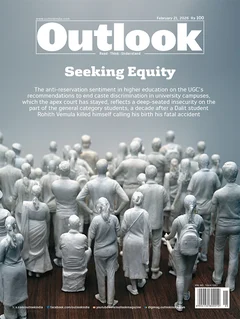


This article appeared in Outlook's February 21 issue titled Seeking Equity which brought together ground reports, analysis and commentary to examine UGC’s recent equity rules and the claims of misuse raised by privileged groups.