University Grants Commission (UGC) on January 13, one can either conclude that upper caste student groups are so well organised that within a day they can hit the streets.
The power of majoritarian governance lies not only in setting the dominant discourse but also in determining the counter-narratives and the counter-publics.
Home Minister Amit Shah emphasises the significance of returning to the mother tongue even as the National Education Policy (NEP) makes way for the three-language formula
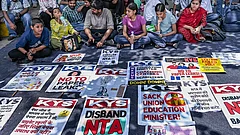
Given the alacrity with which protests emerged against the regulations for the Promotion of Equity in Higher Education Institutions, 2026, by the University Grants Commission (UGC) on January 13, one can either conclude that upper caste student groups are so well organised that within a day they can hit the streets, or these are manufactured protests by the powers that be. I would prefer to read and interpret them as orchestrated protests that fit a longstanding strategy and narrative of the BJP-RSS combine. If one comprehends the larger context, one can make better sense than the kind of desperation shown by the Dalit-Bahujan counter-narrative.

The predictability of the social justice protests feeds the dominant narrative as much as the aggressive victimhood of the caste Hindu mobilisation on the streets. It’s a double-whammy that is entrapping the protest politics in aiding and abetting majoritarian consolidation. Protests cannot afford to be formulaic, otherwise they will be sorted out by ruling classes into a design or a strategy of governance. The power of majoritarian governance lies not only in setting the dominant discourse but also in determining the counter-narratives and the counter-publics. We are living in anomalous political times where the dominant elite think dialectically and the protest politics of the marginalised have become formulaic and mechanical. The social justice and secular-progressive response is already calibrated by the regime in order to pay rich electoral dividends. Cynical pragmatism has colonised optimistic idealism.



What has been the longstanding strategy of the current regime? The strategy is to gain legitimacy by flagging off a civilisational narrative of cultural unity—like the campaign of Kashi to Kanchi; we are a single cultural entity. This cultural unity is bounced against and used to reinforce everyday social conflicts. Even as the unity between Kanchi-Kashi is foregrounded, you have the growing anxieties of the imposition of Hindi on Tamilians. It is unity with Tamil Nadu without Tamilians, just like the unification of Kashmir without the Kashmiris.

Home Minister Amit Shah emphasises the significance of returning to the mother tongue even as the National Education Policy (NEP) makes way for the three-language formula and the Centre stops funds to Tamil Nadu for not implementing the new language policy. The new nationalism of the BJP-RSS is about cultural unity without social harmony; it’s about social harmony without economic equality; it’s about economic welfare without political agency. It’s a story of wheels within wheels, but ultimately directed towards consolidating a majoritarian order without a majority, and a democracy without constitutionalism. It’s about creating a universal vulnerability, distrust and abject submission read as loyalty.
One needs to understand the current controversy around the UGC regulations also in this light. It’s meant neither to promote social justice and equity nor hurt the interests of the dominant castes. It’s meant neither for justice nor to convince the privileged to become more democratic. It’s meant for the two to be at loggerheads and further consolidate their support behind the BJP-RSS combine. Both ends of the spectrum are made to feel vulnerable and without a choice other than siding with the ruling dispensation. And this is not the first time this has happened.

The promulgation of the Economically Weaker Section (EWS) scheme excluded the Scheduled Castes (SCs), Scheduled Tribes (STs) and Other Backward Classes (OBCs), but offered nothing substantially new for the caste Hindus, given the fact that of the eight-lakh-rupee income bracket, it would have included all those who were anyway coming into the system through regular entrance. The promulgation of triple talaq criminalised Muslim men without offering alimony to Muslim women. The Aam Aadmi Party (AAP) government was brought down by capturing the imagination of the Delhi voter through a transactional quid pro quo. You vote for us to get benefits, otherwise you suffer the delay in developmental work. To get what is legitimately due to the Delhi voters, they had to vote for a double-engine sarkaar that still finds a scapegoat and refuses to take responsibility. It’s a new imagination of complete power with absent responsibility.
The UGC regulations, by including the OBCs, made their intent clear. In the earlier round of elections, OBCs were consolidated when the Home Minister said ‘Ambedkar, Ambedkar, Ambedkar’ in the Parliament. Now, it’s the turn of the caste Hindus to bounce around in order to consolidate the OBCs before the elections in Uttar Pradesh. Like all previous occasions, the regulations were stayed in the court. Nobody gained or lost anything, but electoral arithmetic begins to come to life on the ground. It is a wholesome performance of social conflicts without social justice. It is a demonstration of the power of the dominant to create vulnerability in the marginalised.
One could see the protestors beating the photos of Prime Minister Narendra Modi and Shah with chappals, but no action has been taken. It’s not an insult to the leaders but a cynical reminder for the vulnerable castes of what dominance means. Much less toxic but certainly deeply political protests by the students of Jawaharlal Nehru University (JNU) led to the rustication of its student leaders and Jawaharlal Nehru University Students’ Union (JNUSU) office bearers. Aggressive victimhood barbs of Asaduddin Owaisi are overlooked, but passive protests by Umar Khalid lands him in prison. Aggressive Muslimhood of Owaisi is necessary for polarisation and finally to be seen by the Muslims as the only alternative to the confused-looking secular parties. The more such affinity develops, the more the votes split, without it being called an illegitimate strategy. There is nothing illegal or even unethical about this strategy. It’s an articulation of the underlying structural condition.
The BJP-RSS combine is finding a possible articulation of the already existing fissures in society. We are a society marked by ‘graded inequalities’, where prejudices run across the spectrum, and from top to bottom. These prejudices disallow fraternity not only due to dominant groups but are also missing in the ‘politics from below’. What we need is a new fraternal language where a Dalit has empathy for the poverty suffered by a Brahmin, and a Brahmin woman is seeking an alternative to patriarchy in inter-caste marriages.

The conflict we are witnessing around the UGC regulations is about justice without fraternity. While dominant groups orchestrate protests to remind us of their power, the vulnerable groups fall into the trap of predictable identity narratives without taking into account the larger strategy at work. The OBCs are given psychological relief seeing the students of the dominant castes aggrieved and hitting the streets, just the way castes got consolidated in Haryana around the anti-Jat plank. It is these fissures that are real and are mobilised for manufactured dissent that will only result in all the castes and classes progressively becoming acutely vulnerable and submit before the centralised organisational power of the RSS. In this, neither the secular-progressive discourse nor the social justice protests seem capable of stalling this consolidation. If anything, by default, they are surreptitiously sucked into a war-like political machine.
(Views expressed are personal)


Ajay Gudavarthy Is With the Centre For Political Studies, Jawaharlal Nehru University