






When Rabri Devi was sworn in as Bihar’s Chief Minister in 1997, it marked one of the most transformative moments in Indian politics. A homemaker with no administrative experience and almost no formal education, she caught the global imagination. Nearly three decades later, as she continues in public life as Leader of Opposition in Bihar Legislative Council, her political legacy is still considered ground-breaking, and yet many contest its meaningful impact on the actual lives of women.
Rabri Devi’s most enduring contribution to women’s empowerment may well be her mere presence in office. In a state where public life had long been dominated by men, her position as chief minister disrupted entrenched assumptions about who could wield power. She did not come from an elite, English-speaking, urban background. Instead, she embodied a rural identity that mirrored the lived realities of a vast number of women in Bihar. Her tenure expanded the imagination of political possibility for these women, suggesting that leadership was not the preserve of a narrow class. For millions of rural women in Bihar that symbolic shift mattered a lot.
But this symbolism had its limits. Rabri Devi governed within the ideological framework shaped by Lalu Prasad Yadav and the Rashtriya Janata Dal, where the central axis of politics was social justice, caste assertion and the empowerment of historically marginalised communities. This framework did alter Bihar’s social landscape. Backward castes, Dalits, and minorities gained a stronger presence in public life, and women within these groups benefited indirectly from this shift in power. Yet, gender itself was not treated as a distinct policy category. Women were present within the broader social justice discourse, but were rarely at its centre.


The limitations of this approach became clearer when viewed through the lens of governance. Bihar during the late 1990s and early 2000s struggled with weak administrative capacity, fragile law-and-order systems, and limited delivery of public services. The structural deficiencies like insecure public spaces, under-resourced health systems, and weak educational infrastructure, had a disproportionate impact on women. Even without explicitly neglecting women, the broader governance environment made it difficult to produce meaningful improvements in their lives.
Nowhere is this gap more visible than in the domain of education. For instance, there is little evidence of sustained efforts during Rabri Devi’s tenure to expand girls’ schooling, reduce dropout rates, or build institutions aimed at improving women’s access to education. This absence is striking, particularly given that her own life story, shaped by limited educational opportunity, could have served as a powerful basis for policy focus.
During her reign as chief minister in 1997 and 2005, Bihar saw the presence of several women-focused schemes such as the centrally sponsored Balika Samridhi Yojana, the Swayamsiddha programme for self-help group mobilisation, and the Mahila Samakhya initiative. However, their implementation in Bihar remained uneven. While Mahila Samakhya created pockets of grassroots mobilisation, schemes like Balika Samridhi Yojana and Swayamsiddha suffered from low awareness, weak institutional support, and limited reach, reflecting the broader governance constraints of the period.

In her current role as the Leader of Opposition, Rabri Devi has taken on a more vocal position on issues affecting women, particularly around safety and law and order. She has raised concerns over rising crime against women and questioned the government’s response.

MORE FROM THIS ISSUE
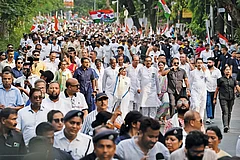


For millions of women in Bihar, Devi’s legacy is that she normalised the presence of non-elite women in positions of power, even if she did not transform the structures that govern their lives. Her political journey, therefore, sits between breakthrough and limitation. She altered the image of who could occupy power in Bihar, but did not fundamentally reshape the institutional landscape for women’s empowerment.
















