During Modi’s Norway visit, journalist Helle Lyng asked, “Prime Minister Modi, why don't you take some questions from the freest press in the world?”
Modi did not respond and walked away, triggering a debate on media access and press freedom.
Lyng said her questions were informed by the World Press Freedom Index, "Norway has the number one spot on the World Press Freedom Index, India is at 157th, competing with Palestine, Emirates & Cuba," she said on X.
It started with the question, “Prime Minister Modi, why don't you take some questions from the freest press in the world?"
Modi is on a five-nation tour that began on May 15 in the UAE. He subsequently visited the Netherlands, Sweden and Norway before reaching Italy.
Much has happened in terms of bilateral relationships and strategic meetings. On Wednesday, during his meeting with Italian Prime Minister Giorgia Meloni, Modi gifted her a packet of Melody toffees, playing on the popular “Melodi” moniker coined from their names.
The action triggered a frenzy back home, with the confectionery reportedly going out of stock on several quick-commerce platforms. Shares of Parle Industries also rose after some investors mistakenly assumed the company owned the Melody brand.
However, another moment from the tour that drew international attention took place in Norway. While Modi was awarded Norway’s highest honour for foreign nationals — the Grand Cross of the Royal Norwegian Order of Merit — he was also confronted with a pointed question from Norwegian journalist Helle Lyng of the local newspaper Dagsavisen, who was part of the media contingent covering the visit.


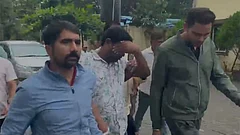

As Norwegian Prime Minister Jonas Gahr Støre and Modi concluded their joint statements and exchanged a handshake, Norwegian journalist Helle Lyng asked the Indian leader why he does not take questions from the press.
Modi did not respond to the question and walked away, accompanied by other dignitaries.
Earlier, in a post on X, Modi had written, “Addressing the joint press meet with PM Jonas Gahr Støre of Norway.” However, despite describing the event as a press meet, he did not take any questions from reporters.
In a post on X, however, she noted that “Some members of the Indian press were hung up on the fact that this was not a press conference with questions,” adding that in Norway, a press briefing typically includes an opportunity for journalists to ask questions.
After the exchange with Modi, Lyng posted on X that the Prime Minister had declined to answer her questions.
"To me it was a usual question but maybe it was a tough question for PM Modi. There’s differences in opinion, but I think critical questions are the backbone of journalism and that's where journalism should always come from," Lyng told Outlook.

The Indian Embassy in Norway subsequently responded, inviting her to a press briefing on the Prime Minister’s visit and asking her to raise her questions there.
At the briefing, addressed by Indian diplomats, Lyng pressed officials on human rights concerns in India. Why should we trust you? Can you try to stop the human rights violations that goes on in your country? she asked, repeatedly urging officials to provide a direct answer.
India rejected the allegations, stressing its “commitment to justice and freedom”.
Responding to her questions, Indian Ministry of External Affairs (MEA) Secretary (West) Sibi George highlighted India’s historical and democratic credentials, referring to the country’s association with the invention of chess and the origin of the concept of zero. He also spoke about India’s hosting of the G20 summit and its management of the Covid-19 pandemic.
Lyng remained unconvinced, repeatedly arguing that the diplomat was avoiding her questions on human rights. George, visibly upset, asked Lyng not to intercept him, stating that “This is my press conference.”
Lyng said that MEA Secretary (West) tried to answer just half of the question, which was about trust, but he did not look at trust in regards to human rights violations and press freedom.
"I think that’s important. I wish I had gotten some information on policies. For instance, is the government considering doing anything to improve human rights or improve press freedom? Will Prime Minister Modi start taking questions at press conferences at one point?," she said.
Meanwhile, MEA Secretary (West) George stated India’s democratic record, describing its elections as a festival of democracy and stating that India is the country which is based on the Constitution.
“We have a constitution which guarantees the rights of the people, fundamental rights of the people. We have equal rights of the women of our country which is very important,” he added.
Lyng said that she was hoping for direct answers, but she did not receive them.

Lyng later wrote on X: “Journalism is sometimes confrontational. We seek answers. If any interview subject, especially with power, do not answer what I asked, I will try to interrupt and get a more focused response. That is my job & duty. I want answers and not just talking points.”
Journalism is supposed to be challenging, she told Outlook. "At this point, it might have been seen as confrontational because I was trying to go back and forth, and to many people in India that might not be common to see," she stated, adding that while the questions might have appeared "heated" in India, it was business as usual in Norway.
"I just reject the premise that any leader of any powerful country can come to Norway and not be getting tough questions," she said.
However, she has also been subject to ridicule, with many commenters online stating that she was "foreign plant" and a "spy", with the motive to embarrass India. Furthermore, she claimed on May 20 that her Instagram and Facebook accounts had been suspended.
She told Outlook that these are undocumented allegations with no truth to it. However, her mental health has been affected by the entire episode. "For the first few days, even if I slept for six to seven hours, I still woke up kind of exhausted. I could feel it in my face," she said.
Lyng has repeatedly said that her question was informed by India’s ranking in the World Press Freedom Index. She said that she researched India before the Prime Minister's visit. "I knew the situation was bleak before but I didn't know how bad it was. I started reading a few stories coming out of both international newspapers and from India. I learnt that two-three journalists die each year in India, and that's alarming," she said.
As of now, India ranks 157th out of 180 countries in the Reporters Without Borders World Press Freedom Index, placing its media environment in the "very serious" category. It ranked 151 in 2025. Norway has held the first rank on the charts for a decade.
Furthermore, the PM has also not held a single news conference in India in his 12-year term in office.
Modi’s response has also invited criticism from the Congress party, with the Leader of Opposition Rahul Gandhi saying: "When there is nothing to hide, there is nothing to fear.”
Lyng responded to the post, requesting for an interview with Gandhi. She said that it would be nice to see Gandhi interview with major Indian organisations.
The Norway episode has also drawn comparisons with Modi’s 2023 visit to Washington, DC, where he appeared alongside then-US President Joe Biden at a joint press conference and took questions from both Indian and American journalists after their bilateral meeting.
During the event, Sabrina Siddiqui of The Wall Street Journal asked Modi about concerns raised by human rights organisations regarding the treatment of religious minorities and the state of free speech in India. Following the exchange, Siddiqui said she faced online harassment, prompting expressions of support from the White House.
“Mr. Prime Minister, India has long prided itself as the world's largest democracy, but there are many human rights groups who say that your government has discriminated against religious minorities and sought to silence its critics... What steps are you and your government willing to take to improve the rights of Muslims and other religious minorities in your country and uphold free speech?” Siddiqui had asked.
In response, Modi defended India’s democratic record, saying that democracy is deeply embedded in the country’s values. “Democracy is in our spirit; it runs in our veins,” he said, adding that there is no place for discrimination on the basis of caste, creed or religion. “That is why India believes in 'sabka saath, sabka vikas, sabka vishwas, sabka prayaas' and walks ahead with it.”