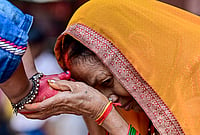
Mamata Banerjee, has cemented ‘Banglar Ashmita’, which translates to Bengali identity and pride as a crucial poll plank.
Experts attribute the mistrust towards the BJP in Bengal to cultural imposition.
BJP believes TMC’s efforts to 'secularise' Bengali identity and culture are aimed at satiating Muslim infiltrators and erasing the state's history.
Two men, both lanky and grey-haired, in phatuas (cotton tunics), stood in front of the shuttered gates of Mirtyunjoy Sweets, a popular sweet shop in Hooghly. The notice, which stated that the shop would remain shut owing to the LPG crisis, somehow offended the men, whose days begin with a visit to the shop.
When asked about their opinion, Bijon, nearing 70, blurted out the rhetorical obvious. “Bangali mishti chara bachte parbe?” (Can Bengalis survive without sweets?), he quipped confidently. The other man quickly politicised the conversation, “What more do we have to see with Modi at the Centre? Beg America to allow us to buy oil, implore Iran to let our tankers pass? Now, there’s no mishti. It’s a travesty and we can only watch.”
As election dates loom, conversations on the streets of Bengal are politically charged—most of them dramatic, half-baked, and confusing, but essential to the ethos of the state. Shiny TMC banners, besides having Mamata Banerjee and Abhishek Banerjee welcoming people into the city, sound a stark warning: that the state wouldn’t bow down to anti-Bengal forces. And amid the rumble, a foundational question emerges—‘Who is a Bengali?’


Threading both sides of the border together, the Bengali identity has always been a simple one on the surface—a composite cultural tag. Does being a Bengali still feed into stereotypes? The land of the dhoti-clad intelligentsia, the opinionated woman, the chain-smoking pseudo-intellectual, or of an identity shaped by cultural richness, liberal ideals, and the vision nurtured by nineteenth-century Bengali nationalism standing on language, education, and reformist thought?
The ruling party in the state, under Mamata Banerjee, has cemented ‘Banglar Ashmita’ as a crucial poll plank. The phrase, which roughly translates to ‘Bengali identity and pride’, has been weaponised to frame their tussle against the BJP as a cultural clash against ‘Hindi-speaking, communal, casteist forces’. Since the last assembly elections in 2021, the TMC’s focus on the ‘ashmita’ factor has been consistent and loud, aimed at reminding people of the state’s linguistic and cultural heritage. Every TMC party worker, down to the grassroots cadet, echoes the threats that the BJP’s political heritage and Hindi-forward policies pose to Bengal.
For many, this very identity remains inaccessible. Tahira, a domestic help in her late sixties, when asked what it means to be a Bengali, says, “But I am a Musalman.” She speaks in broken Bengali and stands far away from the worlds of Tagore, Ray and Nazrul. She seeks holidays around Eid and Durga Puja, a mandatory bonus during the latter festival. She’s been a voter from Bengal for many decades, but is not politically vocal. To her, the tag ‘Bengali’ always meant the Hindu middle-class.
When asked if being a Musalman takes away her right to call herself a Bengali, she said, “I think I am a Bengali Musalman. It wasn’t such a point of concern earlier. But nowadays, we are mostly identified by religion.”
Mamata Banerjee’s recent attacks against the BJP have been majorly driven by centre-state exchanges and violence against Bengali migrant workers in BJP-ruled states, in the aftermath of religious friction in Bangladesh—most of which had workers being targeted for speaking in Bengali. Last year, at the TMC-organised Martyrs Day rally, she launched Bhasha Andolan (language movement) where Banerjee argued that Bengal was not only being targeted politically, but also culturally.
‘Here, Durga is non-negotiable. Bengal will never have space for aggressive and restrictive Hinduism.’
Jawhar Sircar, a retired IAS officer, attributes the mistrust towards the BJP in Bengal to cultural imposition. “Despite Bengalis having an intrinsic difficulty in communicating in proper Hindi, we don’t have any deep-rooted antagonism to Hindi. But whenever we feel that somebody is trying to impose a culture that is not germane to Bengal, there is a huge problem. The BJP is thus being perceived as a Hindi party. The Congress was never branded the same and neither was the BJP under Vajpayee, as they never imposed, and were moderate.”
“Much like when Amit Shah asked Malayalis to worship Vamana instead of Asura King Mahabali on the occasion of Onam, the BJP’s iconography and aggressive display of Hindutva pride through motorbike rallies and open swords have always been met with repulsion from a culture that worships a composite deity. Here, Durga is non-negotiable. Bengal will never have space for aggressive and restrictive Hinduism,” Sircar adds.
The BJP’s attempts to address these gaps have been evident in the way campaign language has been altered. Prime Minister Narendra Modi speaking in Bengali, referencing Bengali literature, and invoking Maa Kali in a recent open letter have been pointed out as departures from the BJP’s usual invocation of Ram. Modi went on to invoke numerous Bengal icons in recent speeches. In his latest visit, he was seen addressing the Brigade Parade Ground with a cut-out of the Dakshineswar Temple serving as the backdrop.

The BJP’s decision to appoint Samik Bhattacharya, a relatively moderate face who has repeatedly been identified as a fish-and-meat-loving Bengali, as the state party president, is also being seen as an attempt to appeal to the middle class.
Rudranil Ghosh, convener of the BJP’s Cultural Cell, says, “When we speak of Bengal, we must not forget that the Hindu renaissance was born on Bengal’s soil... TMC wants to remove the Hindu identifier from all these names. Who were they then?” On the other hand, the TMC has consistently criticised the BJP’s attempts to appropriate Bengal’s cultural icons. Critics point at the fallacy as both Tagore and Subhas Chandra Bose harboured an idea of nationalism that denounced fundamentalism, in direct contrast to the BJP’s ideological core.
Ghosh believes that the TMC’s concerted efforts to eliminate Hindu markers are to satiate Muslim infiltrators and mask the glaring lapses in governance. “Mamata Banerjee has imported an illegitimate sense of culture which panders only to that specific vote bank... Is it okay for somebody in Bengal to wear a jibbah and roam around in summer? The TMC government has made a mockery of our culture. They have ‘secularised’ icons like Ramakrishna and Vivekananda. I ask again, weren’t they Hindus?”

Ghosh goes back to a 2017 incident where the government renamed ‘Ramdhanu’ (Rainbow) to ‘Rangdhanu’ in state-published textbooks to ‘secularise’ the word by removing ‘Ram’. “What right do they have to talk about Bengali culture when they have reduced the identity of Bengalis to migrant workers and made Bengal synonymous with theft and corruption?” Ghosh asks.
The Bengali baajar, a constant witness to the political tides, often offers gritty perspectives. Ansari, a fish vendor, when asked about Bengali identity, launched an expletive. “About time we stop equating Bengal with hilsa, mutton, luchi, roshogolla, and Rabindranath. Why is it never about the lack of jobs and industries, the unchecked spread of corruption, the fall of educational values?” he asks.
A regular customer reminded Ansari that if he were in a BJP-ruled state, his profession would be under perennial threat, alluding to the incident where vendors in Delhi’s CR Park were asked to shut shops during Navratri.
While counting notes, he diverts, “It is important to decry nostalgia, but it is high time they understand our culture and food go beyond caste, communal identity, and prejudice. Our poets were liberal. And our goddesses too. They have fish, meat and alcohol and there is nothing they (BJP) can do about it. However, I am glad Tagore didn’t live to see the day where our identity was up for grabs in a polling booth.”

MORE FROM THIS ISSUE

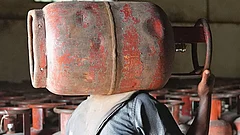
This article appeared in Outlook's April 1st, 2026 issue titled ParaDime Shift, which looks at how the US-Israel attack on Iran has come home to India with the LPG crisis and is disrupting India’s energy ecosystem, exposing policy gaps, and testing the limits of its diplomacy.