Intensifying strikes across West Asia have fuelled fears of a catastrophic escalation, with the Strait of Hormuz emerging as a critical flashpoint.
Donald Trump has announced a temporary 10-day pause on targeting energy facilities to allow space for diplomacy, even as the US continues to reinforce its military presence in the region.
Backchannel negotiations are underway but face deep mistrust, with Iran leveraging its control over key energy routes and rejecting US demands on its nuclear and missile programmes.
On the ground it is pitch-dark. But the skies light up every once in a while as incoming missiles are intercepted and the debris scattered through the night sky. The deafening sound of explosions—as bombs drop on strategic targets—convulse and shake the ground around. Bunker buster bombs target nuclear sites in Natanz, Fordow and Isfahan.

In the distance, flames from gas fields, refineries and oil depots flare and noxious smoke spreads through the region. Taps run dry as water desalination plants across West Asia are destroyed. The glittering cities built on oil wealth—Dubai, Doha, Riyadh and Muscat—are dark silhouettes. Around the Strait of Hormuz, the fighting rages. If Iran’s largest nuclear-powered Bushehr electricity plant is hit, it would be a catastrophe and the radiation will not be confined to Iran, but will spread across West Asia. Even the risk of damage to such a site would send waves of panic across the region, raising the spectre of a nuclear disaster. For now, this is only a doomsday scenario that will send the global economy into convulsion.


US President Donald Trump has extended his self-imposed deadline for a diplomatic breakthrough by 10 days. This does not mean that the war is over, just that energy hubs will not be targeted till April 6. “As per the Iranian Government’s request, please let this statement serve to represent that I am pausing the period of Energy Plant destruction by 10 Days to Monday, April 6, 2026, at 8 PM, Eastern Time,” Trump said on his Truth Social platform.
There is little clarity on whether the push for a breakthrough will yield results or simply run out of time. Meanwhile, the missiles and drones keep raining down across West Asia. Hours before Trump’s extension of the deadline, Israel said it had “blown up and eliminated” the Revolutionary Guards’ naval commander, Alireza Tangsiri, and several senior officers in a strike on the Iranian port of Bandar Abbas. The signals coming out of Washington are mixed.

While Trump appears to give peace a chance, he is also reinforcing his forces in the region. Additional forces, including 1,000 troops from the 82nd Airborne Division, are on their way, so are around 5,000 more marines trained in amphibious assaults. Thousands of sailors are being rushed to the region and will arrive by the time the deadline expires. There is speculation of a ground invasion, swift action on Kharg Island, Iran’s main oil exporting terminal, and taking over the Strait of Hormuz that has become the surprise X factor in the war. Is Trump buying time to beef up US military strength before a final thrust?
The war has triggered major shocks to the global economy, reversing growth trends with the hit on the flow of energy through the Strait of Hormuz as well as attacks on Qatar’s largest gas plant, Saudi and Kuwaiti oil refineries and forcing the UAE to shut gas facilities. Trump is sensitive to business interests and is, therefore, willing to pause and cool the stock and bond markets. He hinted of “productive conversations”. Signals emerged of backchannel contacts, mediators shuttling between capitals, and even the possibility of a meeting in Islamabad.
There is little clarity on whether the push for a breakthrough will yield results or simply run out of time. Meanwhile, the missiles and drones keep raining down across West Asia.
The contours of a possible deal are, at least on paper, taking shape—a reported 15-point proposal from Washington, and a five-point proposal from Iran. Mediators like Pakistan, Turkey and Egypt are trying to bridge the gap. Envoys are working the back channels though public posturing is very different from the hard-nosed bargaining that will happen behind closed doors.
Iran’s army spokesman, Ebrahim Zolfaghari, taunted Trump saying, “Has the level of your inner struggle reached the stage of you negotiating with yourself?” Iran’s mistrust of American overture is well founded. Peace talks were slated when the US joined Israel in bombing Iran’s nuclear sites last June. The February 28 attacks happened even as another round of negotiation was planned.

“Having rejected Trump’s coercive diplomacy before the war, the Iranians now think they have more leverage because of their control over the Strait of Hormuz and their ability to retaliate in kind against the Gulf States and Israel,” says Deepika Saraswat of the Manohar Parrikar Institute for Defence Studies and Analyses. “Iranians will not back down unless the US climbs down from its maximalist demands against Iran’s nuclear and missile programme and offers meaningful relief from sanctions,” she adds. The Strait of Hormuz is now a weapon Iran uses to choke the world’s energy supplies. Trump now is talking more about the Strait of Hormuz than of either Iran’s nuclear programme or regime change. So long as Iran controls the Strait, it has leverage in the war. Former chief of the Secret Intelligence Service of the UK, British Alex Younger, speaking to The Economist’s Shashank Joshi, said that Iran has the upper hand. “The reality is the US underestimated the task and I think as of about two weeks ago lost the initiative to Iran,” he said in the podcast, adding, “In practice, the Iranian regime has been more resilient than I think anyone would have expected.”
There is a huge trust deficit between Iran and the US, a gap that cannot easily be bridged. Tehran has already rejected the 15-point US peace proposal. They were on expected lines: Giving up the nuclear option, opening the Strait of Hormuz—which Iran says is closed only for US, Israel and their allies—ending the ballistic missile programmes and no funding of proxy groups. These are the main sticking points. Another crucial question is what happens to the 440 kg of highly-enriched uranium that Iran has?
Tehran’s counter proposals are an immediate halt to a US-Israel military aggression, targeting and assassination of officials and legal and verified guarantees against future attacks on Iran. Tehran is afraid that Israel will continue to conduct strikes whenever it wants as it does in Gaza, Syria and Lebanon. It wants payment of war reparations, end to regional hostilities, including all resistance groups, and recognition of sovereignty and control over the Strait of Hormuz. Both the US and Iran have put forward maximalist positions that can be narrowed in time through negotiations.
As of now, neither side is willing to compromise. So what happens after the deadline? Most analysts believe that Trump will be looking to control Kharg Island, through which 90 per cent of Iran’s oil exports take place. According to CNN, Trump always had his eyes on the island, and had spoken of taking it on as far back as 1988!
“Given that Trump’s hope for a quick win has been dashed, he is willing to make a high-risk gambit, threatening a ground operation aimed at seizing the Iranian island of Kharg or three other islands, which are disputed by the UAE,” says Saraswat.
Most analysts say that if the US deploys ground troops, it will work towards Iran’s advantage. However, no one can say what will happen, more so as the US-Israel military will take full advantage of their superior air power. Iran will be pounded to the ground, but Iranians have demonstrated that they have a higher pain and risk tolerance level. The regime has nothing to lose. Regime change is no longer bandied about by either Trump or Israeli Prime Minister Benjamin Netanyahu. In this fourth week of the war, the issue has moved from degrading the regime to the territorial integrity of the Iranian nation.
“The war is clearly heading towards a stalemate demanding heavy military mobilisation by the US, dragging the Gulf Cooperation Council (GCC) states in a war of unpredictably high risks. Trump never planned for this long war, it was all a shock and awe war,” says Omair Anas of Ankara Yıldırım Beyazit University. “All that Trump needs is an exit and all that Iran benefits from is a prolonged conflict. As a result, there are only two possibilities, full war with boots on the ground or a negotiated exit,” adds Anas.



Seema Guha is a senior journalist covering foreign affairs
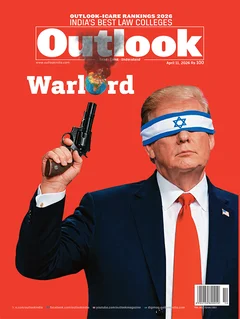
This article appeared in Outlook’s April 11 issue titled ‘Warlord’ that focuses on the aggression unleashed on Iran by US President Donald Trump and the repercussions that are being felt across the globe with no end in sight.