






The conflict is framed as a test of endurance and national resolve, with Iran drawing on historical pride and identity to resist pressure from Donald Trump and his allies.
Drawing parallels with World War II and the writings of Harold Nicolson, the piece argues that societies under attack often unite rather than fracture.
It suggests the US may be underestimating nationalism and ideological resilience in Iran, turning the war into a prolonged contest of nerves rather than a swift military outcome.
Why has Tehran not yet capitulated to President Donald Trump in his war of choice on Iran? No one can answer that question; no one can even predict what West Asia will look like after a few weeks. We do not even know exactly what kind of pain and destruction the adversaries have managed to inflict on Iran; nor, for that matter, can anyone know the retribution that Iran has visited on its adversaries.
That apart, there is no way to assess in real time the impact of the US-Israel’s relentless aggression on Iran, its ruling elites, and the citizens at large. Historians tell us that a war forces every society to redefine itself, to find the reservoir of resolve and rectitude to face the “enemy”.

One can get a fairly good idea of the psychological stress and the emotional trauma a society undergoes from reading wartime diaries. Perhaps no other wartime account matches the lucidity, sincerity and integrity of Sir Harold Nicolson’s Diaries and Letters, 1939-1945.


Nicolson was an eminent ‘public intellectual’ of his time, an enthusiastic Winston Churchill crony, and, it was natural that he should have effortlessly found himself co-opted in the decision-making at the highest level during the Second World War. His diary entries and correspondence provide a tentative clue to what the Iranians might be experiencing right now with cities being subjected to destruction.
On December 9, 1942, Nicolson candidly writes to his wife:
“I feel this war is a test of our character and I rejoice that all those I love have come through it enhanced and not diminished. I want to live through this war with my courage unabated, my faith firmer, my energy increased, and my hoped and beliefs lit be a sun that has never lit them before. I have much pride in my own people and much faith in the future. I really do believe that we in England have set an example to the world.”

Standing up to aggression has an intoxicating tinge to it. Most Americans practitioners of realpolitik may believe in the concept of “just war” or “necessary war”, but for the invaded country the only option is to stand up, hold its ground, and defy the aggressor. In this case, the Iranians have the undiminished pride of an ancient civilisation to sustain themselves against Trump’s thuggish onslaught. The Iranians perhaps also know that Trump’s recklessness is against the grain of the American sense of their own society and its moral values.
During the early days (September, 1940) of the Second World War, Hitler had the upper hand. Nicolson notes:
“Hitler has done great material and moral damage in London by employing only a few planes on nightly raids. He can, if he wants, sends planes across London for the whole twenty-four hours. Shall we be able to stand it?”
That is the question occurring to many Iranian leaders and citizens. Like the citizens of London then, the Iranians now must be on the edge of their collective seat when Trump is threatening unprecedented force of violence. Hitler’s hope then was that the English morale would crack and the British establishment would be forced to sue for peace on German terms. Now the American calculation seems to be that the Iranian people—after suffering all the pain the Trump-Netanyahu duo has inflicted on them—would spurn their rulers. What colossal underestimation of the power of nationalism!
Another diary, of July, 1940, is illuminating:

“I think that Hitler will probably invade us within the next few days. He has 6,000 aeroplanes ready for the job. How strange it all is! We know that we are faced with a terrific invasion. We half-know that the odds are heavily against us. Yet there is a sort of exhilaration in the air. If Hitler were to postpone invasion and fiddle about in Africa and the Mediterranean, our morale might weaken. But we are really proud to be people who will not give way. The reaction to Hitler’s speech yesterday is a good reaction. Yet I know well that we shall be exposed to horrible punishment. It is so strange that in this moment of anxiety there is no hatred of Hitler or the Germans.”
Nicolson’s wartime ruminations on how the English sense of honour and pride induced the society to close ranks behind Winston Churchill provided the template that got repeated in Vietnam, Afghanistan and Iraq. Trump himself, at one time, railed against “strategic imbecility” that stranded successive American administrations in endless wars. Now he has allowed himself to be persuaded to ignore the lessons of history and the power of nationalism.
Sixty years ago, Thomas C. Schelling, the guru of all ‘strategic’ gurus, had anticipated, in his classic, Arms and Influence, the current conundrum:
“War appears to be, or threatens to be, not so much a contest of strength as one of endurance, nerve, obstinacy, and pain. It appears to be, and threatens to be, not so much a contest of military strength as a bargaining process—dirty, extortionate, and often quite reluctant bargaining on one side or both—nevertheless a bargaining process.”
The American-Israeli war on Iran has come down to a contest of nerves. The Trump crowd seems to have convinced itself: (a) the Islamic Revolution has spent itself out, and that a cabal of military thugs and religious fanatics have hijacked Iran; (b) that the Iranians hanker after the good old days before Ayatollah Khomeini returned to Tehran in January 1979 (after 14 years of exile); and, (c) that the Iranians cannot take punishment for long and would soon reach a breaking point and then they would “take back their country”.

This is a gross misunderstanding of Iranian national identity. Iran, very much like the US itself and Israel, has become conditioned and acclimatised to a culture of war: unending conflicts with others no longer upset the rhythm of daily life.
For nearly five decades—for better or for worse—rigorous Islam has been officially crafted on Iran’s national imagination. It is not that it was Khomeini who introduced Islam to Iran; the Ayatollah’s great achievement was to resurrect the religious moorings which the Shah had sought to suppress and impose his own “modernising” ideas. Islam and its doctrines and dogmas cannot be wished away.

Beyond Islam, there is the pride of an ancient Persian civilisation that infuses Iranian identity. Unfortunately, the Americans, with so little of pride in their national journey, have arrogantly belittled the power of memories.
The Islamic regime sees itself—just as the Shah did—entitled to influence and control the region. Not long ago, Washington was content to cast Iran in the role of a “policeman” in the region. Former US Secretary of State Henry Kissinger effusively had called the Shah’s Iran “a friend of our country and a pillar of stability in a turbulent and vital region”. The Islamist rulers are not willing to let go of that kind of role.
The great irony is that Trump who promised to walk away from the “Washington elites’” obsession with nation-building abroad has now fallen for idea of “democracy” in Iran. It is a matter of debate whether Iran was more democratic under the Shah, whom Kissinger called a “gentle, even sentimental man” and whose autocratic excesses were “in keeping the traditions” of his society.
All it adds up to is a simple lesson which American policymakers have consistently refused to learn and respect: do not underestimate the power of nationalism and its hold on popular imagination. Iran will once again drive home the potency of nationalism.
(Views expressed are personal)
Harish Khare is a Delhi-based senior journalist and public commentator
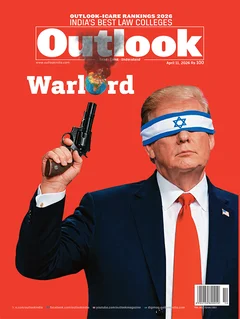



This article appeared in Outlook’s April 11 issue titled ‘Warlord’ that focuses on the aggression unleashed on Iran by US President Donald Trump and the repercussions that are being felt across the globe with no end in sight.
















