A two-week US-Iran ceasefire has paused hostilities, with crucial talks set to begin in Islamabad.
Control of the Strait of Hormuz remains a key leverage point for Iran in negotiations.
Ongoing Israel tensions and deep mistrust threaten the chances of a lasting peace deal.
“A whole civilization will die tonight, never to be brought back again.” This dark ominous tweet by US President Donald Trump captured the mood of a world teetering on the brink. That doomsday scenario has, for now, been pushed back, thanks to the enormous backroom diplomatic efforts led by Pakistan with China coming in at the last moment to persuade Iran to agree.
What is in place is a fragile two-week pause to the bombings. Negotiations between the US and Iran will begin on April 11 in Islamabad. Vice President J. D. Vance is leading the US delegation. Whether that leads to a lasting peace or a fresh start to the war is anybody’s guess. Meanwhile, Israel’s continuous bombing of Lebanon could just be a deal breaker, with the US and Iran quibbling over Lebanon being included in the ceasefire.
Both sides are shaping their narratives to claim victory. The trust deficit between the US and Iran remains in place. The US had twice attacked Iran in the middle of the talks—last June and again this February. “We will not allow diplomacy to be used as a cover to prolong the confrontation,” Abbas Araghchi, Iran’s foreign minister, noted before the agreement, adding that “the Iranian people cannot be threatened every year.”


Both Trump and Iran finally agreed to the pause just around 90 minutes ahead of the deadline. The ceasefire has led to some respite from the daily bombings and given the global economy some hope. Oil prices are down significantly. The Gulf-Arab states of the region, which were targeted repeatedly by Iran for hosting the US forces, have already suffered losses and realised that without the pause, they were liable to suffer much more damage. Their reputation as the global hub for business has already taken a big hit.

The next two weeks will be a period of high-stakes poker where both sides will argue over every point. Israel’s unease is palpable as its strategic objectives have only been partially met. It will want to wreck the deal. Iran, battered but unbowed, knows it has played its cards well. The Strait of Hormuz is its most potent weapon. It is the only weapon it has as leverage in a war against the world’s most powerful military. By controlling the waterway—through which 20 per cent of the world’s energy passes—Iran has leverage over global trade and will not agree to give that up. Trump went to war relying on Prime Minister Benjamin Netanyahu’s assessment that once the top Iranian leadership is decapitated, and some heavy bombings clear the ground, the regime would collapse. It would be short and swift. Nothing like that has happened and Trump wants to get off before more damage is done.
Iran has agreed to Trump’s demand of immediately opening the waterway. Araghchi has made it clear that the Strait will remain open during the two-week ceasefire, and safe passage will be possible only after “co-ordination” with Iran’s armed forces. Tehran for now remains in charge of the Strait. It halted movement temporarily after Israel’s heavy bombing of Lebanon. Iran’s 10-point ceasefire proposal includes a plan to impose a fee of roughly $2 million per ship and share the revenue with Oman. Tehran will use the funds to rebuild the infrastructure damaged in the recent US and Israeli strikes.
“The two-week pause serves both sides. Trump has backed off despite his overblown rhetoric about bombing Iran back to the Stone Age and destroying Iran as a civilisation. Trump cannot accept the core of the 10-point Iranian plan as it would amount to a humiliating defeat for the US. That Iran has stood up to the US and forced a ceasefire is a success for Iran. But the whole thing is uncertain,” says Kanwal Sibal, India’s former foreign secretary.
Ahead of the Islamabad talks, and after over a month of war, where do the US, Israel and Iran stand? Trump has already declared victory several times, and he can still claim that and walk away as the US and Israel have substantially degraded Iran’s defence forces. So far, the US military, in co-ordination with Israel, has carried out strikes against 13,000 targets in Iran. Another 3,000 were on the list, according to reports in the American press. The downing of a US F-15 over Iranian airspace briefly punctured the myth of invincibility surrounding the world’s most powerful military, but that disappeared following a high-risk rescue mission under heavy enemy fire of an American colonel from behind enemy lines just two days later. Trump can frame his Iran misadventure to his supporters as a big win.

Netanyahu may not be too happy as his hopes of destroying all of Iran’s civilian infrastructure and bringing in regime change remain unfulfilled.
As for Iran, despite the fact that Supreme Leader Ali Khamenei, top security officer Ali Larijani and most leading figures of the regime were taken out and its military capabilities destroyed to a large extent, it is claiming victory. As Ian Bremmer, president of the Eurasia Group, says, “Iran now has more geopolitical influence than before the war” because of its control over the Strait of Hormuz. Iran will go to the negotiating table with renewed confidence and may not be as willing to give up its nuclear options as well as the enriched uranium it still has.
Realists point to the fact that there is deep mistrust between the two sides. Iran is determined to get out of the crippling sanctions regime, while Washington wants to cap Iran’s nuclear and missile capabilities.
“A short ceasefire is unlikely to transform the strategic picture on its own, but it may still open the door to a longer pause… that could potentially produce an extended ceasefire without producing a deeper political settlement,” says Ali Mammadov, scholar and researcher at George Mason University.
The US-Israeli action in Iran has already blurred the line between military and civilian targets. On the first day of the war, America hit a school in Minab killing 175 children and teachers. Iran’s premier vaccine production centre—the Pasteur Institute founded in 1920 that has a research centre attached—was razed to the ground. Universities, health centres and schools have all been reduced to rubble. All this before the April 7 deadline. As in Gaza, no place was safe for the people of Iran and no target out of bounds for the US and Israel.
“Trump’s threat to ‘bomb Iran back to the stone ages (sic)’ (April 1, 2026) and to cause ‘a whole civilization to die, never to be brought back again’ (April 7, 2026) is not a mere war crime, but the expression of intent to commit genocide,” says Philip Golub of the American University of Paris. “The point is that even if it was intended as a blackmail threat, it still constitutes in law a statement of intent to commit genocide (as per the Genocide Convention),” adds Golub.
He goes back in history to point out that “…Trump will be remembered as the heir to the Roman general Scipio Aemilianus who razed Carthage to the ground in 146 BCE during the Third Punic War. Like the Romans, he and Netanyahu are creating ‘desolation and calling it peace’”.

Tehran has also targeted civilian infrastructure in retaliation, oil refineries as well Qatar’s LPG hub. Hotels that hosted American military officers were also attacked.
The US-Israel and Iran war is a perfect David and Goliath situation, with Iran displaying an enormous tenacity to absorb the punishing blows. What explains Iran’s resilience? “Yes, the cost of war is extremely high. But a nation that chooses dignity and pride is prepared to pay any price,” says an Iranian diplomat who did not want to be identified. Some of this is embedded in the embrace of martyrdom for a just cause among Shia Muslims.
The martyrdom of Imam Husayn ibn Ali, the grandson of Prophet Muhammad at the hands of the superior forces of the Umayyad ruler Yazid 1, remains an abiding principle of resistance for Shia Muslims. Their religion glorifies death for a just cause, and takes inspiration from the battle of Karbala fought in 680 CE.
“If we feared death, we would not have entered this war, and would not have offered our finest men as martyrs. Death is an honour for us while defending our homeland …We were born free and we will die free,” Araghchi said recently when asked about taking on the world’s most powerful country.
The two-week pause to give negotiations a chance could go either way. Expectations are low. “This is, first and foremost, an Israeli war. The United States has been drawn into it, largely due to the influence of a powerful pro-Israel lobby in Washington,” says Mohammad Makram Balawi, secretary general of the League of Parliamentarians of al Quds and Palestine. “Even if the current war were to stop, it would most likely represent only a temporary pause within a longer-term ideological and strategic confrontation,” he adds.

Realists point to the fact that there is deep mistrust between the two sides. Iran is determined to get out of the crippling sanctions regime that has bound its natural talent indefinitely, while Washington wants to cap Iran’s nuclear and missile capabilities once and for all, and if possible, ensure that the Strait of Hormuz remains out of Iranian control.
As negotiators prepare to gather in Islamabad, the world holds its breath. Failure to stop the war will hurt not only the region, but the entire global economy.
Seema Guha is a senior journalist covering foreign affairs.
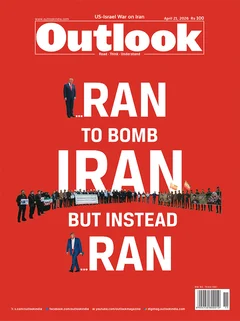


This article appeared in Outlook’s April 21 issue, 'I Ran To Bomb Iran, But Instead I Ran' which looked at the US-Israel war on Iran and what it means for families living through it and what is at stake in the states going to elections in the first phase.