Maritime attacks linked to the Iran-US conflict have put Indian lives at risk and sparked diplomatic protests.
Despite an interim trade deal, tariffs and ongoing negotiations continue to strain economic ties.
A surge in deportations and controversial remarks about India have added to bilateral tensions.
India has found itself caught in the crossfire between Iran and the United States, with three maritime incidents involving vessels carrying Indian nationals reported within a week and linked to actions by U.S. authorities.
U.S. Central Command (CENTCOM) issued statements on two of the incidents — one on Monday and another on Wednesday — saying its forces had targeted Palau-flagged vessels Marivex and Settebello while they were transiting international waters in the Gulf of Oman.
According to CENTCOM, precision munitions were used after the vessels’ crews failed to comply with directions issued by American forces.
Iran and the United States have renewed exchanges of strikes, raising concerns that the fragile April ceasefire between the two countries may be unravelling.
India’s Ministry of External Affairs condemned Wednesday’s attack on the Settebello, which had 24 Indian nationals onboard. While 21 crew members were rescued, three were initially reported missing.
On Thursday, Minister of Ports, Shipping and Waterways Sarbananda Sonowal confirmed the deaths on X and described the incident as deeply unfortunate. The deceased included one each from Uttar Pradesh, Himachal Pradesh and Andhra Pradesh.

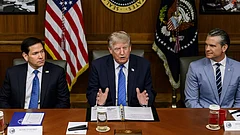


While US President Donald Trump has not made any public statements regarding the targeting of vessels carrying Indian nationals, relations between the two countries appear to be entering a difficult phase as New Delhi balances its strategic ties with Washington against growing concerns over the safety of Indian citizens caught in the conflict.
As India reiterated its “call for immediate de-escalation of tensions”, the government also summoned Jason Meeks, Deputy Chief of Mission at the U.S. Embassy, and lodged a “strong protest” over the incident.
The war in West Asia, which began in February after Iran's supreme leader, Ayatollah Ali Khamenei, was killed in US and Israeli air strikes, has had significant repercussions for India. With the Strait of Hormuz closed, the country has been grappling with rising fuel and gas prices while also seeking to preserve stable bilateral relations with the United States amid mounting economic pressure.
India’s stakes in the conflict were high from the outset. On March 4, a U.S. Navy attack submarine sank the Iranian Navy frigate IRIS Dena in international waters off Sri Lanka’s southern coast. The warship had been returning from the multinational MILAN naval exercise hosted by India in Visakhapatnam, underscoring New Delhi’s proximity to developments that would later draw it into the fallout of escalating tensions between Washington and Tehran.
US Secretary of State Marco Rubio’s recent four-day visit to India, his first since assuming office in January 2025, was widely understood to be aimed at repairing bilateral ties that have been significantly strained over the past year.
During the visit, Rubio addressed repeated questions about U.S. President Donald Trump’s post that amplified anti-immigrant sentiments and referred to India as a “hell-hole”.
“The President’s a big fan of India, a big fan of Prime Minister Modi,” he said.
The issue arose when Trump, on Truth Social, reposted comments by conservative podcaster Michael Savage during a discussion on birthright citizenship in the United States.
"A baby here becomes an instant citizen, and then they bring the entire family in from China or India or some other hellhole on the planet," the transcript documents Savage as saying.
Without naming Trump or Savage, India strongly objected to remarks, describing the comments as uninformed, inappropriate and in poor taste.
"They certainly do not reflect the reality of the India-US relationship, which has long been based on mutual respect and shared interests," the ministry said in its statement.
India and the United States have endured a tumultuous period since Trump returned to office, with trade disputes and deportations emerging as major points of friction. Tensions escalated further after Washington imposed additional tariffs on Indian imports in response to India’s continued purchases of Russian oil.
In August last year, the Trump administration announced that it would levy a further 25% tariff on India, citing continued Indian imports of Russian oil and raising total tariffs on Indian goods to 50%.
The President signed an emergency executive order titled “Addressing Threats to the US by the Russian Federation”, invoking his constitutional powers to argue that Russia and Russian products posed an “unusual and extraordinary threat to the national security and foreign policy of the United States”. The order specifically singled out India over its continued direct and indirect imports of Russian oil.
A trade agreement was eventually reached in February this year, after Trump agreed to withdraw the additional 25% tariff on Indian imports in recognition of India’s commitment to halt purchases of Russian Federation oil.
“Given India’s willingness to align with the United States to confront systemic imbalances in the bilateral trade relationship and shared national security challenges, the United States will lower the Reciprocal Tariff on India from 25% to 18%,” the U.S. statement read.
However, despite the interim February trade agreement being in place, Trump has continued to send mixed signals over the prospects of a broader trade deal, repeatedly suggesting that an agreement is close even as fresh tariff proposals from his administration threaten to complicate negotiations, with Trump frequently referring to India as a "tariff king".
"We'll get to a deal, because I like your prime minister a lot," Trump told reporters in the Oval Office last week. "He's a good friend of mine. We get along great, and we're going to make a deal."
India has maintained that both sides remain committed to securing a mutually beneficial bilateral trade pact. Yet uncertainty has persisted after the United States announced new tariffs ranging from 10% to 12.5% on dozens of countries, covering almost all imports, over concerns that they were not doing enough to address forced labour. India was among the countries included in the measures.
Trump also renewed his criticism of India’s trade practices, arguing that New Delhi had long benefited from an uneven trading relationship with Washington. "They charged us tremendous tariffs and paid nothing...Now it is the exact reverse and we are making a lot of money with India," he told reporters on Thursday.
Over the past year, the United States has also intensified its crackdown on illegal immigration, making it one of the busiest periods in the history of the US Immigration and Customs Enforcement.
Furthermore, after last week’s vote, the agency is set to receive tens of billions of dollars in additional funding after Congress approved a $70 billion package to finance ICE and the U.S. Border Patrol through the remainder of Trump’s administration.
Despite strains in bilateral ties, Trump has continued to express personal admiration for Indian Prime Minister Narendra Modi. As Modi became India's longest-serving elected prime minister, Trump congratulated him on the milestone, describing him as “a Great One he is!”
Meanwhile, the number of deportees sent back to India has risen sharply in recent years, increasing from 617 in 2023 to 1,368 in 2024. In 2025, the figure surged further to 3,258 as of November 28, highlighting a significant escalation in deportation numbers.
“As many as 1,076 Indian nationals have been deported from the U.S. this year so far,” the Ministry of External Affairs said on Friday June 5, 2026.