Thousands gathered at Jantar Mantar before the CJP's Parliament march ended in clashes with police.
Protesters and police personnel were injured as tear gas and lathi-charge followed attempts to cross barricades.
Hospital scenes and eyewitness accounts reflected the human impact of a day marked by confrontation and unrest.
At the emergency ward of Ram Manohar Lohia (RML) Hospital on Monday evening, students with bloodied bandages, stitched wounds and bruised and swollen limbs waited for treatment after violence broke out during the Cockroach Janata Party's (CJP) protest demanding the resignation of Union Education Minister Dharmendra Pradhan at Jantar Mantar.
Most of them had travelled to Delhi after appearing for the National Eligibility cum Entrance Test (NEET) held on May 3 this year, which saw a massive leak and led to at least 12 NEET aspirants committing suicide.
A group of young men present at RML told Outlook India they had joined the demonstration not out of political allegiance but to demand accountability from the government over what they described as repeated controversies surrounding the medical entrance examination.
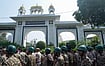
By late morning, Jantar Mantar had filled with students, young professionals and supporters carrying the tricolour and handwritten placards. Volunteers moved through the crowd distributing food and water, while organisers repeatedly reminded demonstrators to remain peaceful and avoid any confrontation with the police. Beyond the gathering, multiple layers of barricades, along with a heavy deployment of Delhi Police and paramilitary personnel, sealed the roads leading towards Parliament, preventing the march from moving beyond the protest site.


Among those who arrived was 19-year-old Abhishek Sharma, a NEET aspirant. He said he reached Jantar Mantar expecting a peaceful demonstration, only to find the area heavily barricaded and under tight police surveillance. What began with slogans and speeches, he said, soon descended into chaos as police used lathis and tear gas to disperse the crowd.
Sharma said he was struck on the head with a baton and lost consciousness. Friends pulled him out of the crowd and rushed him to RML Hospital. Hours later, he was discharged with his head wrapped in bandages after receiving two stitches. "If the government had acknowledged its mistake and assured us it wouldn't happen again, we wouldn't have been here," he said.

Inside RML's Emergency Ward
The demonstration came after weeks of mobilisation by CJP, which has sought to channel widespread student anger over examination-related controversies into a broader demand for accountability from the government. The movement gathered fresh momentum over the weekend after police shifted activist Sonam Wangchuk to a hospital on the 21st day of his indefinite hunger strike in support of the campaign. His wife said he continued his fast from the hospital. On Monday, Wangchuk appealed to doctors to discharge him so he could join the march, but he was not permitted to leave.
By evening, the impact of the clashes was visible across RML's emergency ward. According to hospital sources, at least 60 injured people were brought in throughout the day. Of them, at least 25 were admitted, while one person remained in critical condition. Alongside injured protesters, police personnel in blood-stained uniforms waited for treatment in the same corridors.
Police officials present at the hospital said at least 30 personnel were injured during the unrest, offering a sharply different account of how the violence unfolded.
One of the injured officers, deployed outside Parliament Street Police Station, said the situation remained under control until around 11.45 am, when demonstrators approached from both sides of the road. "We were just trying to move them back," he said. "Then suddenly they became aggressive. There was some sloganeering, and all of a sudden stone-pelting started."
The officer, who received three stitches to his head, said he and a colleague were injured within minutes of being deployed. "We didn't even realise where the stones had come from or how we were hit," he said. He added that a woman Delhi Police constable was seriously injured after a tear gas shell exploded nearby and she was caught in the ensuing stampede. "I think she's been put on a ventilator," he said.
Despite his injuries, the officer said he initially continued on duty before being sent to hospital. "We aren't made of steel," he said. "Someone suddenly gets hit by a stone, it could happen to anyone."

Rain, Tear Gas And Injuries
Back at the protest site, even a spell of rain failed to disperse the gathering. Volunteers stretched blue tarpaulins over clusters of demonstrators as chants continued and soaked protesters waited for word from the police barricades. By then, they were encircled by a human chain of Delhi Police and Rapid Action Force (RAF) personnel. Behind the security cordon, a police vehicle moved along the edge of the gathering, repeatedly firing tear gas shells as officers attempted to disperse the crowd.
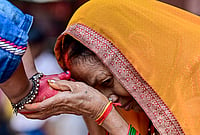
Caught in that chaos was 32-year-old Nutan Toppo, who had come not because she had appeared for NEET but to stand in solidarity with the students. As protesters turned to flee the tear gas, a shell struck her near the ear, tearing through the side of her face. The injury ripped apart the external structure of her ear, requiring emergency surgery at RML Hospital.
Toppo had expected to attend a peaceful protest and return home the same day. Instead, she found herself in an emergency ward, brought there by strangers she had met only hours earlier at the protest. "Even when we were sitting peacefully, they kept firing tear gas again and again," she said. "I never imagined it would happen this way."