Justice Muralidhar said governments must prioritise humanitarian aid, protect children and uphold international law.
He said the commission's evidence was already informing international legal proceedings.
The UN report documented more than 20,000 Palestinian child deaths and over 44,000 injuries since October 2023.
Days after the United Nations (UN) Independent International Commission of Inquiry released its findings on Gaza, Commissioner Srinivasan Muralidhar said the evidence collected by the panel is already informing proceedings before international courts. He said both the ICJ and the ICC are relying on the commission's evidence because it meets their high evidentiary standards and aligns with their evidence-gathering protocols.
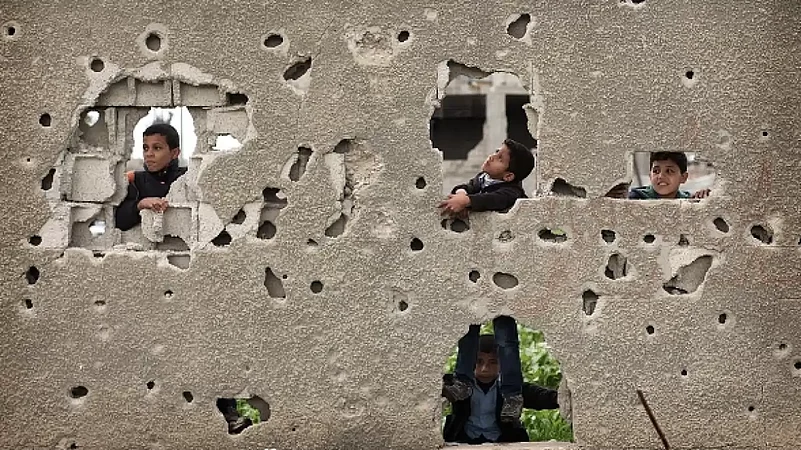
"Children constitute more than 30 per cent of those killed in the Occupied Palestinian Territory between October 7, 2023 and October 7, 2025," he said. The report documents the killing of more than 20,000 children and the injury of over 44,000, alongside widespread destruction of schools and healthcare facilities, rising malnutrition, and the disruption of education and medical care.
In an interview with Outlook India, the former Delhi High Court judge discusses the commission's findings, the evidence underpinning its conclusion that Palestinian children have been systematically targeted, the prospects for accountability under international law, and why he believes governments must move beyond action statements.


Edited excerpts:
The report talks about the systematic targeting of children. Why is it that children are targeted specifically?
Children constitute the sociological and biological continuity of the Palestinian people. The intent of the State of Israel that there should be no continuity of the Palestinians as a group is discernible from the statements made on public platforms by far-right Israeli politicians, particularly after October 7, 2023, that no child in Gaza should be spared and that every child there is an enemy.
The report explains how intensive airstrikes are used in the most densely populated areas to cause maximum fatalities, which has continued from October 7, 2023 to October 7, 2025. The airstrikes have continued even after the ceasefire. The percentage of children dying in those airstrikes is very substantial, as 30 per cent of all those killed since October 7 have been children. The number could be higher because, for example, when a building is brought down under the rubble, there could be several children's bodies still trapped. The above figure also does not include those who have died of malnutrition and starvation or for want of medical help.
Can you please elaborate on how these attacks were conducted?
The attacks happen in two ways. One is the airstrikes. In the first two weeks of the intense bombing after October 7, it became clear that children were a greater proportion of the fatalities. Any country that is launching such a campaign would have its plan changed if it finds that too many children are dying. However, Israel did not do that and persisted with the same intense air bombing for nearly two years, even thereafter.
The second method of attack is using quadcopters, drones, and sniper rifles. The quadcopters are fitted with thermal imaging cameras, and the operator, sitting in a remote location, can see on the screen whether the target is a child or an adult. Therefore, they can specifically target a child either in the head or the neck.
The testimonies of the treating doctors who deposed before our Commission, including the three who deposed at the oral hearings we conducted in Geneva and the photographs produced by them, show that a large number of children were brought in during these two years of bombing with injuries specific to the head and the neck.
These are vulnerable parts and the attack is intended to cause instantaneous death. There are small cube-shaped pellets being used to target the upper portion of children's bodies. The photographs were shown to us by the doctors, who explained that the cube-shaped pellets have tungsten in them. Once it enters the baby's body, it dissolves the tissues and causes massive damage to the internal organs.
We have instances where a ten-day-old breastfeeding baby is shot through the head, and the breastfeeding mother is unharmed. In another, a child was shot while the accompanying adult escaped unharmed. This is a trend that we have seen, which is why we say it is very deliberate and targeted.


The previous UN report found genocide in Gaza, while the latest says Israeli policies and settlement expansion may amount to international crimes. Can these findings lead to meaningful policy action?
The Commission’s findings are of assistance to ongoing judicial proceedings. One is what South Africa has brought against Israel in the International Court of Justice (ICJ). There is another proceeding before the International Criminal Court (ICC). Both these bodies are using the evidence gathered by this commission because it is of a very high standard and aligned with their evidence-gathering protocols.
How else can this report aid the justice process?
In the report, we have identified the specific brigades, units and divisions of the Israel Defence Forces (IDF) involved in incidents of war crimes, genocide and crimes against humanity. These battalions also have nationals of countries other than Israel. Citizens of nearly 17 countries are serving in the Israeli Defence Forces, including nearly 13,000 US nationals, 6,000 French, German and UK citizens.
Many of these countries are treaty parties to international conventions, like the Geneva Conventions, the ICCPR or the Convention on the Rights of the Child. Therefore, there is an obligation on such treaty parties to ensure that anyone accused of violating those provisions is investigated and brought to trial in their respective countries. So, under international human rights and humanitarian law, the respective countries are under an obligation to investigate that person's role if authorities find there is a case to answer.
In that exercise, the domestic courts or government can reach out to this commission for evidence, and the commission is prepared and mandated to share the evidence it possesses. The process of cases being instituted against members of the Israeli Defence Forces in domestic courts around the world has already begun. That is one change we are seeing.

The commission has recommended including both Israeli and Palestinian groups in any future peace process. Given the current composition of the Board of Peace, do you believe these recommendations can realistically be implemented?
Of course, I have hope. These recommendations are made with the expectation that they will be acted upon. Otherwise, we would be wasting our time writing a report like this. I am not going to say we spent months and years collecting evidence, but have no hope. We are not here to tell the world that we have done all this work and still have no hope. You have to have hope.
India has long recognised Palestine, while it has also started to deepen its strategic and defence ties with Israel. How do you view India's position in the current context?
Recently, during his visit to Indonesia, our Prime Minister reiterated India’s support for the two-state nation solution and for the Palestinian people.
Beyond legal accountability, what immediate steps should the international community take to protect Palestinian children and address the humanitarian crisis in Gaza?
The Palestinian children are in dire need of immediate relief. They are in a precarious condition with the denial of basic needs of shelter, healthcare and education. They are all in displacement camps and are getting bombed, leading to more fatalities. There are no health facilities. Paediatric hospitals have been destroyed, neonatal facilities have been destroyed, and children who need urgent medical evacuation have to depend on Israel's permission to leave Gaza through the Rafah border with Egypt.
If Israel permits their evacuation to places such as the West Bank or East Jerusalem, where better medical facilities are available, many more children can be saved. Children awaiting medical treatment are dying at the Rafah border because not enough can be evacuated. This is despite neighbouring countries offering to take them for treatment. This seems to be happening in front of the world's eyes.

Do you see signs that global attitudes towards the situation in Gaza are changing?
The mood on the ground is changing. Although many people in the media whom I have spoken to keep expressing despondency, when Palestinians themselves have not lost hope. The flotilla activists are telling the whole world: whether our countries want to act or not, we want to act. We have already seen three waves of flotilla activists. If people had no hope, they would not be doing that.
Everybody recognises that the situation in Palestine is dire and something needs to be done to help the Palestinian people, particularly children. Humanitarian aid should be allowed into Gaza in much larger volumes than what is happening now. Countries should put aside their geopolitical compulsions and ensure that no child in Gaza dies of starvation and no child dies for want of medical treatment.
It is not just about Palestine. Even as we speak, the situation in Sudan is also very bad. There are many parts of the world where children and innocent civilians are suffering needlessly because of hostilities. If, despite all the Geneva Conventions and other international treaties, countries are unable to put politics aside to deliver aid to people who desperately need it, then it poses a big challenge to the international legal order itself.
You do not need any more proof or reports. The time to act is now. We cannot shrug our shoulders, allow children to die in such large numbers, and then, five or ten years later, say, "We should have done this. We should have done that." That voice of outrage has to be heard and acted upon by countries, not just India, England or France, but every country in the world. I think every country has obligations under international law.