The death of ride-sharing driver Prakash Bhusal after self-immolating during a protest has triggered Nepal's largest demonstrations since last year's political transition.
Protesters are demanding accountability from Kathmandu's municipal police and broader institutional reforms.
The incident has reignited concerns over governance, policing and whether Nepal's new leadership is delivering on its reform promises.
The government's response to the investigation and wider reforms is likely to shape public confidence in Nepal's new political order.
What began as a confrontation between a ride-sharing driver and Kathmandu's municipal police has rapidly evolved into the first major political challenge for Nepal's new government.
In the capital city, 25 year-old Prakash Bhusal, a ride-sharing driver, died after setting himself on fire during a protest outside the Kathmandu Metropolitan City office, days after his vehicle was seized by municipal police during an enforcement drive.
His death has since triggered demonstrations across Kathmandu and other parts of Nepal, with protesters demanding accountability from city authorities and wider reforms to the country's policing and governance systems.
Bhusal's family has filed a complaint against Kathmandu Metropolitan City's municipal police, alleging that officials failed to prevent the incident despite being present and seeking legal action against those they believe were responsible, according to The Kathmandu Post.
His death has become a rallying point for ride-sharing workers, youth groups and civil society organisations, who argue that the tragedy reflects deeper institutional failures rather than an isolated incident.
The protests mark the largest public mobilisation since the political transition that followed last year's nationwide anti-establishment demonstrations.


Why Did The Incident Trigger Widespread Anger?
Bhusal's death resonated far beyond the immediate circumstances surrounding the incident because many Nepalese viewed it through the prism of broader frustrations that have accumulated over several years.
According to Human Rights Watch, the protests that reshaped Nepal's political landscape last year were driven by widespread anger over corruption, economic inequality, youth unemployment, weak public services and growing distrust of traditional political parties.
Demonstrators also opposed restrictions on social media and demanded greater government accountability, transparency and institutional reform. The movement ultimately paved the way for a new political arrangement built around promises of cleaner governance and administrative reform.
Against that backdrop, Bhusal's death has become symbolic of concerns that ordinary citizens continue to face arbitrary treatment by state institutions despite the change in government.
For many protesters, the issue extends beyond the conduct of individual municipal police officers. Instead, it has reignited questions about whether the institutions that citizens demanded be reformed have actually changed.
Kathmandu's Municipal Police At The Centre Of The Controversy
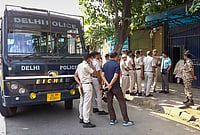
The immediate trigger for the protests was the role of Kathmandu Metropolitan City's municipal police.
Unlike Nepal Police, which operates under the federal government, municipal police are responsible for enforcing local regulations, including traffic management, street vending, public space management and municipal by-laws.
Bhusal's motorcycle had been seized during an enforcement operation before the fatal protest. His family alleges that municipal personnel failed to intervene effectively as he set himself ablaze, accusations that have intensified calls for an independent investigation into both the seizure and the authorities' response.
The controversy has also renewed debate over the powers, accountability mechanisms and training of municipal police forces, particularly when dealing with confrontations involving members of the public.
Rather than remaining a dispute over local law enforcement, the incident has evolved into a broader examination of how public institutions exercise authority and respond to citizens in moments of crisis.
How Has It Tested Nepal's New Government?
The timing of the protests presents a significant challenge for the government that emerged from last year's political upheaval.
The administration came to office promising institutional reform, greater transparency and a break from governance practices that had fuelled public dissatisfaction. However, the protests over Bhusal's death have become an early test of whether those commitments can be translated into visible administrative change.
According to the government's 100-day progress assessment, only around one-third of its planned reform measures had been completed during its first hundred days in office. Several governance and institutional reforms remain pending, even as expectations among the public remain high.
The government's own trimester progress report also indicates that while administrative initiatives have been launched across multiple sectors, public demonstrations and citizen grievances continue to feature prominently, highlighting the persistence of governance-related challenges despite the political transition.
The protests therefore represent more than a reaction to one tragic incident. They have become an assessment of whether the new administration can respond differently from its predecessors when confronted with demands for accountability.
What Happens Next?
Authorities now face two parallel challenges.
The first is determining accountability for the circumstances surrounding Bhusal's death, including the actions of Kathmandu's municipal police before and during the incident.
The second is political. Last year's protests created expectations that Nepal's new leadership would reform institutions that many citizens viewed as unresponsive and lacking accountability. The demonstrations following Bhusal's death suggest those expectations remain largely unmet for many young Nepalis.
Whether the government can restore public confidence will depend not only on the outcome of investigations into the incident but also on whether it can deliver the institutional reforms that formed the basis of its mandate.
For Nepal's new political order, the protests are therefore more than a law-and-order challenge—they represent the first major test of whether a government born out of demands for change can convince the public that meaningful change is still possible.