M. K. Stalin has intensified welfare politics with direct cash transfers and appliance vouchers, positioning it as rights-based social investment.
The DMK frames its schemes as empowerment—recognising women’s unpaid labour—while expanding its electoral appeal ahead of the 2026 polls.
By doubling down on welfarism despite criticism, Stalin has forced the opposition to engage on the terrain of social justice.
On the eve of Valentine’s Day, the Tamil Nadu government announced that it had transferred Rs 5,000 to over 1.31 crore women across the state. This was part of the Kalaignar Magalir Urimai Thogai (Women’s Entitlement) Scheme launched in September 2023. This move—one that ought to be regarded as M.K. Stalin’s first surgical strike on opposition parties—sounded the poll bugle in Tamil Nadu. Stalin followed this with the election manifesto, wherein he offered to provide every eligible household with a Rs 8,000 coupon (voucher) to buy any home appliance. Combined, the double strikes have raised the stakes in the political battle between the Dravida Munnetra Kazhagam (DMK) and its challengers.

With elections notified in Tamil Nadu, along with Assam, Kerala, Puducherry and West Bengal, every political move is being watched closely for what it may reveal about emerging electoral strategies. Of the five states heading to the polls in April 2026, Assam and Puducherry have incumbent governments belonging to the National Democratic Alliance, led by the Bharatiya Janata Party (BJP). West Bengal, Kerala and Tamil Nadu, however, remain—at least for now—beyond the BJP’s electoral grasp. With the Trinamool Congress, the Communist-led Left Democratic Front, and the DMK all seeking another term, the stakes are naturally higher.


Over the past three months, Prime Minister Narendra Modi and Union Home Minister Amit Shah have visited Kerala and Tamil Nadu, promising to usher in BJP-led governments in these states. In these months, political battle entered the judicial arena as well. We witnessed West Bengal Chief Minister Mamata Banerjee taking on the Union Government by appearing before the Supreme Court of India. The capital’s winter had hardly receded when political temperatures soared with CM Banerjee advancing arguments before the Chief Justice of India challenging the propriety of the Special Intensive Revision being conducted by the Election Commission of India.

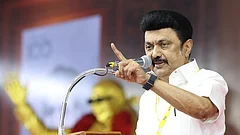
Stalin, on the other hand, waited for his moment. It arrived a little later: on February 13. With the push of a button, he set in motion the disbursal of Rs 5,000 to over 1.31 crore women across Tamil Nadu. His government, in September 2023, had introduced what was then the country’s largest cash transfer scheme, fulfilling an election promise made ahead of the 2021 Assembly polls to provide a monthly transfer of Rs 1,000. Today, eight other states have initiated similar cash transfer schemes targeting women. Yet, the Tamil Nadu model stands a class apart.
First, touching almost every household in Tamil Nadu, it has the widest footprint among its counterparts. Second, the scheme has been refined over two and a half years of implementation and is now seamlessly integrated into the state’s public welfare architecture. Third, its implementation has been studied by international scholars and vindicated for its positive social outcomes. Most importantly, however, the symbolism of “entitlement” is a distinguishing feature not seen elsewhere.

In Tamil, urimai translates to “rights” or “entitlement”. Drawing on its legacy of social justice politics, the DMK consciously chose the language of entitlement over that of largesse. By framing the payment as a right, the government has shaped a narrative that this monthly transfer compensates, in part, for the disproportionate share of unpaid domestic labour performed by women in households. In doing so, the state recognised and monetarily acknowledged invisible labour. In short, the Tamil Nadu scheme positions itself as an instrument of empowerment—not a dole or a “freebie”.

Stalin accompanied the transfer with a video message clarifying that the amount covered the months of February, March and April 2026, along with a top-up. He squarely charged the BJP and its allies with contemplating ways to stall the scheme, citing the impending elections. When his political opponents assumed he had nothing further to offer, Stalin came up with the Ilaatharasi Scheme in the DMK election manifesto. This scheme offers a one-time coupon for all eligible households to purchase home appliances, such as microwave oven, washing machine, refrigerator and so on. This is an extension of the social investment made by the DMK in the Tamil Nadu household. Today, no other state can match Tamil Nadu in terms of economic progress, with the state recording a 11.19 per cent growth over the last year.

For now, the election campaign is at its peak but Stalin’s surgical strikes knocked the wind out of the opposition’s campaign. Undeterred by allegations that the state’s coffers are running low, he has doubled down to reaffirm his government’s welfarist priorities. In doing so, he has thrown down the electoral gauntlet. What others deride as wasteful expenditure, Stalin has reframed it as social investment. The opposition’s only viable response may be to meet him on the terrain of social justice—an arena where he remains firmly entrenched and unflustered.

(Manuraj Shunmugasundaram is a DMK spokesperson and an advocate practising before the Madras High Court)
Views expressed are personal