The party first came to power in 1967 under Annadurai.
Stalin entered politics through the youth wing and spent decades in organisational roles before taking on executive responsibilities.
The DMK government expanded several welfare schemes, particularly financial assistance programmes for women.
The DMK’s return to power in 2021 with a clear majority marked one of Tamil Nadu’s more decisive electoral outcomes. Five years later, the 2026 Assembly election has produced a markedly different picture — a highly competitive and fragmented verdict, with TVK emerging as the single largest force in early counting trends.
At its core, this is not primarily a story of ideological shift. It reflects changing electoral conditions in Tamil Nadu: a party that retains organisational strength and welfare appeal now faces a strong new challenger in TVK, more segmented voting patterns, and a significant erosion of its 2021-level dominance.
DMK’s origins and leadership transition
The DMK was formed in 1949 after breaking away from the Dravidar Kazhagam under C.N. Annadurai. It emerged from the Dravidian movement, rooted in anti-caste politics, Tamil identity, and resistance to linguistic centralisation. Over time, it evolved into one of Tamil Nadu’s two dominant political forces, alternating power with the AIADMK for decades.
The party first came to power in 1967 under Annadurai. After his death in 1969, M. Karunanidhi took over and led the party through multiple electoral cycles, serving several terms as Chief Minister. Under him, DMK consolidated its organisational depth and retained a stable voter base built around welfare politics and state autonomy narratives.
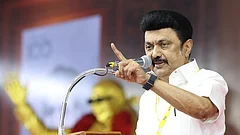


M.K. Stalin entered politics through the DMK youth wing and spent decades in organisational roles before taking on executive responsibilities. He served as Mayor of Chennai and later as Deputy Chief Minister (notably from 2009 to 2011). After Karunanidhi’s death in 2018, Stalin became party president, marking a structured leadership transition.

2021 mandate and what has changed in 2026
In the 2021 Tamil Nadu Assembly elections, the DMK-led alliance returned to power after a 10-year gap, winning 159 of 234 seats and securing a clear majority. M.K. Stalin became Chief Minister. The mandate was widely attributed to anti-incumbency against the AIADMK, along with concerns over unemployment, welfare delivery, and pandemic-era governance.
Once in office, the DMK government expanded several welfare schemes, particularly financial assistance programmes for women, food subsidy systems, and urban infrastructure spending. It also continued to assert long-standing positions on issues such as NEET and state autonomy.
The 2026 Assembly election, however, has delivered a far more disruptive outcome. As of the latest early counting trends on May 4, 2026 (as reported by the Election Commission of India), Tamilaga Vettri Kazhagam (TVK) led by actor-turned-politician Vijay has surged ahead, leading in over 100 seats. The DMK-led alliance is placed significantly behind (around 50–66 seats range in trends), with the AIADMK+ also competing in a fragmented three-cornered contest.
Unlike the 2021 broad-based sweep, the 2026 cycle shows highly fragmented voting patterns and strong performance by TVK across many urban, semi-urban, and even some traditional DMK pockets. A notable setback is that Chief Minister M.K. Stalin is trailing in his Kolathur constituency against TVK candidate V.S. Babu.
DMK’s organisational structure and alliance network remain factors, but they have not prevented a sharp decline in seat projections compared to 2021. The election highlights the limits of statewide consolidation for the ruling party in the face of a new challenger.

What has emerged is the continuity in DMK’s political positioning and organisational base, but a clear variation and downturn in its electoral strength. The 2026 results reflect a more competitive, regionally differentiated, and political environment that has transformed, which raises fresh questions about the extent of M.K. Stalin’s and DMK’s dominance going forward.