






TVK , though leading in the majority of seats would need others' support to form the government
Political alliances may undergo a recalibration in the coming days
Tamil Nadu appears to be witnessing a moment reminiscent of 1977, when actor-turned-politician M. G. Ramachandran formed the government after establishing the All India Anna Dravida Munnetra Kazhagam
2026 has turned into one of the most consequential electoral moments in the history of Tamil Nadu. Riding high on a blend of welfare-driven governance and a strong articulation of Tamil identity politics, the incumbent Dravida Munnetra Kazhagam (DMK), led by M. K. Stalin, was widely seen as nearly invincible. Most opinion and exit polls reinforced this narrative, with only a lone outlier hinting at a possible upset by Tamilaga Vettri Kazhagam (TVK).
However, what has unfolded is nothing short of a political upheaval. The surge led by actor-turned-politician Vijay is set to reshape the electoral landscape, pushing the DMK into an unexpected third position—behind the All India Anna Dravida Munnetra Kazhagam (AIADMK)-led NDA alliance.
Though the AIADMK front is leading in 45 seats, now the BJP is leading in just one seat.
The results signal more than just an electoral shift—they point to a potential rupture in the decades-long Dravidian duopoly, with a new political force successfully tapping into both aspirational and identity-driven currents among voters.
In the 234-member Assembly of Tamil Nadu, the TVK, at the time of writing, is leading in 105 seats— 13 short of the simple majority mark. This places the party in a decisive position, necessitating a recalibration within the existing electoral alliances.
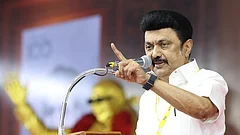


The opposition bloc led by the DMK comprises key allies such as the Indian National Congress, the Left parties—including the CPI and CPI (M), as well as the DMDK, forming a broad but now electorally strained coalition.
Within the Congress, there has been a notable view that the party should reconsider its alliance with the DMK and explore aligning with the TVK. The absence of Rahul Gandhi from the campaign trail alongside M. K. Stalin further fuelled speculation about unease in the relationship between the two parties.
At present, the Congress is leading in four seats, while the CPI and CPI(M)) are leading in three and four seats respectively. Adding to the friction, A. K. Balakrishnan has sharply criticised the DMK for allocating insufficient seats to the Left parties.
The choices these parties—particularly the Congress and the Left—make in the coming days will be crucial, not only for the future of the DMK -led front but also for the prospects of the TVK.
Options before TVK are manifold – either split the DMK front and elicit support from Congress and left parties, or secure support from the entire AIADMK or split the party by offering cabinet berth to some of its members

When the AIADMK was formed following a split from the DMK, it went on to win its very first election under the leadership of the legendary actor-turned-politician M. G. Ramachandran.
Nearly five decades later, history appears to be echoing itself in a different form. After 1977, when M. G. Ramachandran became Chief Minister, the Dravida Munnetra Kazhagam had to wait for 12 years—and until his death—before it could return to power under its own leadership.
Now, the DMK finds itself in a comparable moment, pushed into a difficult position by political newcomer Vijay. How the party navigates this period of crisis will be crucial for its future as a central force in Dravidian politics. Even its leader, M. K. Stalin, is trailing, suggesting the setback is far more serious than initial trends might suggest.
















