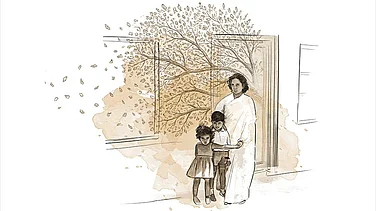
A missing son unravels Maryam’s carefully held world, forcing her to confront grief, doubt, and the weight of public scrutiny.
Waheed’s restrained prose captures the quiet violence of surveillance, prejudice, and the erasure of personal truth.
At its core, the novel probes who gets to define reality in an age shaped by fear, media narratives, and state power.
When I started reading Kashmiri-British writer Mirza Waheed’s new novel, Maryam & Son, it struck me that Waheed is particularly adept at building the action in his fiction around a single individual’s experiences, drawing readers into the heart of that character’s world, familiarising us with the intricate workings of their inner life. In Maryam & Son, we get to know Maryam Ali intimately. Her young son Dilawar who works in the IT sector goes missing, turning Maryam’s life upside down. In Waheed’s harrowing 2011 debut novel, The Collaborator, it was the unnamed 19-year-old protagonist from Kashmir whose voice got under our skin as he shared his, and by extension, his homeland’s story. In his 2018 novel Tell Her Everything, Waheed delved into the protagonist Dr K’s rise and moral fall and his struggle to convince his daughter—and himself—why he made the life choices he made. Waheed fleshes out the dilemmas of these characters with a rare sensitivity, ensuring that readers can’t help being invested in them.
In Maryam & Son, Maryam’s dilemmas are many layered. She is a British Muslim woman of Indian-Pakistani origin. Her parents immigrated to the UK when was three years old. Maryam’s husband, Ash, unexpectedly passes away. Shattered by his death, mother and son (Dil is a teenager at that time) cling to each other, vowing to stop grief from defining them “despite the daily desolation”.


When Dil disappears, Maryam wrestles with fear, self-doubt, anxiety. She starts to question her parenting style, wondering if it was something she said or did that drove her son away. Maryam’s immediate family—her feisty younger sisters Zarrine and Saffina and her mother—rally around her. They love Dil dearly and would do anything to bring him home. When the police suspect that Dil has gone to Iraq to join ISIS, Maryam is required to let investigators into her home. She reluctantly gives them permission to inspect his room. Her longing to hold on to Dil’s things and to retreat into the comfort of her memories of him is poignantly sketched. Aware that her world is broken, Maryam suffers “bouts of flushed anger and crushing doubt”, aching for “one word from Dilawar but dreading it at the same time, fearing it might prove what they said about him was true.”


Though the ordeal of “waiting and not knowing” is overwhelming, Maryam finds the strength to “appear more or less together” and is careful not to “look dishevelled in front of the government people.” She refuses to be ordered around by law enforcement officials, making it clear that it is not within their power to reduce her to a victim or simply “the mother” of a suspected extremist. Dil’s disappearance and the scrutiny it invites place her under constant surveillance. Most law enforcement officials and society at large tend to judge her. The media is keen to perpetrate the trope of the ‘bad Muslim’ when reporting about her and Dil. Nuance doesn’t sell. Prejudice, on the other hand, is guaranteed to turn a profit.

Keenly observed vignettes of Maryam’s days and nights reveal how all of this affect her daily life. Even the simplest things she used to enjoy like stepping out into the communal garden in front of her flat becomes something to be avoided. Wary of “the neighbours’ eyes on her”, she stays home and gazes at the garden from behind her window, taking in its “manicured beauty and the shaded wilderness of the larger plants.” But there are times too when Maryam manages to make room for the small joys of life, planning a picnic with her sisters or whipping up a family feast at Christmas time.
Maryam defies easy categorisation. This complex character upends set notions—of motherhood and femininity; of Muslim identity and immigrant identity. The bond Maryam shares with Julian, the young family liaison officer in charge of her case, is also hard to define. The two of them belong to opposite ends of the spectrum. Maryam: daughter of immigrants, working-class (school chef) Muslim woman. Julian: well-off, well-connected White male, law enforcement official. Yet, they manage to forge a genuine connection and to her credit, Maryam doesn’t completely clamp down on her feelings, despite everything that stands between Julian and her.
One of the topical questions the novel raises is about the nature of information in our time. Who decides whether a piece of news is true or untrue? Whose word is automatically taken for fact? Whose word is made suspect and by whom? In Maryam’s case, all the news she receives about her son is filtered through official sources. She doesn’t hear from Dil directly even once after he vanishes. Officials keep passing on bits and pieces of information to her with the expectation that she will accept these as the truth. Maryam has a hard time processing these and often refuses to believe them. Her truth, or what she believes to be true about Dil, contradicts the official version many a time. However, the balance of power being blatantly skewed, in the contest between her truth and the official narrative, her chances of being heard or believed remain zero.

Waheed’s style is pared down. He painstakingly weaves together the tapestry of Maryam’s life, seeped in the shades of her solitude, her sorrows and fears, her moments of doubt and her moments of hope, her memories, insights, and interactions with family, friends, neighbours, packs of hardnosed officials and with Julian. The wheels of politics hum in the background. At one point, Maryam remembers the wave of public protests that washed over the streets of London before the British government joined the US-led coalition in attacking Iraq in 2003, she rubbishes the false claims of Saddam Hussein having weapons of mass destruction floated by the government. She watches the news; hears about terror strikes, hears about new wars and old wars and never-ending wars. As the narrative builds up towards its well-earned end, all the wars and all the violence blow Maryam’s own private world into smithereens. The impact of that contained explosion is sure to leave readers reeling.

MORE FROM THIS ISSUE




Vineetha Mokkil is senior associate editor, Outlook. She is the author of the book A Happy Place and Other Stories
This article appeared in Outlook’s April 11 issue titled ‘Warlord’ that focuses on the aggression unleashed on Iran by US President Donald Trump and the repercussions that are being felt across the globe with no end in sight.