The Indian Left’s century-long legacy includes major gains for women, but leadership and organisational gaps persist.
Women’s struggles within the Left reveal unresolved issues of patriarchy, caste, and unpaid care work.
To remain relevant, the Left must centre intersectional gender justice as core to its political future.
For a century, the Indian Left—from the old generation communists to various student unions—have been fighting for economic equity and defending the rights of the ‘mazdoor’ (worker) and the ‘kisan’ (farmer). As we mark this centennial milestone, the most urgent question isn’t merely what the Left has achieved, but whether a movement perpetually fighting for its survival can still summon the courage to imagine a fairer future for the world’s largest democracy.
When asked to reflect on a century of the Indian Left with the gender question in mind, I felt a mix of emotions. The exercise was not to eulogise or defend, but to engage honestly—much like siblings remembering a complicated family. We can look back and say, “This could have been done differently; that could have been avoided,” yet still acknowledge the moral and intellectual weight of the Left’s contribution to Indian public life. For every ideological misstep or electoral loss, there exists a legacy of compassion, courage, and clarity of purpose that continues to challenge the inequities of the present.


This reflection is also deeply personal. In 2022, the Communist Party of India-Marxist (CPI-M) gave me the opportunity to contest the Ballygunge bypoll against the All India Trinamool Congress’ (TMC’s) incumbent Babul Supriyo. As a corporate dropout and an Army officer’s daughter, I wasn’t a traditional Leftist candidate. The lone battle I faced as a first-time candidate was not one for the faint-hearted. I faced brutal trolling and a smear campaign allegedly orchestrated by the Congress candidate who, incidentally, happened to be a Muslim. Despite having to fight against both the BJP and the TMC combine, I also faced a communal campaign designed to make me look like a “lesser Muslim” to cut my minority votes.
My electoral run was heralded as an electoral resurgence. Not only did I defeat the BJP and the Congress candidates by an overwhelming margin, I also drastically increased the Left’s vote share from five per cent to 30 per cent within a year. Yet, the biggest hurdle I faced was the clear absence of my polling agents in a majority of booths. This shocked and deeply disturbed me. Here I was, swimming against the tide, doing a stupendous job, and in all probability would have won the election, but I faced embarrassingly low participation from booth-level organisers. In this scenario, no matter how good the candidate is, how does a progressive, Muslim, Left-leaning woman win?
This raises an important question: why are some of the brightest young women in the Left camp today facing organisational challenges that prevent them from winning elections? This isn’t just about one bypoll or one candidate. It’s about recognising that while the Left has made significant strides in championing women’s causes, there still remains work to be done in fully elevating women from being the backbone of the movement to the front of its leadership.
To speak of the Indian Left is to speak of women’s courage. The Indian Left has consistently championed the cause of the oppressed. Its history is synonymous with legendary struggles of workers, peasants, and the landless poor. What makes this history remarkable is that women’s contribution has been foundational—often preceding and sustaining the formal structures of the movement.
From the Tebhaga and Telangana peasant movements to the militant dock and textile worker strikes led by the All India Trade Union Congress (AITUC), women were the fearless organisers. Their activism was revolutionary in two ways: it challenged colonial and feudal structures, and simultaneously, broke the confines of the domestic sphere. Women created parallel economies during boycotts, formed vigilance squads against liquor consumption, and ran underground communication networks, ensuring the movement’s continuity when male leaders were imprisoned.
The Left once had beacons of courage like Captain Lakshmi Sahgal, known for her dedication to both socialism—she was a lifelong member of the CPI(M)—and the armed anti-imperialist struggle as part of the Indian National Army. There were other inspiring Left women leaders as well—Comrade Nalini Gupta was one of the newly emerging Communists in India, dedicated to establishing a communist state and overthrowing the British government through revolution. For these women, political freedom was inseparable from economic and social equality.
Similarly, there were many prominent Indian women freedom fighters with strong Leftist or Communist affiliations. Aruna Asaf Ali is famously remembered as the “Grand Old Lady” of the Independence movement for hoisting the Indian National Flag at the Gowalia Tank Maidan in Bombay during the Quit India Movement in 1942, after most leaders were arrested. She went underground for years, leading the movement from hiding, and dedicated her life to radical socialist politics, later serving as Delhi’s first elected mayor.
Kalpana Datta was a revolutionary who was part of the armed resistance movement in Bengal. She was a close associate of Surya Sen and actively participated in the 1930 Chittagong Armoury Raid. After her capture and release, she officially joined the Communist Party of India, where she married fellow Communist leader P. C. Joshi and focused on organising peasants and women.
Closer to home was Pritilata Waddedar, a revolutionary nationalist from Bengal and a contemporary of Kalpana Datta. She led a team of revolutionaries in an attack on the European Club in Chittagong, a symbol of colonial racism and power. She achieved martyrdom during the raid to evade arrest, becoming a potent symbol of female revolutionary courage.
Figures like Godavari Parulekar—who mobilised tribals in Maharashtra, and the countless women who joined the cultural fronts in Bengal and Kerala—were not mere participants, they were strategic minds and frontline fighters. These women understood that political independence was only the first step toward true liberation, which must include fundamental changes to the economic and social structure of the new nation.
For these women, the struggle for class equality was intrinsically linked to the struggle for gender liberation. They didn’t see these as separate battles, but as interconnected fronts in the same war against oppression. The Left gave them a platform, unlike many other movements of the time.
Before examining the challenges, it’s important to acknowledge what the Left has achieved for women in India. In states where the Left governed, particularly Kerala and West Bengal, landmark legislations and policies advanced women’s rights. Kerala’s land reforms in the 1960s and 1970s gave women independent land rights, a revolutionary step in a society where women were seen as dependents. The Left government’s investments in public health and education disproportionately benefited women and girls, leading to Kerala’s remarkable social indicators—the highest female literacy rate in India, the lowest infant and maternal mortality rates, and a near-universal access to healthcare.

West Bengal under Left rule implemented progressive labour laws that recognised women’s specific needs—maternity benefits, protection against sexual harassment in the workplace, and equal pay for equal work. The Left-led governments also pioneered women’s participation in local governance through panchayats, long before the 73rd Constitutional Amendment mandated reservations for women.
The Left’s cultural organisations—the Indian People’s Theatre Association (IPTA), Progressive Writers’ Association, and various other women’s fronts—created unprecedented spaces for women’s artistic and intellectual expression. These platforms allowed women to challenge patriarchal norms through art, literature, and performance in ways that were both radical and accessible to ordinary people.
The All India Democratic Women’s Association (AIDWA), founded in 1981, has been at the forefront of campaigns against dowry deaths, domestic violence, and communal violence. AIDWA’s grassroots work in organising women workers—from beedi workers to agricultural labourers—has given voice and power to some of India’s most marginalised women. Their advocacy led to important legislative changes, including amendments to laws on domestic violence, sexual harassment, and property rights.
The Left’s ideological commitment to gender equality, even when imperfectly practised, created an environment where questions of women’s oppression could be raised and debated. Unlike conservative political forces that seek to confine women to traditional roles, or liberal parties that treat gender as an afterthought, the Left has consistently maintained that women’s liberation is central to social transformation.
Despite these significant achievements, the Left faces challenges in fully realising its vision of gender equality, particularly within its own organisational structures. These aren’t failures unique to the Left—they reflect broader societal patterns—but addressing them is crucial for the movement’s future.
While the Left has been strong on class analysis and has made important contributions to gender discourse, there’s room to deepen the integration of caste and gender dynamics into its central framework. The party has sometimes struggled to address how a woman factory worker faces not just exploitation as a worker, but also specific gendered experiences—lower wages for the same work, sexual harassment, and the expectation of unpaid domestic labour. A woman who is a Dalit agricultural labourer faces intersecting oppression as a worker, as a woman, and as a Dalit.
The Left has begun addressing this, particularly through its work with Dalit and Adivasi women’s organisations, but there’s more work to be done in making this intersectional lens central rather than peripheral to its politics. This isn’t about abandoning class analysis, but enriching it with a fuller understanding of how different forms of oppression interact and compound each other.
The Left parties have made conscious efforts to promote women in leadership positions, yet women remain underrepresented in the highest decision-making bodies. Like other institutions in Indian society, party structures sometimes reflect the patriarchal patterns of the broader culture.
This manifests in various ways. Women sometimes lack the same mentorship and sponsorship that male colleagues receive. Meeting schedules can conflict with caregiving responsibilities that still fall disproportionately on women, making consistent participation challenging. Even when present in leadership bodies, women are sometimes channelled toward “soft” portfolios like social welfare or education rather than power portfolios like finance or organisational strategy.
The Left has been more progressive than most political parties in this regard, having women in state leadership—as ministers, and in organisational roles—but there’s acknowledgement within the movement that more needs to be done. Some state committees have implemented internal quotas and mentorship programmes, showing the way forward.

Perhaps the most significant structural challenge is fully grappling with the realities of unpaid care work. As women have entered the workforce and political life, the burden of home and family care has remained largely unchanged. The Left has championed women workers’ rights in the formal economy, but has been slower to address how unpaid domestic labour constrains women’s full participation in public life.
The Left doesn’t need to start from scratch. It needs to build on its considerable strengths and accelerate changes already underway in parts of the movement.
Several state units have already implemented internal quotas for women in decision-making bodies with positive results. This practice should be universalised and deepened—ensuring at least 33 per cent and moving toward 50 per cent representation of women from local committees to the Politburo.
The Left can draw on its own history of creating alternative institutions—from literacy campaigns to health clinics—to build structures that support women’s full participation. This means:
Childcare facilities at party offices and during major meetings;
Flexible meeting schedules that accommodate caregiving responsibilities’
Economic support for full-time women activists, recognising their financial needs; and,
Clear, independent mechanisms to address harassment with real accountability.
Today, the Left needs more women, more queer folks and more Dalit voices at the very top echelons. The Indian Left has a historic legacy of fighting for the oppressed. The Left has consistently shown strong solidarity in campaigns like the fight for the rights of the transgender community, and the push to decriminalise Section 377. But to secure the next century, the Left must fully embrace the idea that the fight for gender equality in all its intersectional glory is not a secondary struggle, it must be the revolution itself.
(Views expressed are personal)
Saira Shah Halim is a left political activist and author of the recently published Comrades And Comebacks, published by Penguin Random House.
MORE FROM THIS ISSUE


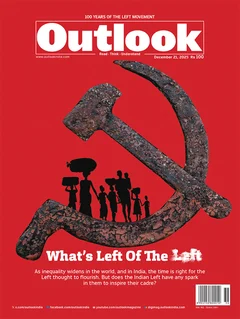
This article appeared as Women Left Out in Outlook’s December 21, 2025, issue as 'What's Left of the Left' which explores how the Left finds itself at an interesting and challenging crossroad now the Left needs to adapt. And perhaps it will do so.