Persistent anti-Left rhetoric by Right-wing leaders reflects the enduring appeal of socialist ideas, which continue to resonate with working people.
The rise of neoliberalism after the collapse of the Socialist Bloc led to deregulation and soaring corporate power, deepening inequality and culminating in crises like the 2008 crash.
The global turn to the far-Right has been fuelled by economic insecurity, corporate backing and manufactured social polarisation.
Zohran Mamdani’s victory in New York underscores the continued relevance of egalitarian, despite aggressive attacks from leaders such as Trump.
It is striking that Right-wing leaders across the world continue to use communist and socialist-bashing as a central feature of their politics even while repeatedly declaring Left ideology “dead and buried”. If socialism is supposedly irrelevant, why is it still treated as a threat? The answer is simple: socialist ideas continue to resonate with working people everywhere, especially in times of deep crisis. This is why those in power remain preoccupied with discrediting the Left.
The vicious language used by US President Donald Trump against Zohran Mamdani—the self-declared democratic socialist who won the New York City mayoral election—is a telling example. While Mamdani was campaigning, Trump described him as a “lunatic communist,” a “subversive,” and condemned socialism as “the most noxious idea in human history”. Yet, Mamdani won decisively in the heart of global capitalism. His victory showed that even in metropolitan America, a political programme rooted in equality, public welfare and working-class rights has widespread support.

The collapse of the Soviet Union and the socialist bloc in the early 1990s was hailed by capitalist powers as “the end of history”. They celebrated the elimination of a model that had forced Western governments to adopt social security, welfare protections and labour rights. With its collapse, these concessions were treated as dispensable. Neoliberalism—the new template of global capitalism—proclaimed the privatisation of public assets, corporate tax concessions, sweeping deregulation, restrictions on labour rights and massive cuts in public expenditure as the formula for growth.


Neoliberalism grew out of the demands of finance capital, merging into huge corporations across national borders for unfettered access to markets across the world without national regulations. Deregulation enabled speculative capital to flow across borders, unconstrained by concerns of social welfare or adherence to legal rights for workers, which were dismantled in many countries. The result was the dramatic enrichment of large corporations at the expense of ordinary people. Wages stagnated even as corporate profits and executive bonuses rose sharply. Public health and education systems were starved of funds. Pension guarantees and social security protections were steadily dismantled under the doctrine of “austerity”, while the wealthy enjoyed tax bonanzas. For workers, neoliberalism translated into outsourcing, contractualisation, the destruction of job security, and the weakening of unions. A vast population of precarious workers —with no guarantee of income or social protection—became the new global norm. The 2008 financial crash, which pushed millions into unemployment and poverty, was not an accident but the logical culmination of the neoliberal order.
When Absence Meant War
The absence of the Socialist Bloc of countries was felt throughout the world—by developing countries who lost a key ally against the hegemony of the Western imperialist powers, the working people in capitalist countries, those countries fighting for national sovereignty. It is no coincidence that this was when wars led by the US were waged, particularly on West Asian countries to grab their oil wealth. The US supported the most fundamentalist Islamist forces to overthrow regimes not compliant with US interests. The symbol of such forces, Osama Bin Laden, was a creation of this imperialist policy of the US as was the Taliban against the pro-socialist regime in Afghanistan.

As the social and economic consequences of neoliberalism hardened, discontent spread across the world. It was the betrayal of mainstream social-democratic parties and centrist parties, leading governments, that had earlier embraced neoliberal reforms themselves, unable to provide any alternatives which created the space for the far-Right. It channelled widespread economic insecurity into hatred—much like the Nazis did in 1930s Germany—replacing class anger with hostility towards immigrants, minorities and marginalised groups. In a kind of Right-wing International, these forces developed similar slogans and platforms: that authoritarian nationalism is the true guardian of culture, that corporate dominance represents development, and that attacks on minorities are legitimate expressions of majoritarian identity. The pattern has repeated itself across the US, Italy, Turkey, Hungary, the Philippines, and in India. In almost every case, the political rise of the far-Right has been achieved through the fusion of immense corporate backing with carefully manufactured social polarisation.
socialist ideas continue to resonate with working people everywhere, especially in times of deep crisis. This is why those in power remain preoccupied with discrediting the Left.
The scale of this shift is dramatic. A recent Global Parliament Index (Arden strategies) estimates that Right-wing governments now account for roughly 37 per cent of national leadership worldwide—the highest proportion in decades. Yet, contradictions are mounting. The neoliberal model that these governments championed is in crisis; protectionism is replacing globalisation, tariffs have been weaponised by the US to establish hegemony, and fears of another major financial collapse haunt Western economies. Public approval ratings for several Right-wing incumbents are falling sharply, including those of Trump in the United States.

At the same time, socialist China—which follows a model of state-led planning and public control of key resources—has emerged as a major pole in global politics against which the US is scrambling to build alliances. Whatever internal debates the global Left may have about the nature of Chinese socialism, the fact remains that a country once economically behind India now stands among the world’s most technologically advanced because it refused to submit to neoliberalism and retained what it describes as “Socialism with Chinese characteristics.” The relevance of socialism is proved by the example of China, which refused to bow under the bullying and intimidation of the US in its current tariff war, because it is confident of the strength of its own domestic economy based on socialist principles.
The Impact of the Left
The Left’s impact is often judged narrowly by electoral outcomes. But elections today are far from being democratic. Corporate financing plays an overwhelming role in shaping electoral success. Media houses across the world are owned by business conglomerates that openly champion Right-wing interests. Control of social media platforms enables the systematic spread of misinformation and the character assassination of dissenters. The question to be raised is: in so-called democracies are elections free and fair or is democracy corporate-driven, in which parties of the working classes, devoid of funds, have little chance to win an election?

Moreover, where electoral verdicts deliver a Left-wing victory, the US and its allies often intervene to instal compliant regimes. Look at what is happening in Latin America. The national sovereignty of the people of socialist Cuba, their lives, livelihoods and the very right to life, are under attack daily through the cruel decades-old sanctions imposed by the US and cowardly accepted by most so-called democratic governments. The people of Mexico, Columbia, Venezuela and Brazil defeated the US-backed efforts to impose pliant regimes electing governments committed to a pro-people policy framework influenced by socialist principles. Venezuela is currently being punished through the real threat of war.

Given this, it is misleading to assess the influence of the Left purely through its electoral strength, as though there has been a level playing field. The Left also shapes society through mass struggles, against class exploitation, against racial and caste violence and discrimination for the rights of marginalised communities, against war, ecological destruction. Its struggles have often been successful in defending peoples’ rights. The fightback of the working classes, the farmers, youth, students and women against neoliberal policies and for human dignity against Right-wing hatred, have been led by the Left through various organisations and platforms.
When most “centrist” political parties remained silent in the ongoing US-supported Zionist genocide in Gaza, it was the massive mobilisations of Left and progressive forces across campuses, workplaces and neighbourhoods that forced governments to shift their positions.
The Indian situation is inseparable from this global context. We are witnessing the consolidation of a political regime in which Hindutva ideology and corporate power reinforce each other—a communal corporate regime. The influence and control of the Rashtriya Swayamsevak Sangh (RSS) in determining the government agenda is clear. Economic and social policy today is structured simultaneously around neoliberal policies and majoritarian cultural domination marked by open hostility and escalating hate campaigns against minority communities and increasing attacks on all dissent.
The early 2000s showed that this trajectory was not inevitable. The surge in Hindutva mobilisation in the 1990s was checked by the emergence of the United Progressive Alliance (UPA) government in 2004, dependant on the Left, whose Common Minimum Programme (CMP)—drafted under Left pressure—forced a partial retreat from unrestrained neoliberalism. During this period, landmark legislation in which the Left played a critical role, such as the Forest Rights Act and the Mahatma Gandhi National Rural Employment Guarantee (MGNREGA) work guarantee were secured. Wherever the Left governed—in Kerala, West Bengal and Tripura—alternative policies took a systematic form. Land reforms; strengthened rights of agricultural workers and tenant farmers; minimum guaranteed wages; protection and advance of Dalits, Adivasis and minorities; defence of the public sector; and prioritisation of universal access to health and education. Kerala’s achievements, including its pioneering household-level micro-planning programme for poverty eradication, remain unmatched.
The Left’s strong stand prevented the hijacking of the political agenda by the Bharatiya Janata Party (BJP) when it was in Opposition. The rupture came when the Congress capitulated to corporate and US pressure to form a strategic alliance with the US, an instrument of which was the Indo-US nuclear deal, in violation of the CMP. Subsequently backed by the corporate media, the Congress spent its energies in attacking the Left even while the Right wing grew. Within five years, the coalition led by the Congress collapsed, leading to the victory of the BJP under Narendra Modi.

Despite the electoral setbacks, the Left has stood firm. In Kerala, confronting deliberate discrimination by the centre and resulting financial stress, the Left-led government has expanded welfare programmes and created new employment avenues. In Bengal, the unholy combination of parties from the extreme Left to the Right succeeded in defeating the Left Front government. Braving state-sponsored repression and murder of hundreds of cadre by the Trinamool Congress, through popular struggles, mobilisations and a rectification of past mistakes, the Left parties are building strong links with the people and are poised for a breakthrough. In Tripura, the party is regaining its strength through a brave resistance against BJP repression. The Left has played an important role in the significant struggles of workers and kisans (farmers), of students and women on their day-to-day issues, which have been an important aspect if not the backbone, of the fight against the current regime. The Left has been uncompromising in its defence of minority rights.
There are some well-wishers who urge the Left—and more specifically the Communist Party of India (Marxist)—to stop being “dogmatic” and “so ideological” and to become more practical. There are many legitimate criticisms of the CPI(M) or Left approaches which should and must be addressed. We have seen the sorry fate of those parties belonging to various hues, who sacrificed ideology for short-term gains. “Soft” Hindutva can never defeat Hindutva. The use of caste for political purposes can never eliminate the caste system. Compromise with policies which are anti-working class and which destroy the lives and livelihood of the rural poor and farmers in the name of development have to be strongly opposed. India needs a robust Left which will never compromise on the fundamental interests of the working people of India. To save those interests is to save and serve India. This is a battle for minds, not just for votes. A strong Left can help to bolster the wider platforms and combinations of secular political forces required to defeat the ongoing RSS-BJP project of a Hindutva rashtra.

The global rise of the Right has made the Left not irrelevant but indispensable. Capitalism is not the end of history. Injustice, inequality, hate and division are not human fate. The Left stands out as the enduring political current offering a coherent alternative based on public control of resources, an end to the exploitation of human labour, equitable access to the benefits of development, equality, secularism, peace and human dignity. This is why the Right cannot stop attacking socialism. It knows that an organised Left is the greatest obstacle to its project of division and exploitation. Socialism as an achievable goal fashioned in each country according to its national specificities, is the hope and the horizon to build a better world.
MORE FROM THIS ISSUE


Brinda Karat is a politburo member of the CPI(M)
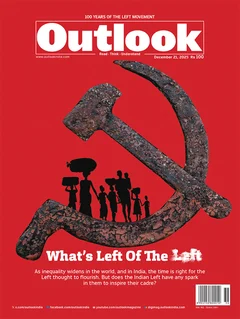
This article appeared as 'Red Star, Lodestar' in Outlook’s December 21, 2025, issue as 'What's Left of the Left' which explores the challenging crossroads the Left finds itself at and how they need to adapt. And perhaps it will do so.